
Most beginner accounts do not fail because of one huge error. They fail through a handful of repeated, ordinary mistakes. This page lists ten of them, shows the arithmetic behind how much each can cost and suggests a specific fix. Use it as an audit of your own trading: tick the ones that sound familiar and fix one at a time.
The Ten, at a Glance
| # | Mistake | Typical damage | Fix |
|---|---|---|---|
| 1 | No fixed risk per trade | One loss of 10–20% of the account | Risk 1–2%; see position sizing |
| 2 | Overleveraging | Stop-out on a normal move | Keep effective leverage low; see high leverage |
| 3 | No stop loss | Small loss becomes a margin call | Every trade has a stop; see stop loss strategy |
| 4 | Trading without a plan | Random results you cannot analyse | Write a plan; see building a trading plan |
| 5 | Revenge trading | Larger, worse trades after a loss | Forced break; see trading psychology |
| 6 | Overtrading | Costs eat the edge | Cap trades per day; track cost per trade |
| 7 | Chasing quick money | Unrealistic targets, high risk | Measure in R, not in monthly doubling |
| 8 | Ignoring costs | Spread and commission exceed profit | Know cost per lot; see what a spread is |
| 9 | Trusting signals and gurus | Losses on someone else’s unknown rules | Verify statements; test on a demo |
| 10 | Choosing an unregulated broker | Cannot withdraw | Verify the licence; see regulated forex brokers |
1–3: The Risk Trio
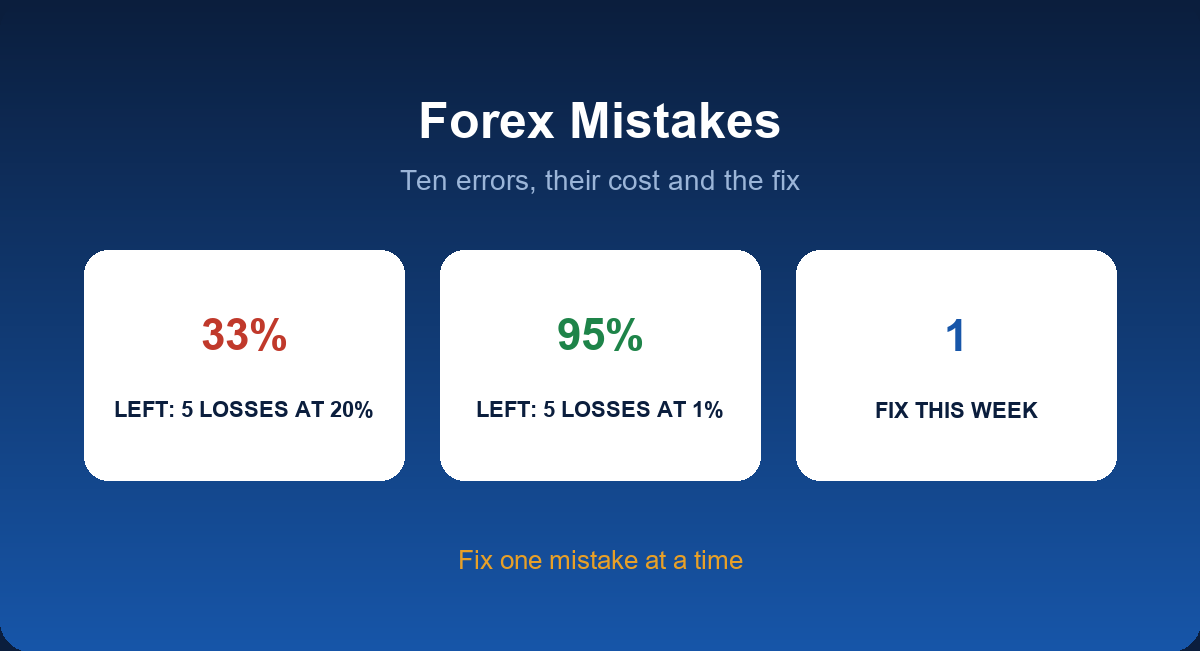
Take a $500 account. A trader risks 20% on one trade with no stop: a $100 loss. Five such trades in a row, which is plausible, would reduce the account to about $164 (0.8⁵ × $500). Compare 1% risk: $500 becomes about $475. Same strategy, different survival. Add leverage that lets you open a position larger than your risk rule, and the stop-out arrives before your reasoning does. The fix is mechanical: risk a fixed percentage, place the stop before you click, and size from the stop. Our risk management framework gives the full set of limits.
4–5: Trading Without Rules and Then Trading Angry
If you cannot describe in one sentence why you entered a trade, you will not be able to learn from it. A plan with entry, exit, size and session rules makes each trade a test. The partner mistake is revenge trading: after a loss, the urge to make it back produces larger positions and lower-quality set-ups. A forced 30-minute break after two losses breaks the loop.
6: Overtrading and What It Costs
A trader places 8 trades a day, 20 days a month, 0.20 lots each, with an effective cost of $2 per trade: $320 a month. If the strategy’s gross edge is $250, the month is a loss of $70 even though the strategy “works”. Cutting to the three best set-ups a day reduces cost to $120 and often improves results. Count your cost per trade and your trades per day.
7–8: Quick Money and Hidden Costs
Doubling an account every month is not a plan; it requires risk that nearly always ends in ruin. Think instead in R: a month of +3R is a very good month at 1% risk. Then look at costs. On a 5-pip target a 1-pip cost is 20% of the reward. See forex scalping for why small targets are so sensitive to cost.
9–10: Who and What You Trust
Signal sellers, “account managers” and bonus offers share a pattern: they promise returns and shift responsibility. Before you follow anyone, ask for independently verified results over a long period and the rules behind them. Before you deposit with any broker, verify the licence, read the withdrawal terms and test a small withdrawal. Our guides to verifying a broker licence and no deposit bonus red flags show how.
A One-Page Audit
- Write the percentage you risk on a typical trade and compare it with your last 20 trades.
- Count trades without a stop or with a moved stop.
- List what you traded after a loss within the next 30 minutes.
- Calculate your average cost per trade and per day.
- Choose one mistake to fix this week; do not try to fix all ten.
Three Short Case Studies
These are composites, not specific people.
- The compounding dream. A trader starts with $200, risks 15% per trade chasing a monthly double, and loses 6 trades out of 10 in the first fortnight. The account is $62 after 12 trades. Risking 1% would have left about $188.
- The signal follower. Someone pays $50 a month for signals, takes each at the recommended size and never records the results. After four months a spreadsheet shows a net loss that costs, with fees, more than the subscription. The signals were never tested on a demo.
- The cheap-spread hunter. A trader moves to a broker with a 0.0 spread account, ignores the commission and trades five times as much, and ends with higher costs than before.
Warning Signs in People Who Sell Trading Help
- Promises of guaranteed or fixed monthly returns.
- Screenshots of profit but no verified statements.
- Pressure to deposit or sign up through a specific broker link immediately.
- No explanation of the rules or the risk.
Our own links to brokers earn us a commission, which is why we show how to verify them. See regulated forex brokers and how to choose a forex broker.
A 90-Day Plan to Fix the Biggest Ones
- Days 1–30: demo only. Write a plan, size trades by the formula and keep a journal.
- Days 31–60: a tiny live account. Trade the plan at minimum size and withdraw a small amount.
- Days 61–90: review results and rule breaks. Increase size only if the breaks are rare and expectancy is positive.
Key Takeaways
- Most failures come from repeated ordinary mistakes, not one big error.
- Fix risk first: fixed percentage, a stop on every trade, size from the stop.
- Count your costs; overtrading and small targets make them dominate.
- Verify brokers and signal sellers before you trust them with money.
FAQ
What is the most common beginner mistake?
Risking too much per trade, often combined with no stop loss or too much leverage.
How long does it take to stop making these mistakes?
It varies. A written plan, a journal and weekly reviews speed it up.
Should I start with a demo or a small live account?
Practise on a demo first, then use a very small live account to experience real emotions at low cost.
Are signals worth buying?
Be sceptical. Without verified long-term results and clear rules, they are a risk in themselves.
Open a JustMarkets Account & Activate Rebate →
Risk Disclaimer: Trading forex and CFDs carries a high level of risk and may not be suitable for all investors. You can lose all the money you deposit. JFRebate earns a referral commission from brokers it reviews; this never changes the spreads you pay. This article is for information only and is not financial advice.

Om Erick, CTA, is a Certified Technical Analyst and a forex trading veteran active since 2010, recognized as one of the Top 35 Best Traders in the World (MQL5, 2024). As the author of “Belajar Trading dari 0” and “Psikologi Trading,” as well as an active Psychological Trading Coach, Om Erick is dedicated to providing objective, data-backed trading guidance. Through JFRebate, he helps traders achieve peak performance by providing access to trusted brokers and a transparent, industry-leading rebate system.