Most trading advice is about finding entries. The accounts that last are built on something less exciting: limits that decide how much you can lose before you stop. This guide sets out a risk framework you can apply to any account size. It covers risk per trade, daily and weekly limits, why drawdowns are harder to recover than they look, and how to turn all of it into a routine. The related guides on position sizing, stop losses, risk-reward and building a trading plan go deeper on each part.
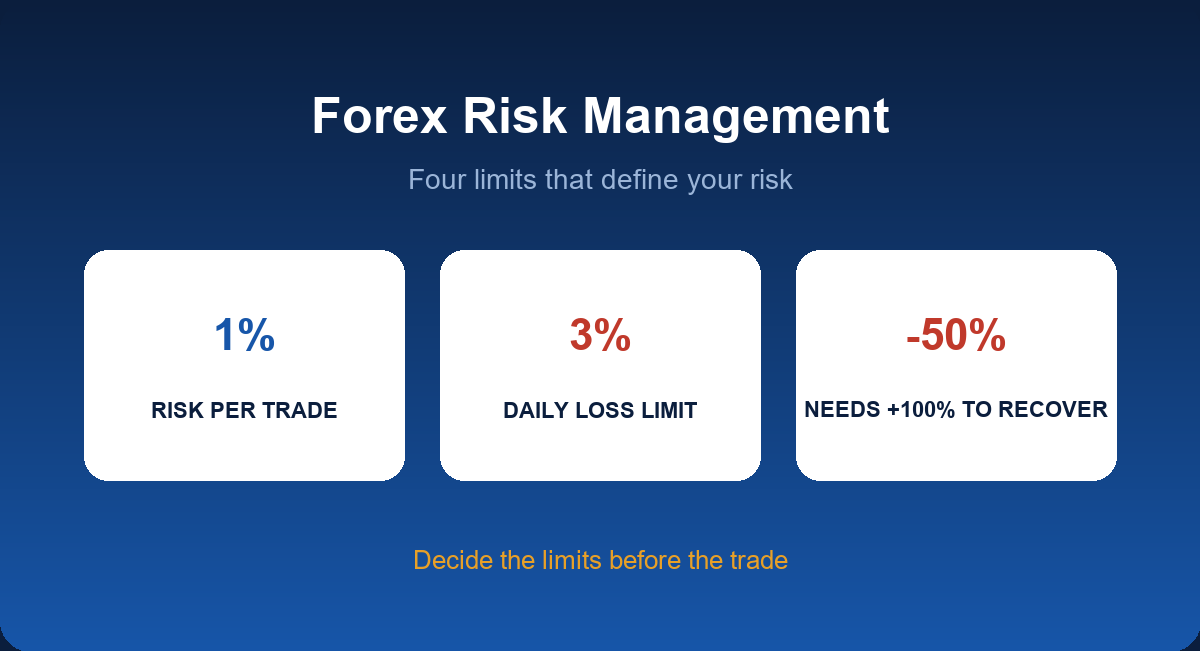
The Four Limits That Define Your Risk
| Limit | Typical range | What it prevents |
|---|---|---|
| Risk per trade | 0.5% to 2% of balance | One loss ending the account |
| Daily loss limit | 2% to 4% | A bad day turning into a spiral |
| Weekly or monthly loss limit | 5% to 8% | Long losing streaks eroding the account |
| Total open risk | 3% to 5% | Several positions all losing together |
These ranges are common starting points rather than rules. What matters is that the numbers are written down before the trade and that you stop when you reach them.
Why Drawdowns Are Worse Than They Look
A loss of 50% requires a gain of 100% to recover, not 50%. The percentage needed grows faster than the loss.
| Account loss | Gain needed to recover |
|---|---|
| 5% | 5.3% |
| 10% | 11.1% |
| 20% | 25% |
| 30% | 42.9% |
| 50% | 100% |
| 70% | 233% |
This is why the first goal of risk management is to avoid deep drawdowns, not to maximise return. A trader who stays within a 10% drawdown can recover with an ordinary good month; a trader down 50% usually cannot.
How Many Losses in a Row Can You Survive?
| Risk per trade | Balance left after 10 straight losses | After 20 straight losses |
|---|---|---|
| 1% | 90.4% | 81.8% |
| 2% | 81.7% | 66.8% |
| 5% | 59.9% | 35.8% |
| 10% | 34.9% | 12.2% |
A strategy with a 45% win rate will produce a streak of eight or more losses sooner or later. At 10% risk per trade such a streak is a disaster; at 1% it is an uncomfortable month.
A Worked Example on a $1,000 Account
- Risk per trade: 1% = $10.
- Daily limit: 3% = $30, so three full losses end the day.
- Weekly limit: 6% = $60, after which you review instead of trading.
- Total open risk: 3% = $30, which allows up to three trades at 1% each.
- For a 25-pip stop on EUR/USD, the position is $10 ÷ (25 × $10 per pip per lot) = 0.04 lots.
Step 5 is the heart of it: you do not choose the lot size first. The stop distance and the dollar risk decide it. See position sizing in forex for the method.
Correlation: The Hidden Multiplier
Three positions in EUR/USD, GBP/USD and AUD/USD may look like three trades, but all three are largely a bet on the US dollar. If the dollar strengthens, they can lose together. Count correlated trades as one position when you add up open risk, or reduce the size of each.
Leverage and Margin
Leverage does not change the risk per pip; lot size does. High leverage mostly lets you open bigger positions than your risk rule allows. Keep effective leverage low and know where your stop-out level is. Our guide to high leverage forex brokers explains margin, margin level and stop-out with numbers.
Costs Are Part of Risk
Spread, commission and slippage reduce every result. Over many trades they can exceed what a modest edge returns. See what a spread is in forex and zero spread accounts for how to measure them.
A Daily Risk Checklist
- I know my risk per trade, daily limit and total open risk in dollars.
- I know the next high-impact news time for my pairs.
- Every trade has a stop loss and a planned target before entry.
- I have checked that open positions are not all the same direction on correlated pairs.
- I will stop for the day when I reach my limit, and I will write down why I stopped.
Review, Do Not Just Record
At the end of each week, compare planned risk with actual risk. How many trades exceeded your limit? How many stops did you move? The answer is usually uncomfortable and always useful. Learn the habits behind it in trading psychology and common forex mistakes.
Matching Risk Settings to Your Style
| Style | Typical stop | Risk per trade | Daily trade count | Main extra risk |
|---|---|---|---|---|
| Scalping | 5–10 pips | 0.25–0.5% | 10 or more | Costs and slippage |
| Day trading | 20–50 pips | 0.5–1% | 2–5 | Overtrading |
| Swing trading | 50–150 pips | 1–2% | 0–2 | Overnight gaps and swap |
Fast styles risk less per trade because they place many more trades; slow styles can risk a little more because there are fewer of them. Either way, daily and weekly limits apply.
What to Do After a Bad Week
- Stop trading real money for the rest of the week once your weekly limit is hit.
- Export your trades and tag each one: followed the plan, or broke it, and how.
- Count the cost of the rule breaks in R. If most of the loss came from breaks, the plan is not the problem.
- Next week, trade half size until you have followed the rules on 20 trades in a row.
Account Type and Risk
A very small account can make risk per trade impossible to follow, because the minimum position is larger than the risk you want. A cent account helps with that; see micro vs cent accounts and trading forex with a small account. On any account, check margin, stop-out level and whether negative balance protection applies.
The Questions Behind Every Trade
- How much will I lose if I am wrong, in dollars and in percent?
- What is already open, and does this add to the same risk?
- What would make me exit before the stop?
- What will I do if the market gaps?
- If I lose this trade, would I still follow my plan on the next one?
Where to Go Next
Put the numbers into practice with the lot size calculator, read stop loss placement, and keep a journal as described in trading psychology.
Key Takeaways
- Define four limits: risk per trade, daily, weekly and total open risk, and write them down.
- Deep drawdowns are asymmetric: a 50% loss needs a 100% gain.
- Position size comes from risk and stop distance, not from a lot size you like.
- Count correlated pairs as one exposure and keep leverage low.
FAQ
How much should I risk per trade?
Many traders use 0.5% to 2% of balance. Beginners often start at 0.5% to 1%.
Does risk management guarantee profit?
No. It limits losses and keeps you in the game while you develop an edge.
Should I risk the same amount every trade?
Fixed percentage risk is a common approach. Some traders reduce size after losses and restore it gradually.
Is a daily loss limit necessary?
It prevents a bad day from becoming a bad month, which is why most disciplined traders use one.
Open a JustMarkets Account & Activate Rebate →
Risk Disclaimer: Trading forex and CFDs carries a high level of risk and may not be suitable for all investors. You can lose all the money you deposit. JFRebate earns a referral commission from brokers it reviews; this never changes the spreads you pay. This article is for information only and is not financial advice.

Om Erick, CTA, is a Certified Technical Analyst and a forex trading veteran active since 2010, recognized as one of the Top 35 Best Traders in the World (MQL5, 2024). As the author of “Belajar Trading dari 0” and “Psikologi Trading,” as well as an active Psychological Trading Coach, Om Erick is dedicated to providing objective, data-backed trading guidance. Through JFRebate, he helps traders achieve peak performance by providing access to trusted brokers and a transparent, industry-leading rebate system.