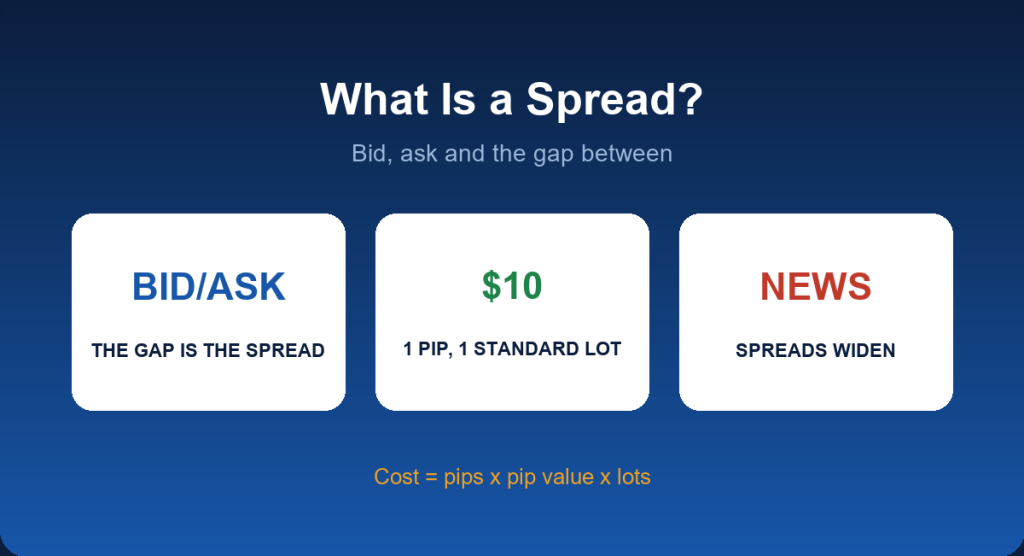
The spread is the most basic cost in forex and one of the least understood. Every trade starts slightly behind because you buy at a higher price than you sell. This guide explains what the spread is, how to read it, why it changes, how to calculate what it costs you and the practical steps that reduce it.
Bid, Ask and Spread
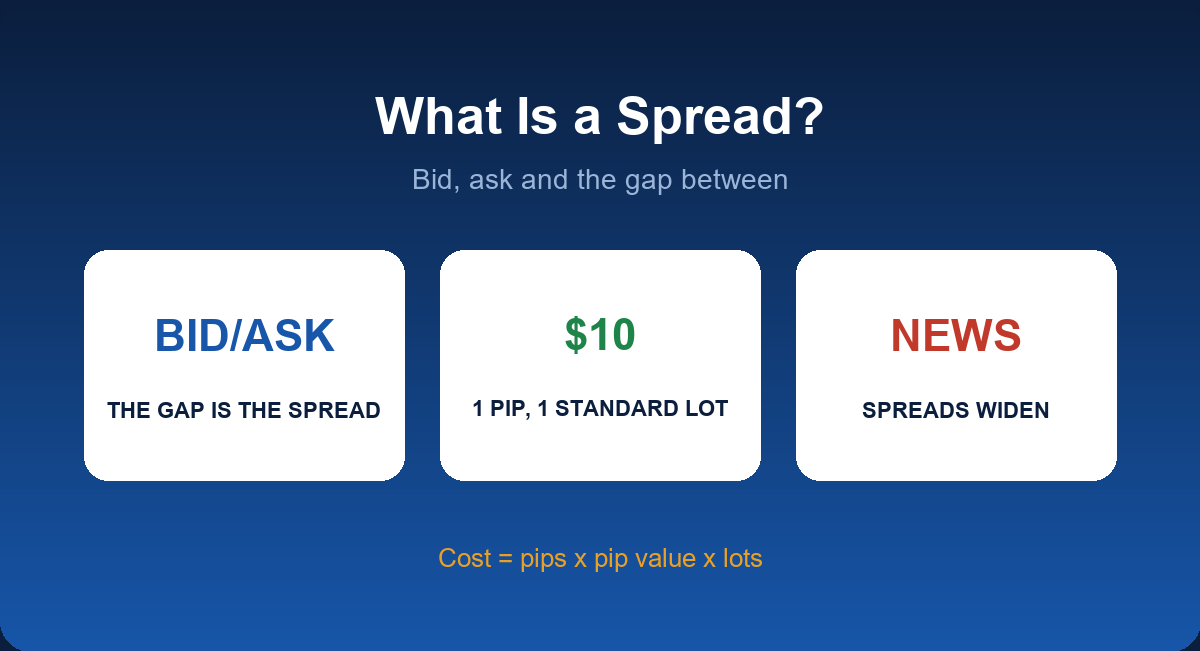
Every currency pair has two prices. The bid is the price at which you can sell. The ask is the price at which you can buy. The ask is always higher than the bid, and the gap between them is the spread. If EUR/USD is quoted 1.08500 / 1.08510, the spread is 0.00010, or 1 pip. The price must move by that amount in your favour before the trade reaches break even.
Fixed vs Variable Spreads
| Fixed | Variable (floating) | |
|---|---|---|
| Behaviour | Stays the same under normal conditions | Changes with market liquidity |
| Typical advantage | Predictable cost | Often tighter in calm markets |
| Typical drawback | May be wider on average; can be requoted in fast markets | Can widen sharply around news and at rollover |
Most online brokers offer variable spreads. The advertised figure is usually a minimum or an average under favourable conditions.
How to Calculate the Cost
Spread cost = spread in pips × pip value × lots. On EUR/USD a standard lot has a pip value of about $10, so a 1.0-pip spread costs about $10 per lot, $1 for a 0.10 lot and $0.10 for a 0.01 lot. For other pairs the pip value differs; see what a pip is and how it is valued.
| Spread | 0.01 lot | 0.10 lot | 1.00 lot |
|---|---|---|---|
| 0.3 pips | $0.03 | $0.30 | $3 |
| 1.0 pip | $0.10 | $1.00 | $10 |
| 2.5 pips | $0.25 | $2.50 | $25 |
Why Spreads Change
- Liquidity. Busy sessions and major pairs have tighter spreads.
- News. Spreads widen sharply around major releases as liquidity providers pull back.
- Time of day. Around the daily rollover and in the first minutes after the weekend open, spreads can be much wider.
- Pair. Exotic pairs cost far more than majors.
- Account type. Standard, Pro and raw-spread accounts price differently; see zero spread accounts.
How to Reduce the Spread You Pay
- Trade liquid pairs and busy sessions.
- Avoid entering right at major news.
- Pick the account type that matches your volume. Compare total cost per lot, including commission.
- Choose a broker with consistently tight spreads. See lowest spread forex brokers for how to compare them.
- Use cashback. A rebate returns part of the cost on every lot; see how IB rebates work.
- Trade less often if costs dominate. Fewer, better trades pay the spread less often.
Spread, Commission and Slippage Together
The spread is only one part. Some accounts charge a commission, and fast markets add slippage, the difference between the price you clicked and the price you got. Add all three for your real cost per trade. A quick test on a demo, repeated across a few days and hours, is more informative than any marketing table.
Spreads at the Brokers We Cover
- JustMarkets: spreads from about 0.3 pips on Standard and Cent, and tighter on Pro and Raw Spread, which may carry commission. See JustMarkets spreads.
- Headway: Cent and Standard spreads from about 0.3 pips, with tighter Pro pricing. See Headway spreads and commission.
Treat these as published starting points and confirm them on a demo account.
Common Mistakes
- Comparing brokers only on the lowest advertised spread.
- Placing a stop loss so tight that the spread alone triggers it.
- Forgetting that a “zero spread” account charges a commission.
- Trading illiquid pairs on a small balance.
Spread, Commission and Swap Side by Side
| Cost | When you pay | Depends on |
|---|---|---|
| Spread | When you open a position | Market liquidity, account type, pair |
| Commission | On opening and/or closing, depending on the broker | Account type and lot size |
| Swap | For each night the position is held | Interest rates, direction and instrument |
A Day Trader’s Monthly Cost
A day trader opens 5 trades a day for 20 days, using 0.20 lots each, so about 20 lots in total. At a 1-pip spread ($10 per lot) the monthly spread cost is about $200. Switching to an account with a 0.6-pip effective cost saves about $80. Cashback of up to 33% of the spread on a standard-type account would return about $66 of that $200. This is why professional traders talk about cost per lot rather than a single spread figure; compare the options in lowest spread forex brokers and brokers with rebates.
How Brokers Earn From the Spread
On a standard account the broker earns the spread (or a markup over the raw spread) on every trade. That is the business model, and it is why a very low advertised spread should always make you ask where the money is made: a commission, a wider spread at other times or the order flow. See ECN, STP and market maker brokers for how the model affects what you pay.
Reading a Contract Specification
In MetaTrader, right-click a symbol in Market Watch and choose Specification. Look for the contract size, minimum lot, lot step, swap values and stop level. The spread itself is dynamic, but the specification tells you how the account prices swaps and how close you can place stops. A quick check takes a minute and removes many surprises.
What Happens During News
When a major economic release hits, liquidity providers widen their quotes and spreads can jump several times above normal. A 0.5-pip spread can become 5 pips or more for a few seconds, and stop orders may fill at worse prices. If your strategy depends on tight spreads, avoid placing orders in the minute before and after high-impact releases, and test your broker’s behaviour on a demo during one such event.
More Questions Answered
Is a lower spread always better?
Not if it comes with a high commission or poor execution. Compare total cost per lot.
What is a typical spread for EUR/USD?
Many retail accounts show roughly 0.1 to 1.5 pips depending on account type and market conditions.
Why is the spread on gold different?
Metals have their own contract sizes and volatility, so spreads are quoted in different units. Check the specification.
Can I avoid the spread?
No, but you can reduce it by choosing liquid pairs, the right account and trading hours, and by using cashback.
Does the spread affect long-term traders?
Much less, because it is paid once on a trade that may last weeks.
How to Test Spreads on Your Own Broker
- Open a demo or live account on the account type you plan to use.
- Add the pairs you trade to Market Watch and enable the spread column (right-click, then Spread).
- Note the spread every hour across one trading day, including the London open, the New York open and a quiet hour.
- Repeat on two other days and include one with a major news release.
- Average the numbers and compare them with the advertised figure.
Many traders are surprised by the gap between the marketing minimum and the average. Once you have your own table, compare brokers with the same method.
Spread Scenarios by Strategy
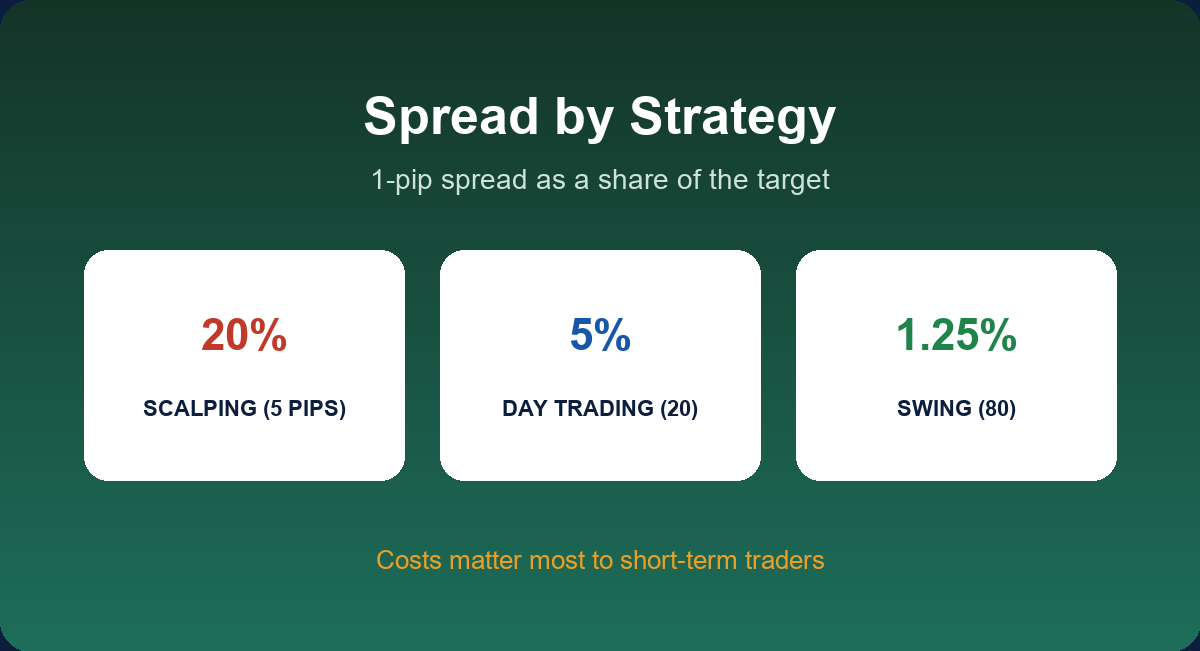
| Strategy | Target per trade | 1-pip spread as a share of target |
|---|---|---|
| Scalping | 5 pips | 20% |
| Day trading | 20 pips | 5% |
| Swing trading | 80 pips | 1.25% |
This is why the same spread is a major problem for one trader and almost irrelevant to another.
Summary of the Practical Steps
Measure your own spreads at the hours you trade, convert any commission into pips, include slippage and swap, and compare the total per lot between accounts. Then decide whether cashback changes the answer. Do the sums once, write them down and revisit them when you change broker or strategy.
Related Guides
This guide is part of our Trading Costs series. For the full overview, start with Brokers With Rebates, then continue with:
Key Takeaways
- The spread is the gap between bid and ask and is paid when you open a trade.
- Spread cost = pips × pip value × lots.
- Variable spreads widen around news and at rollover; test your own hours.
- Reduce cost with liquid pairs, the right account type and cashback.
FAQ
What is a good spread in forex?
On major pairs, anything under about 1 pip is generally considered tight, but account type and commission change the comparison.
Why is the spread wider at night?
Liquidity is thinner around rollover and in quiet hours, so brokers widen spreads.
Do I pay the spread on both entry and exit?
You pay it effectively once, because you open at the ask and close at the bid, so the round trip costs the spread.
Can a broker change the spread?
Yes, spreads vary with the market and the broker’s pricing. Check conditions in your account.
Open a JustMarkets Account & Activate Rebate →
Risk Disclaimer: Trading forex and CFDs carries a high level of risk and may not be suitable for all investors. You can lose all the money you deposit. JFRebate earns a referral commission from brokers it reviews; this never changes the spreads you pay. This article is for information only and is not financial advice.

Om Erick, CTA, is a Certified Technical Analyst and a forex trading veteran active since 2010, recognized as one of the Top 35 Best Traders in the World (MQL5, 2024). As the author of “Belajar Trading dari 0” and “Psikologi Trading,” as well as an active Psychological Trading Coach, Om Erick is dedicated to providing objective, data-backed trading guidance. Through JFRebate, he helps traders achieve peak performance by providing access to trusted brokers and a transparent, industry-leading rebate system.