“What leverage should I use?” is one of the most asked beginner questions, and the usual forum answers swing from “1:10 only” to “1:500, it does not matter”. Both camps are partly right because they are talking about two different things. This guide separates the leverage your account allows from the leverage you actually use, shows the numbers at 1:30, 1:100 and 1:500, and ends with a practical rule you can apply today.
Two Kinds of Leverage
| Account leverage | Effective leverage | |
|---|---|---|
| What it is | The maximum the broker allows, such as 1:100 | Total position value ÷ your equity |
| Who sets it | Broker and regulator | You, every time you choose a lot size |
| What it controls | How much margin each trade locks | How fast your account moves per pip |
| Risk impact | Indirect | Direct |
Example: $1,000 equity and a 0.10 lot EUR/USD position worth about $10,800 (illustrative price 1.0800) is effective leverage of roughly 10.8:1, whether the account is set to 1:30 or 1:500. Your profit or loss per pip is identical in both cases: about $1.
Same Trade, Different Account Leverage
Illustration: a $500 account buys 0.10 lot EUR/USD. We assume a 50% stop out level; check the account page for your real level.
| Account leverage | Used margin | Free margin at entry | Approx. adverse move to stop out |
|---|---|---|---|
| 1:30 | $360.00 | $140.00 | about 320 pips |
| 1:100 | $108.00 | $392.00 | about 446 pips |
| 1:500 | $21.60 | $478.40 | about 489 pips |
For the same lot size, higher account leverage actually gives the trade more room before a stop out, because less margin is locked. So high leverage is not dangerous by itself. The danger is what it allows.
What High Leverage Allows
| $500 account, EUR/USD | Largest lot that fits (approx.) | Effective leverage | A 20-pip loss costs |
|---|---|---|---|
| 1:30 | 0.13 lot | about 28:1 | $26 (5.2%) |
| 1:100 | 0.46 lot | about 99:1 | $92 (18.4%) |
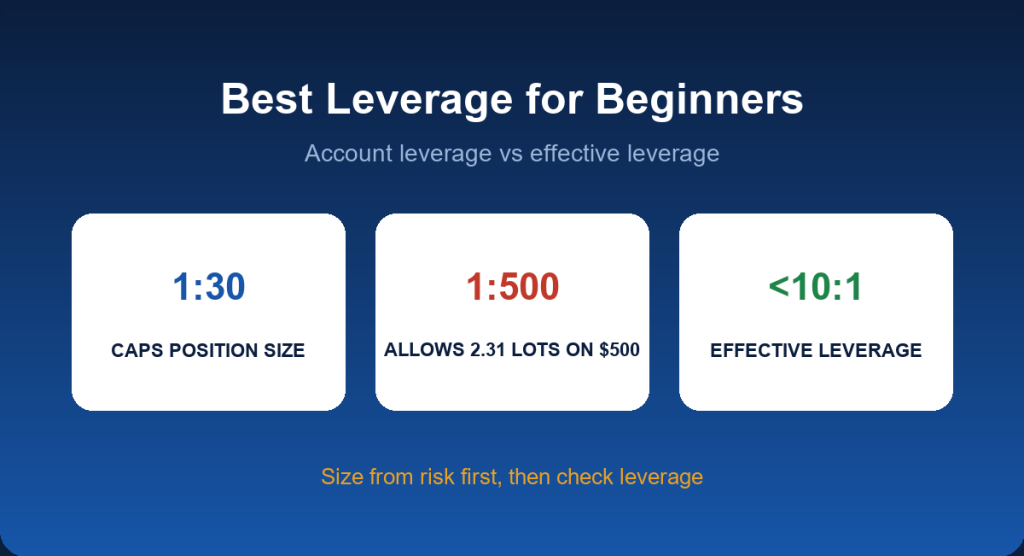
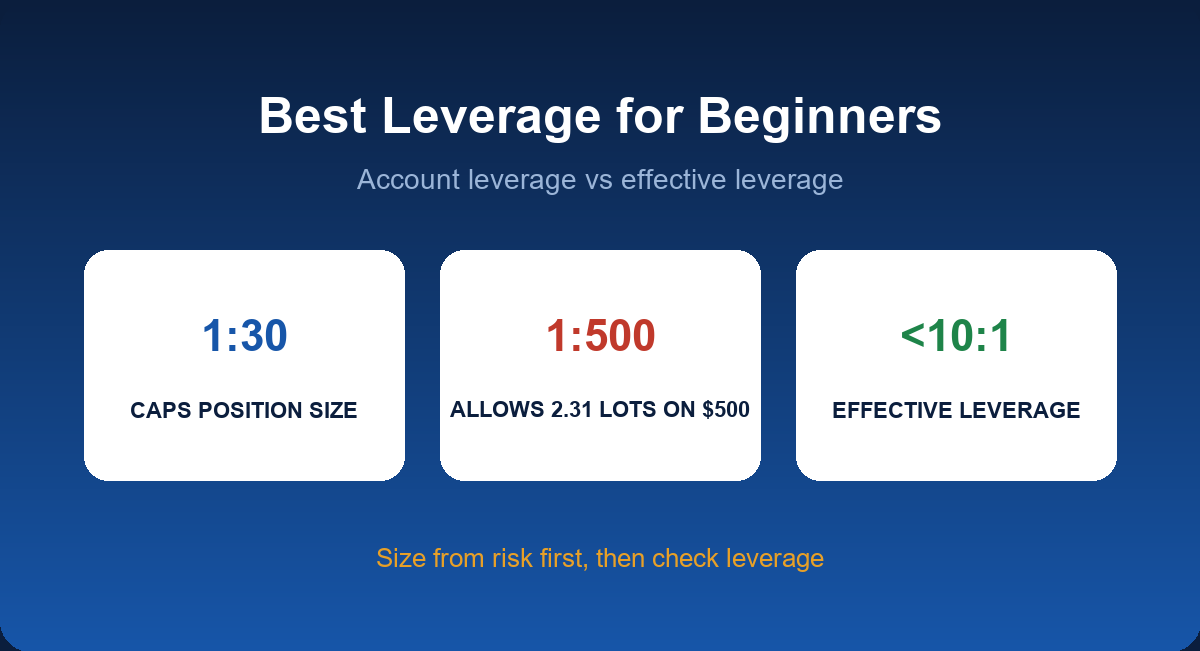
| 1:500 | 2.31 lots | about 499:1 | $462 (92.4%) |
At 1:500 a beginner can open a position where an ordinary 20-pip move wipes out almost the entire account. The first impulsive oversized trade is usually what ends a new account, and a lower cap simply makes that trade impossible.
What Regulators Allow
Many regulators cap retail leverage because of this. Under ESMA rules in the EU, retail clients are limited to 1:30 on major currency pairs, and US retail forex is capped at 1:50 on majors. Offshore-regulated brokers often offer much more. Higher caps are not automatically bad, but they move the responsibility for risk entirely onto you. Learn how to check who regulates a broker in our guide to regulated forex brokers.
A Practical Rule for Beginners
- Decide risk per trade first: 1% of equity. On $500 that is $5.
- Set the stop where the idea is wrong, for example 25 pips.
- Calculate the lot: $5 ÷ (25 pips × $10 per pip per lot) = 0.02 lot. The lot size calculator does this for any pair.
- Check effective leverage: 0.02 lot is about $2,160 notional, roughly 4.3:1 on $500. Keeping effective leverage under about 10:1 is a sensible beginner ceiling.
- Pick an account cap that gives margin headroom without letting a single impulsive click open ten times your plan. For many beginners, 1:50 to 1:200 is a workable range; lower if you know you are impulsive.
Notice that the lot size came from risk and stop distance, not from the leverage setting. That is the whole idea of position sizing.
When Higher Account Leverage Can Make Sense
- Very small or cent accounts, where margin on 0.01 lot would otherwise lock a large share of the balance. See micro vs cent accounts.
- Hedged or multi-position strategies that need free margin headroom while total risk stays small.
- Experienced traders with written risk rules they actually follow.
Most platforms let you request a lower leverage setting from the client area. Leverage options at the brokers we cover are on JustMarkets leverage and Headway leverage; tiers can change with equity and instrument, so check the account page.
How Effective Leverage Shapes a Losing Streak
Every trader meets a run of losses. The table shows a $1,000 account after five losing trades in a row, depending on how much of the account each trade risks (illustration).
| Risk per trade | Typical effective leverage on a 25-pip stop | Balance after 5 losses | Gain needed to recover |
|---|---|---|---|
| 1% | about 4:1 | $951 | +5.2% |
| 3% | about 13:1 | $859 | +16.4% |
| 10% | about 43:1 | $590 | +69.4% |
The account leverage setting does not appear anywhere in that table. What matters is how much you put at risk on each trade, which is why the beginner rule above starts with risk and ends with leverage.
Beginner Leverage Mistakes
- Choosing lot size by how much margin is “free” instead of by risk.
- Assuming 1:30 is safe while opening the maximum position it allows.
- Forgetting that metals, indices and crypto often have lower leverage than forex.
- Ignoring margin level until the margin call message appears.
Related Guides
This guide is part of our Starting Small series. For the full overview, start with Best Cent Account Brokers, then continue with:
- forex margin, margin call and stop out
- a realistic small-account plan
- high leverage forex brokers
- forex risk management
- forex demo accounts
Key Takeaways
- Account leverage is the maximum allowed; effective leverage (position value ÷ equity) is what moves your account.
- For the same lot size, higher account leverage locks less margin and gives more room before a stop out.
- The real danger of high leverage is that it allows oversized positions.
- Size trades from 1% risk and the stop distance; keep effective leverage under about 10:1 while learning.
- Many beginners do well with an account cap of roughly 1:50 to 1:200.
FAQ
What leverage is best for a $100 account?
The setting matters less than the lot size. With 1% risk, a $100 account should usually trade 0.01 lot or a cent account; a 1:100 to 1:200 cap gives enough margin headroom for that.
Is 1:500 leverage good for beginners?
It is not harmful by itself, but it lets you open positions large enough to lose the account on a small move. If you choose it, keep strict lot-size rules.
Is 1:30 leverage safe?
It limits how large a position you can open, which helps, but you can still lose most of the account if you open the maximum lot without a stop.
Can I change leverage later?
Usually yes, from the client area, though some brokers do not allow changes with open positions. Check the account page.
Does leverage affect spread or swap?
No. Spread, commission and swap depend on lot size, not on the leverage setting.
Open a Headway Account & Activate Rebate →
Risk Disclaimer: Trading forex and CFDs carries a high level of risk and may not be suitable for all investors. You can lose all the money you deposit. JFRebate earns a referral commission from brokers it reviews; this never changes the spreads you pay. This article is for information only and is not financial advice.

Om Erick, CTA, is a Certified Technical Analyst and a forex trading veteran active since 2010, recognized as one of the Top 35 Best Traders in the World (MQL5, 2024). As the author of “Belajar Trading dari 0” and “Psikologi Trading,” as well as an active Psychological Trading Coach, Om Erick is dedicated to providing objective, data-backed trading guidance. Through JFRebate, he helps traders achieve peak performance by providing access to trusted brokers and a transparent, industry-leading rebate system.