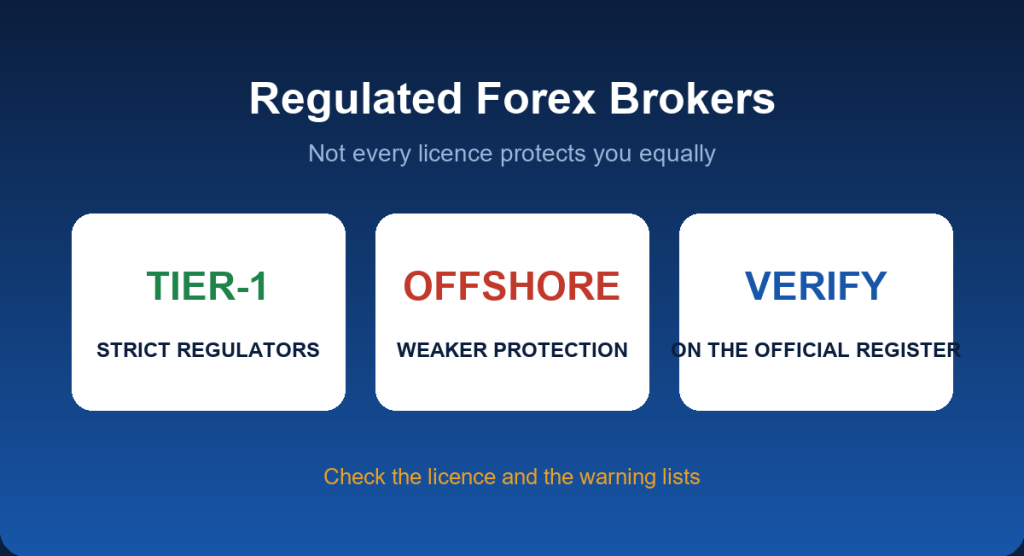
Every broker says it is “regulated”, but regulation varies enormously. A licence from a strict regulator can mean segregated client funds, a compensation scheme and capped leverage; a licence from a small offshore authority may mean very little protection. This guide explains the types of regulators, what protection you really get, and how to verify a broker in minutes.
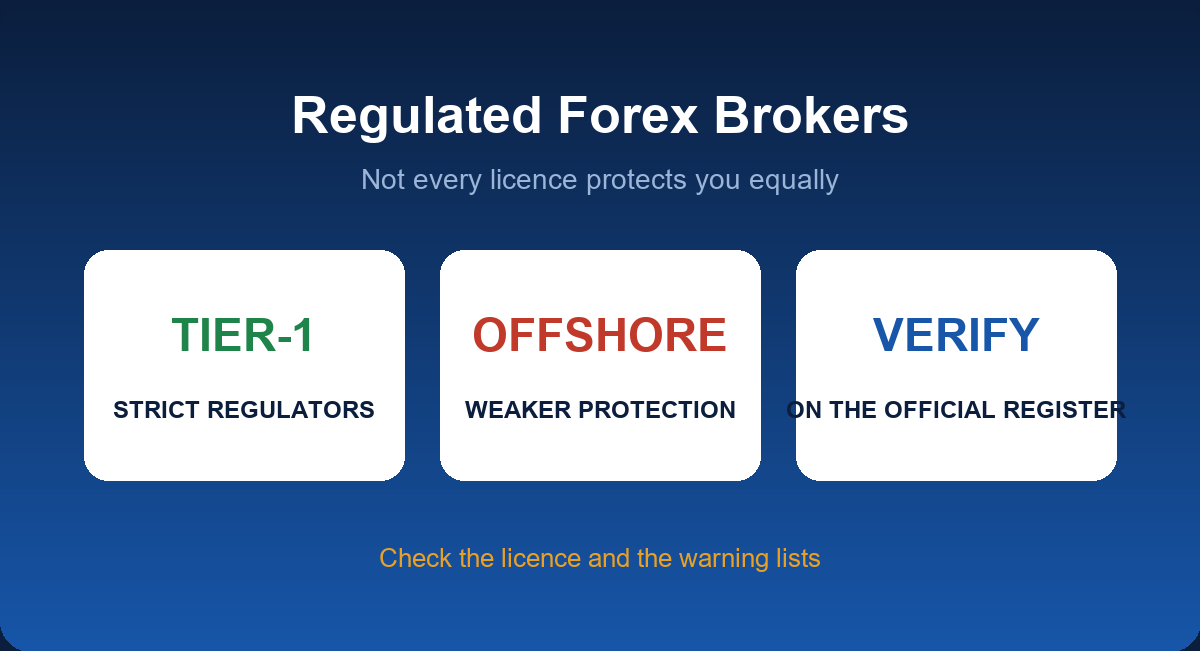
Why Regulation Matters
A regulated broker is supervised by an authority that sets rules on capital, how client money is held, marketing and complaint handling. If a broker breaks the rules, the regulator can fine it or withdraw its licence. An unregulated broker answers to nobody.
Strict (Tier-1) vs Offshore Regulators
| Type | Examples | Typical protection |
|---|---|---|
| Strict regulators | FCA (UK), ASIC (Australia), CySEC and EU authorities, BaFin (Germany), MAS (Singapore), FINMA (Switzerland) | Segregated funds, capital rules, negative balance protection, retail leverage caps (often 1:30), compensation schemes in some jurisdictions |
| Mid-tier / regional | FSCA (South Africa) and similar | Licensing and conduct rules; protection varies |
| Offshore authorities | FSA Seychelles, FSC Mauritius, VFSC (Vanuatu), MISA (Comoros) | Flexible conditions and high leverage, but usually weaker investor protection and no compensation scheme |
Offshore does not automatically mean a scam, but it does mean you rely more on the broker’s own reputation, so test withdrawals early and deposit gradually.
What Regulation Cannot Do
- It does not guarantee profit or protect you from trading losses.
- It does not make high leverage safe.
- It may not help you if you trade through an entity that is not licensed in your country of residence.
How to Verify a Forex Broker in 5 Minutes
- Find the licence number and legal entity name in the broker’s website footer.
- Search that number in the regulator’s official public register.
- Check that the entity name and website address match, to avoid cloned firms.
- Search the broker’s name on regulators’ warning or alert lists. For example, the Securities Commission Malaysia keeps an Investor Alert List, and the FCA and ASIC publish warning lists.
- Check the client agreement for which entity actually holds your account.
Our step-by-step guide to verifying a forex broker licence walks through each step in more detail.
Local Rules Matter
Your country’s regulator may require brokers to hold a local licence. In Indonesia, futures and forex brokers are supervised by Bappebti, and many international brokers are not Bappebti-licensed, which limits local legal recourse. In Malaysia, the Securities Commission can list unauthorised entities. Always check the rules where you live.
Regulation of Brokers We Review
- JustMarkets: entities regulated by CySEC, FSA Seychelles, FSCA and FSC Mauritius; which one serves you depends on your country. See JustMarkets regulation and is JustMarkets safe.
- Headway: regulated by the FSCA (South Africa). See is Headway safe or legit.
- Elev8: licensed offshore and listed on the Securities Commission Malaysia Investor Alert List in June 2026. See is Elev8 safe or a scam.
Regulators by Region
| Region | Regulator | Notes |
|---|---|---|
| United Kingdom | FCA | Strict capital and conduct rules; the FSCS can compensate eligible clients up to a limit |
| European Union | CySEC and national authorities | Retail leverage capped at 1:30; negative balance protection; investor compensation fund (CySEC: up to €20,000) |
| Australia | ASIC | Retail leverage limits since 2021; strict product rules |
| United States | CFTC and NFA | Very restrictive; many international brokers do not accept US residents |
| Singapore | MAS | Strict; few retail CFD providers |
| Indonesia | Bappebti | Supervises futures and forex brokers; many international brokers are not licensed there |
| Malaysia | Securities Commission | Publishes an Investor Alert List of unauthorised entities |
Entity vs Brand: Why the Fine Print Matters
Large brokers operate several legal entities under one brand. The company regulated by a strict authority may serve only clients in its own region, while clients elsewhere are served by an offshore sister company. When you register, the client agreement tells you which entity holds your account. A strict-regulator logo on the homepage does not automatically apply to you. Always check the entity named in your agreement.
Misleading Regulation Claims
- “Registered” is not “regulated”. Company registration is a business filing; regulation means ongoing supervision.
- A licence number for a different entity. The number may be real but belong to a sister company.
- Cloned firms. Scammers copy a real firm’s name and licence number but use a different website. Match the web address on the register to the one you are using.
- Expired or revoked licences. Check the status, not just the existence of the number.
- “Regulated” by a body that does not supervise forex. Some bodies only handle company filing or dispute resolution.
Questions to Ask Support Before You Deposit
- Which legal entity will hold my account, and who regulates it?
- Are client funds segregated, and in which bank?
- Is negative balance protection included for my account?
- What are the withdrawal methods, fees and typical processing times?
- Where do I file a complaint if something goes wrong?
Keep the replies. A broker that avoids answering these questions is not one to trust with your money.
Compensation Schemes: What They Can and Cannot Do
Some strict jurisdictions have investor compensation schemes that pay eligible clients if a regulated firm fails, up to a set limit. They do not cover trading losses, and they do not apply to offshore entities. If your account is with an offshore company, assume there is no scheme and treat the broker’s reputation and track record as your main protection.
How We Treat Regulation in Our Reviews
Regulation and safety carries the heaviest weight in our ratings. When new evidence appears, we change the score. For example, after the Securities Commission Malaysia added Elev8 Markets to its Investor Alert List in June 2026, we lowered the Regulation & Safety score and the overall rating, and added a warning to every Elev8 page. Read the full reasoning in our Elev8 review.
How to Read a Regulator Register Entry
When you look up a broker on a regulator’s website, check these fields: the exact legal name, the licence or reference number, the status (authorised, suspended or revoked), the permitted activities (does it cover dealing in CFDs and forex?), the registered address and the website addresses linked to the firm. If any of these do not match what the broker shows, treat it as a warning. Some registers also list “additional trading names” and “agents”: only trading names listed there should be using the licence.
A Simple Safety Scorecard
| Check | Strong sign | Weak sign |
|---|---|---|
| Regulator | Strict authority covering your country | Offshore only, or none |
| Entity | Named clearly in the client agreement | Unclear who holds your account |
| Client funds | Segregated accounts, named bank | No information |
| Withdrawals | Clear timelines and no hidden fees | Vague rules, repeated delays |
| Track record | Years of operation, consistent complaints handling | New brand with aggressive marketing |
| Alert lists | Not listed on any regulator’s warning list | Listed, even once |
What to Do If You Have a Problem With a Broker
- Contact the broker’s support in writing and keep every reply.
- Escalate to the complaints department using the procedure in the client agreement.
- If the broker is regulated, file a complaint with the regulator or its financial ombudsman, if one exists.
- If the broker belongs to an independent dispute-resolution body, submit the case there.
- Do not pay any “recovery fee” to a stranger offering to retrieve your funds; recovery scams target people who have already lost money.
More Questions Answered
Is a broker regulated if it only has a licence number on its site?
Not necessarily. Verify the number on the official register and confirm the status and the entity name.
Can I trust a broker that is regulated in more than one country?
Multiple licences are a positive signal, but you still need to know which entity serves you and what protection applies there.
Putting It Together: A Five-Minute Routine
Before you open any account, run this routine. First, find the legal entity and licence number in the website footer. Second, search the number on the regulator’s own register and match the name, status and website. Third, search the broker’s name on the warning lists of your local regulator and a couple of major ones. Fourth, read the client agreement to see which entity holds your account and which law applies. Fifth, ask support the five questions listed above and save the answers. If any step produces a mismatch, stop. A broker that is genuine will not mind these checks, and the few minutes you spend are far cheaper than recovering money later. Repeat the routine whenever a broker changes its entity, terms or brand.
Key Takeaways
- Not all regulators are equal: strict regulators offer more protection than offshore authorities.
- Always verify the licence on the regulator’s own register and check warning lists.
- Regulation does not remove trading risk, so size positions carefully.
- Start small and test a withdrawal before depositing more.
FAQ
What is the most trusted forex regulator?
Authorities such as the FCA, ASIC and major EU regulators are generally considered the strictest, but protection also depends on which entity serves you.
Is an offshore forex broker safe?
It can be legitimate, but protection is usually weaker. Verify the licence, read the client agreement and start with a small amount.
How do I know a licence is real?
Search the number on the regulator’s official website, not through a link supplied by the broker.
Does regulation guarantee I will get my money back?
No. Some jurisdictions have compensation schemes with limits; many do not.
Open a JustMarkets Account & Activate Rebate →
Our sister site leaksfx.com publishes its own method for how it checks a broker’s licence, which is a useful second view when you verify a regulator yourself.
Risk Disclaimer: Trading forex and CFDs carries a high level of risk and may not be suitable for all investors. You can lose all the money you deposit. JFRebate earns a referral commission from brokers it reviews; this never changes the spreads you pay. This article is for information only and is not financial advice.

Om Erick, CTA, is a Certified Technical Analyst and a forex trading veteran active since 2010, recognized as one of the Top 35 Best Traders in the World (MQL5, 2024). As the author of “Belajar Trading dari 0” and “Psikologi Trading,” as well as an active Psychological Trading Coach, Om Erick is dedicated to providing objective, data-backed trading guidance. Through JFRebate, he helps traders achieve peak performance by providing access to trusted brokers and a transparent, industry-leading rebate system.