
Position sizing answers one question: how many lots should I trade for this setup? Get it wrong and a normal losing trade can hurt far more than you planned. Get it right and every loss is the size you chose in advance. This guide gives you the formula, worked examples across pairs and a table you can keep beside your chart.
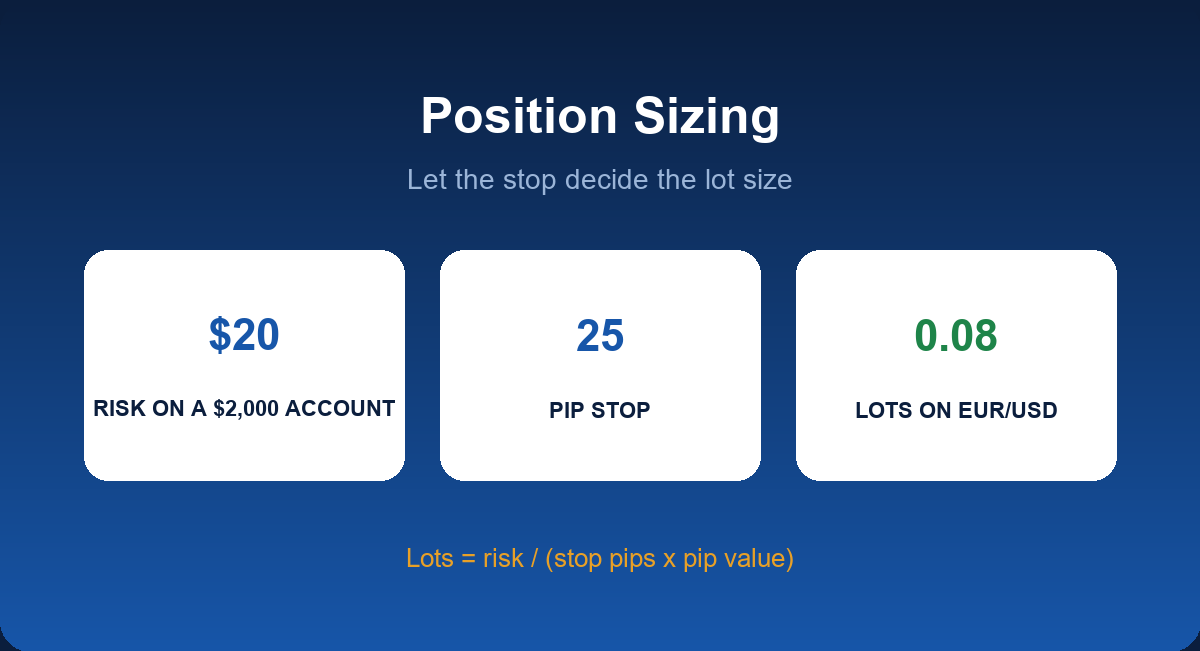
The Formula
Lots = amount at risk ÷ (stop distance in pips × pip value per lot)
Amount at risk is your account balance multiplied by your risk percentage. Pip value per lot is about $10 for EUR/USD and other USD-quoted pairs (see what a pip is and how it is valued).
Example 1: EUR/USD
Balance $2,000, risk 1% = $20, stop 25 pips. Lots = $20 ÷ (25 × $10) = 0.08 lots. If the stop is hit you lose about $20; if you had traded 0.20 lots out of habit, the same stop would have cost $50, which is 2.5% of the account.
Example 2: USD/JPY
Balance $2,000, risk 1% = $20, stop 30 pips. One pip on a standard lot of USD/JPY is 1,000 yen; at a rate of 150 that is about $6.67. Lots = $20 ÷ (30 × $6.67) = 0.10 lots. The same dollar risk produces a different lot size because the pip value differs. The same logic works for any pair once you know the pip value.
Example 3: Wider Stop, Smaller Position
If you widen the EUR/USD stop from 25 to 50 pips because the chart needs more room, the lot size must halve to 0.04. A wider stop is not a problem; ignoring it in your size is. This is why long-term traders trade smaller lots than scalpers on the same account.
A Lot Size Table for USD-Quoted Pairs
Pip value assumed at $10 per standard lot. Lots are rounded down to two decimals.
| Risk amount | 10-pip stop | 20-pip stop | 30-pip stop | 50-pip stop |
|---|---|---|---|---|
| $5 | 0.05 | 0.02 | 0.01 | 0.01 |
| $10 | 0.10 | 0.05 | 0.03 | 0.02 |
| $25 | 0.25 | 0.12 | 0.08 | 0.05 |
| $50 | 0.50 | 0.25 | 0.16 | 0.10 |
| $100 | 1.00 | 0.50 | 0.33 | 0.20 |
For a quick answer on any pair, use our lot size calculator.
Fixed Lots vs Fixed Percentage
| Fixed lot | Fixed percentage risk | |
|---|---|---|
| Simplicity | Very simple | Needs a calculation each trade |
| Risk after losses | Rises as a percentage of a smaller balance | Shrinks automatically with the balance |
| Risk after gains | Falls as a percentage | Grows with the balance |
| Fits different stops | No | Yes |
When the Minimum Lot Is Too Big
On a $100 account with a 1% risk ($1) and a 20-pip stop, you need 0.005 lots, which most brokers do not allow. Your options are a smaller account unit such as a cent account, a tighter stop that still makes sense, or accepting a smaller number of trades. Do not round up and take twice the risk. See micro vs cent accounts and trading forex with a small account.
Adjusting for Spread and Slippage
The stop distance used in the formula should include the spread, because a stop on a buy triggers at the bid. If the spread is 1 pip and your chart level is 25 pips away, size for 26. In fast markets allow a margin for slippage, or avoid trading around news.
Common Mistakes
- Choosing a lot size first and fitting the stop to it.
- Using the account equity instead of the balance inconsistently.
- Forgetting that pip values differ across pairs.
- Increasing size after a winning streak without a rule.
- Ignoring open positions: total risk matters, not just this trade.
A Spreadsheet You Can Build in Five Minutes
Columns: balance, risk %, risk $, pair, stop pips, pip value, lots (formula), spread, result. Fill in the formula once and copy it down. After a month, compare planned and actual risk per trade.
Sizing Several Trades at Once
If you risk 1% on each of three simultaneous trades, your total open risk is 3%. Add a limit on total risk, such as 3%, and treat correlated pairs as one position. For example, long EUR/USD and long GBP/USD are both short the dollar. Counting them as one exposure at 1% each would be 2% of exposure to one idea; in practice it is better to size each at 0.5% or accept 2% as the cost of the idea.
Gold, Indices and Other Markets
The formula is the same, but pip value changes with the contract size. Check the contract specification for the instrument: contract size, tick size and tick value. For instance, if one lot of an instrument moves $1 per 0.01 price change and your stop is 5.00 points (500 ticks), the risk per lot is $500 and a $50 risk corresponds to 0.10 lots. The numbers are examples; read the real specification before you trade.
After a Drawdown
With fixed-percentage sizing, positions shrink after losses. A $1,000 account at 1% risks $10; after a 20% drawdown the balance is $800 and the risk is $8. That is by design: it slows your losses. Resist the urge to “make it back” by restoring size, and restore it only when the balance recovers.
Frequently Missed Details
- Different brokers have different minimum lot and lot step. If the step is 0.01 you cannot trade 0.005.
- The pip value changes with the exchange rate on non-USD pairs, so recheck on cross pairs.
- Commission and swap are separate costs and are not in the formula.
- If your stop moves, the size must be recalculated before you place the order.
A Short Practice Exercise
On a demo, take five chart set-ups. For each, write the entry, stop, risk amount and the lot size from the formula. Place the trades at those sizes and check that each stop-out would cost within a few cents of the planned amount. Repeat until it is automatic.
Related: Forex Margin Explained | Best Leverage for Forex Beginners
Key Takeaways
- Lots = amount at risk ÷ (stop pips × pip value per lot).
- The stop distance decides the size, not the other way round.
- Pip value differs by pair, so check it for non-USD quotes.
- If the minimum lot is too large for your risk rule, use a smaller account unit instead of over-risking.
FAQ
What is the best risk percentage?
Many traders use 0.5% to 2%. Choose a level you can live with after a long losing streak.
Do I use balance or equity?
Pick one and be consistent. Many use balance at the start of the trade.
How do I size gold or indices?
Check the contract size and pip or point value in the specification, then apply the same formula.
Should I reduce size after losses?
Some traders do, with a defined rule for restoring it. It is a personal decision, but it should be written in advance.
Open a JustMarkets Account & Activate Rebate →
To check the arithmetic quickly, the position size calculator on our sister site leaksfx.com applies the same formula to any currency pair.
Risk Disclaimer: Trading forex and CFDs carries a high level of risk and may not be suitable for all investors. You can lose all the money you deposit. JFRebate earns a referral commission from brokers it reviews; this never changes the spreads you pay. This article is for information only and is not financial advice.

Om Erick, CTA, is a Certified Technical Analyst and a forex trading veteran active since 2010, recognized as one of the Top 35 Best Traders in the World (MQL5, 2024). As the author of “Belajar Trading dari 0” and “Psikologi Trading,” as well as an active Psychological Trading Coach, Om Erick is dedicated to providing objective, data-backed trading guidance. Through JFRebate, he helps traders achieve peak performance by providing access to trusted brokers and a transparent, industry-leading rebate system.