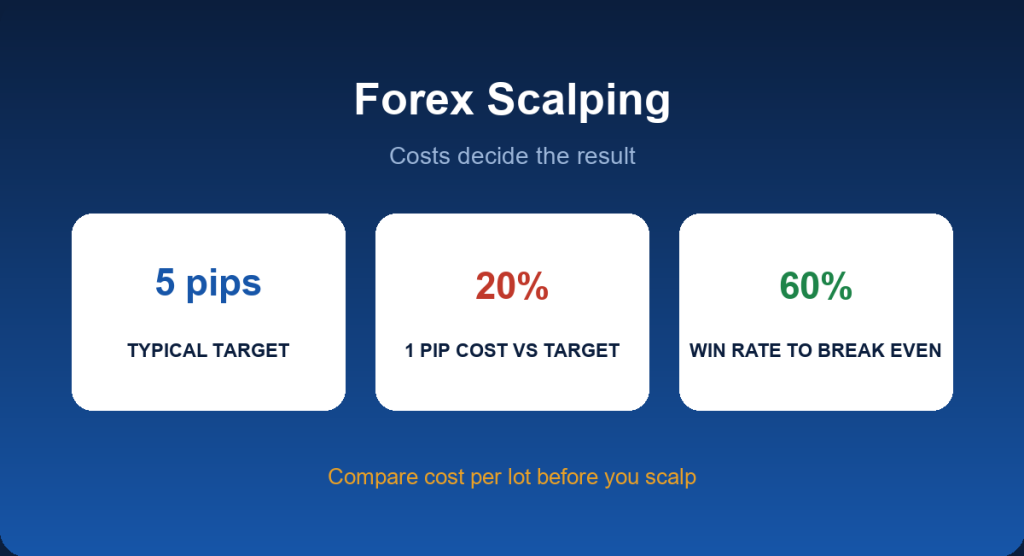
Scalping means opening and closing trades within seconds or minutes to capture a few pips at a time. It sounds simple and it attracts many beginners, yet it is one of the hardest styles to do profitably, mainly because costs eat a large share of each small gain. This guide covers how scalping works, how to calculate whether your edge survives the spread, which broker conditions matter, and where cashback fits in.
What Scalping Is (and Is Not)
A scalper aims for small moves, often 3 to 10 pips, and takes many trades per day. Positions are held for minutes, sometimes less. It is not the same as day trading, where you may hold for hours, and it is not an automatic way to make steady money. Because the target per trade is small, the spread and commission become a large part of the potential profit.
The Cost Problem in Numbers
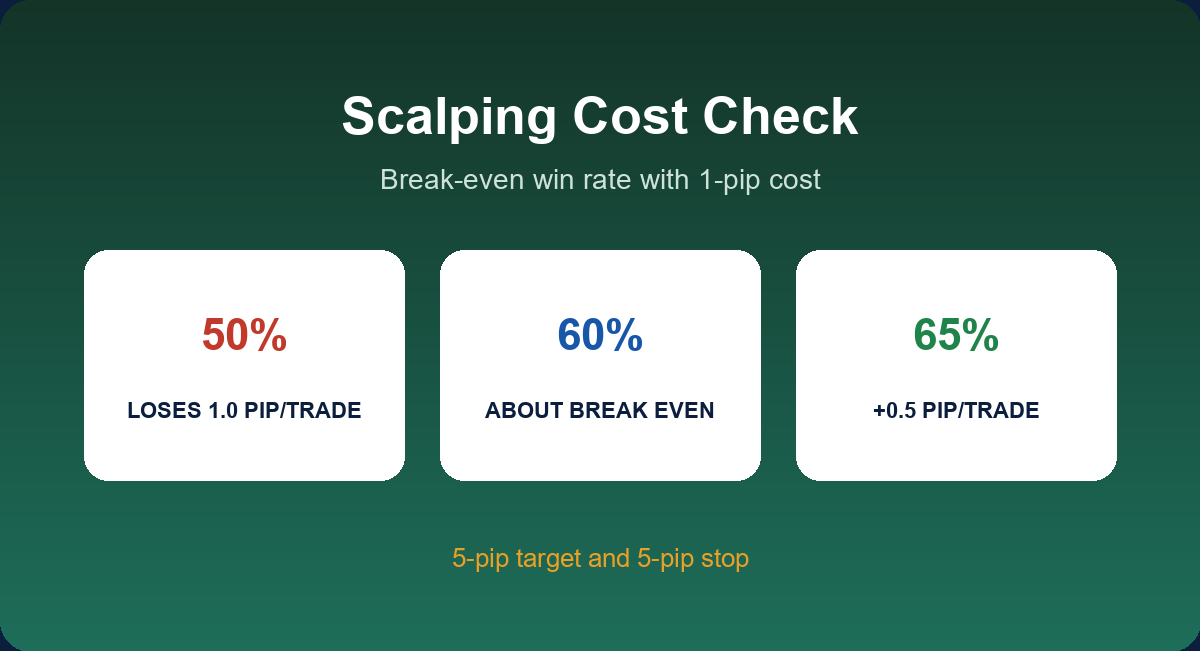
Say your average target is 5 pips and your stop is 5 pips. If the total cost per trade (spread plus commission) is 1 pip, you start each trade 1 pip behind.
| Win rate | Result without costs (5 pips each way) | Result with 1 pip cost |
|---|---|---|
| 50% | 0 pips per trade | −1.0 pip per trade |
| 55% | +0.5 pips | −0.5 pip |
| 60% | +1.0 pip | 0 pips |
| 65% | +1.5 pips | +0.5 pip |
A 55% win rate looks good until you subtract costs. This is why scalpers care more about a fraction of a pip than any other trader. See what a pip is and how it is valued to convert these figures into money.
Broker Conditions That Matter for Scalping
- Total cost per lot. Compare a raw-spread account with commission against a standard account on your own volume. See zero spread accounts.
- Execution speed and slippage. A fast server and stable connection matter more than a platform feature.
- Rules on short trades. Some brokers restrict very short holding times or EAs; read the terms before you build the strategy.
- Stop level. The minimum distance for stop orders can make tight stops impossible on some accounts.
- Reliability during news. Spreads widen and slippage rises; know how your broker behaves.
A Basic Scalping Framework
This is a structure, not a recipe. No set-up works forever.
- Pick one or two liquid pairs, such as EUR/USD or USD/JPY, and trade them only in the busiest sessions (London, and the London and New York overlap).
- Use a higher timeframe for direction (for example 15 minutes) and a lower one (1 or 5 minutes) for entries.
- Define the set-up in one sentence and write down the entry, the stop and the target before each trade.
- Cap the risk per trade, typically 0.5% to 1%. High frequency multiplies mistakes.
- Set a daily loss limit and stop when you hit it.
- Review every trade in a journal, including the spread you paid.
The Role of Cashback
Because scalpers trade many lots, a rebate has the largest effect on them. If you trade 100 lots a month and your cashback is $3 per lot, you get $300 back, which can turn a break-even month into a profitable one. That does not make an unprofitable strategy profitable; it only reduces your cost. The arithmetic is in how to calculate your JustMarkets rebate and how the Headway rebate works. Remember that rebate applies to new accounts opened through the link.
Risk Management for High-Frequency Trading
- Use stop losses on every trade, since a “quick” trade can turn into a long one.
- Keep effective leverage low; see high leverage forex brokers.
- Do not trade immediately before or after major news.
- Avoid revenge trades after a loss. Walk away for 15 minutes.
- Practise on a demo account for several weeks and compare the demo spread with the live one.
Common Scalping Mistakes
- Ignoring costs. Trading a strategy with a 3-pip target on a 2-pip spread.
- Overtrading. More trades are not better trades; each one pays the cost.
- Moving the stop. Widening it to avoid a loss turns a scalp into a hope.
- Using a slow connection or phone hotspot. Latency changes the price you get.
- Copying a screenshot strategy without testing it. Always test on your own account type.
Is Scalping Right for You?
It suits people who can focus for short, intense sessions, who follow rules under pressure and who have a low-cost account. It suits less well anyone who works full-time and checks charts between meetings, who dislikes constant decisions or who is still learning basic risk management. Many traders find that a slower style, with fewer trades and wider targets, fits real life better.
A Sample Session Plan
Scalping works best in short, focused sessions with a fixed structure. A plan might look like this:
- Before the session: check the economic calendar and mark any high-impact news. Decide the one or two pairs you will trade. Note the current spread; if it is above your usual level, wait.
- During the session: trade only your defined set-up. Log each trade immediately: time, direction, entry, stop, target, spread and result.
- Exit rules: stop after a fixed number of trades, a daily loss limit or when your concentration drops, whichever comes first.
- After the session: review screenshots and tag mistakes. Do not trade again until the review is done.
When Spreads Are Best (and Worst)
| Time | Typical conditions for majors |
|---|---|
| London session | Tight spreads, good liquidity |
| London–New York overlap | Highest volume; tight spreads, but fast moves |
| Late New York and rollover | Thin liquidity; spreads can widen sharply |
| Asian session | Quieter; some pairs trade tight, others wide |
| Major news releases | Spreads widen and slippage rises |
Fields for a Scalping Journal
- Pair, time and direction
- Entry, stop and target in pips
- Spread paid and commission
- Result in pips and money
- Did the trade follow the plan? Yes or no
- Emotional state before and after
After 100 trades, total the spread and commission you paid and compare it with your net result. That one figure often explains why a strategy that “wins more than it loses” still loses money.
The Mental Side
Scalping compresses decisions. You may make dozens in an hour, and fatigue, frustration and overconfidence build quickly. A rule that helps: after two consecutive losses, step away for a few minutes, and after a large win, do not increase size. Short breaks protect you from the worst habit of the style, which is trading faster to recover a loss.
Slower Alternatives
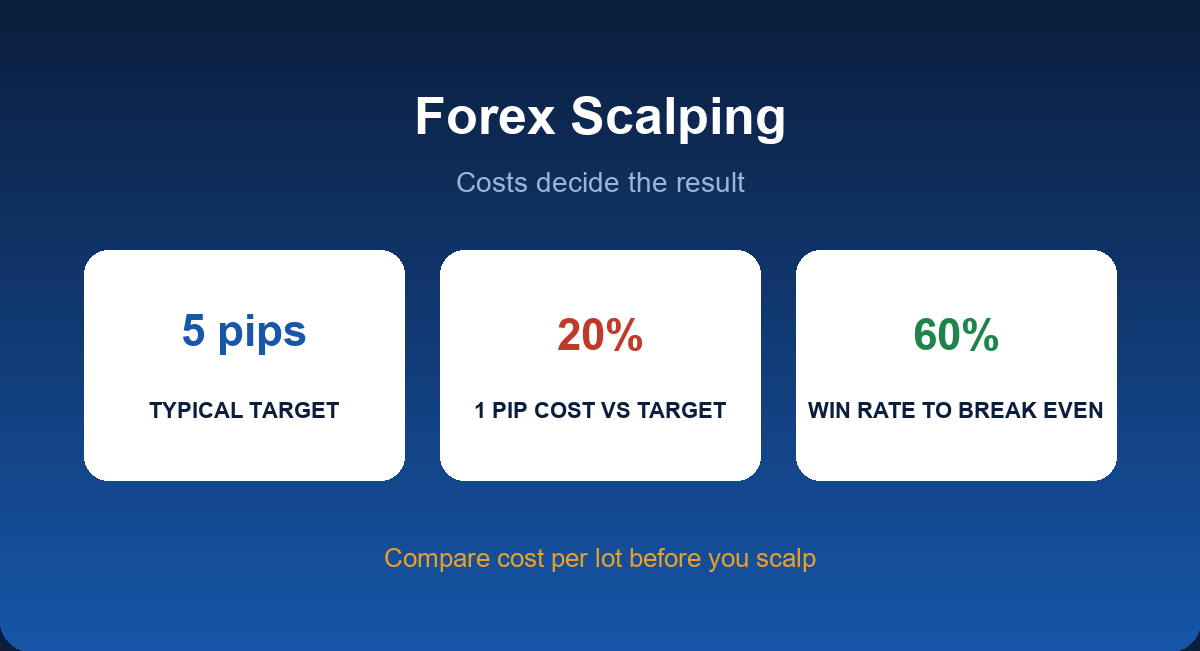
If scalping does not fit your life, consider a style where costs are a small part of the target. A 40-pip target with a 1-pip spread loses only 2.5% to cost, whereas a 5-pip target loses 20%. Swing trading with fewer entries and a wider stop also reduces the number of times you pay the spread. Compare approaches on a demo account before committing capital.
More Questions Answered
How many trades a day is normal for a scalper?
It varies from a handful to several dozen. More trades are not better. Each one pays the spread, so quality and cost control matter more than count.
Can I scalp with a $100 account?
Yes, but position sizes must be tiny and costs weigh heavily. A cent account lets you follow a 1% risk rule and learn the style at low cost.
Which indicators do scalpers use?
Many use moving averages, VWAP-style tools, RSI or simple price action around support and resistance. No indicator replaces a written rule set and a cost check.
Do brokers ban scalping?
Most accept it, but some restrict very short holding times or high-frequency strategies on certain accounts. Read the terms before you start.
Should I scalp during news?
Most scalpers avoid the minutes around major releases because spreads widen and slippage rises. If you trade news, test on a demo and size down.
Related Guides
This guide is part of our Trading Costs series. For the full overview, start with Brokers With Rebates, then continue with:
- what a spread is in forex
- zero spread accounts
- ECN, STP and market maker brokers
- pips and pip value
- a forex VPS
Key Takeaways
- Scalping targets a few pips per trade, so spread and commission decide whether an edge survives.
- Compare total cost per lot on your own volume before choosing an account type.
- Check broker rules on short trades, execution speed and stop levels.
- Cashback lowers cost but does not create an edge. Risk control comes first.
FAQ
Is scalping legal and allowed?
It is legal, but individual brokers set their own rules. Read the trading conditions of your account.
What is the best timeframe for scalping?
Many use 1 to 5 minutes for entries and 15 minutes for direction, but there is no single best choice.
Can I scalp with a small account?
Yes, especially on a cent account, but costs still apply and discipline matters more than size.
Which pairs are best?
Liquid pairs such as EUR/USD and USD/JPY usually have tighter spreads.
Open a JustMarkets Account & Activate Rebate →
Risk Disclaimer: Trading forex and CFDs carries a high level of risk and may not be suitable for all investors. You can lose all the money you deposit. JFRebate earns a referral commission from brokers it reviews; this never changes the spreads you pay. This article is for information only and is not financial advice.

Om Erick, CTA, is a Certified Technical Analyst and a forex trading veteran active since 2010, recognized as one of the Top 35 Best Traders in the World (MQL5, 2024). As the author of “Belajar Trading dari 0” and “Psikologi Trading,” as well as an active Psychological Trading Coach, Om Erick is dedicated to providing objective, data-backed trading guidance. Through JFRebate, he helps traders achieve peak performance by providing access to trusted brokers and a transparent, industry-leading rebate system.