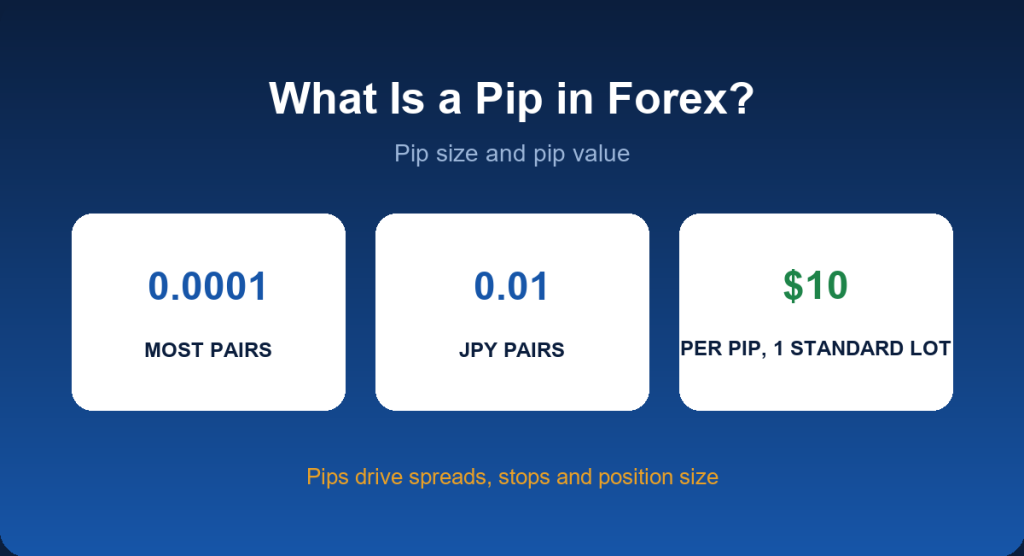
A pip is the standard unit used to measure price movement in forex. Spreads, stop losses and profits are all quoted in pips, so understanding them is the first step to controlling risk. This guide explains what a pip is, how big it is for different pairs, and how to calculate the value of a pip for any position size.
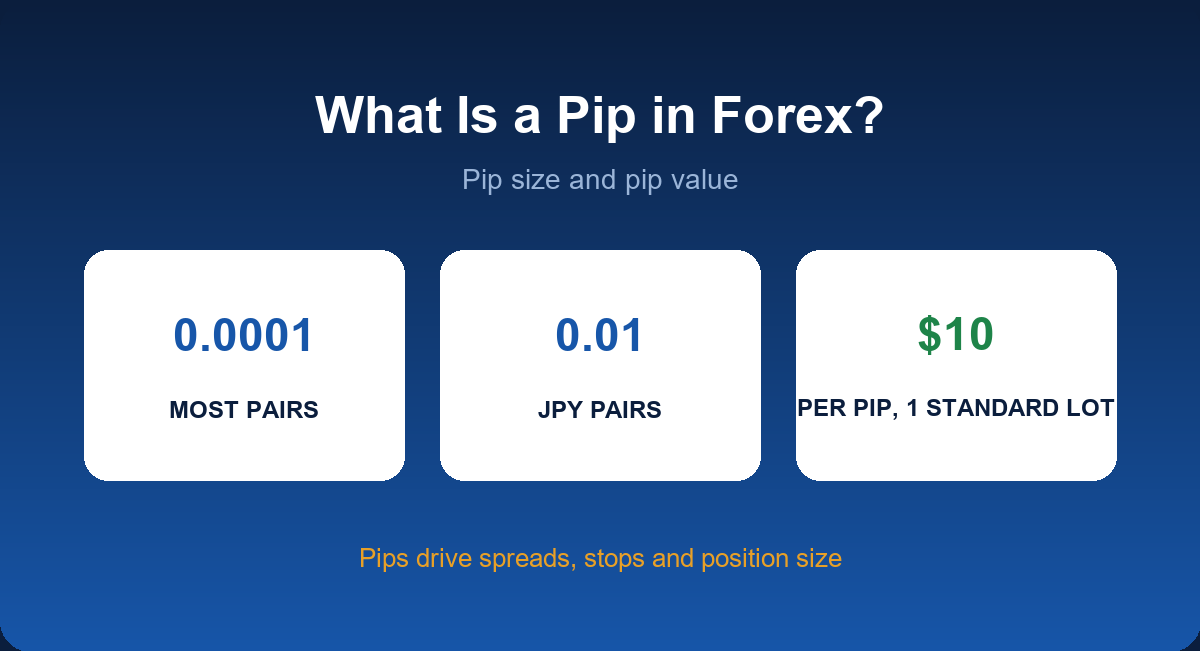
What Is a Pip?
“Pip” stands for percentage in point. For most currency pairs it is the fourth decimal place, 0.0001. If EUR/USD moves from 1.1000 to 1.1001, that is a one-pip move. For pairs that include the Japanese yen, a pip is the second decimal place, 0.01.
| Pair type | Pip size | Example |
|---|---|---|
| Most pairs (EUR/USD, GBP/USD) | 0.0001 | 1.1000 → 1.1001 |
| JPY pairs (USD/JPY) | 0.01 | 150.00 → 150.01 |
Many brokers quote a fifth decimal place, called a pipette, which is one tenth of a pip.
How Much Is a Pip Worth?
The value depends on your position size and the pair. For pairs where USD is the quote currency (such as EUR/USD), the pip value is:
| Lot size | Units | Value per pip |
|---|---|---|
| Standard (1.00) | 100,000 | $10 |
| Mini (0.10) | 10,000 | $1 |
| Micro (0.01) | 1,000 | $0.10 |
The Pip Value Formula
Pip value = (pip size ÷ exchange rate) × position size in units, converted into your account currency. For USD-quoted pairs the quote currency already matches a USD account, so it is simply pip size × units (for example 0.0001 × 100,000 = $10).
Worked Examples
- Profit: You buy 0.5 lots of EUR/USD and the price rises 20 pips. Value per pip is $5, so profit is 20 × $5 = $100.
- Stop loss: You risk $20 with a 25-pip stop on EUR/USD. Pip value must be $0.80 per pip, which is about 0.08 lots.
- Cost: A 1-pip spread on 1 standard lot costs about $10.
Why Pips Matter for Costs
The spread is quoted in pips, so a tighter spread reduces your cost per lot. A cashback rebate also lowers the effective cost; compare how this adds up in brokers with rebates and lowest spread forex brokers.
Use Pips to Size Positions
Decide your risk in dollars, choose a stop distance in pips, then calculate the lot size. Our forex lot size calculator does it for you, and position sizing in forex explains the method.
Pip Value for Pairs Not Quoted in USD
When the quote currency is not USD, the pip value is first calculated in the quote currency and then converted into your account currency.
- USD/JPY at 150.00, 1 standard lot: pip = 0.01 JPY × 100,000 = 1,000 JPY. Converted to USD at 150, that is about $6.67 per pip.
- EUR/GBP, 1 standard lot: pip = 0.0001 × 100,000 = £10. If GBP/USD is 1.25, that is about $12.50 per pip.
- USD/CHF at 0.9000, 1 standard lot: pip = 0.0001 × 100,000 = 10 CHF. Converted to USD at 0.9, that is about $11.11 per pip.
Platform calculators do this automatically, but knowing the logic helps you spot a wrong number.
Pips, Points and Ticks
| Term | Meaning |
|---|---|
| Pip | The standard unit of forex price movement (0.0001 for most pairs, 0.01 for JPY pairs) |
| Pipette / point | One tenth of a pip, the fifth decimal place on most platforms |
| Tick | The smallest change in price for an instrument; it varies by market |
Metals, indices and crypto have their own conventions. Gold, for example, is often quoted with two decimals and what counts as a “pip” differs by broker. Check the contract specification on your platform for each instrument rather than assuming the forex rules apply.
The Spread as a Cost in Pips
| Spread | Cost for 0.01 lot | Cost for 0.10 lot | Cost for 1.00 lot |
|---|---|---|---|
| 0.1 pips | $0.01 | $0.10 | $1 |
| 0.5 pips | $0.05 | $0.50 | $5 |
| 1.0 pips | $0.10 | $1.00 | $10 |
| 2.0 pips | $0.20 | $2.00 | $20 |
These figures assume a USD-quoted pair. Small differences add up over many trades, which is why traders compare low-spread brokers and why a rebate on each lot matters; see how the JustMarkets rebate works.
Using Pips for Stop Loss and Take Profit
Set the stop loss and take profit in pips from your entry, then compare them. If you risk 25 pips to make 50 pips, your risk-reward ratio is 1:2. With a 40% win rate and a 1:2 ratio, expectancy per trade is (0.4 × 50) − (0.6 × 25) = +5 pips; with the same stop but a 1:1 target, it would be (0.4 × 25) − (0.6 × 25) = −5 pips. The numbers show why the ratio and the win rate must be considered together.
From Pips to Money and Back
- Decide how much you are willing to lose in dollars (for example 1% of $1,000 = $10).
- Choose the stop distance in pips from the chart (for example 20 pips).
- Divide: $10 ÷ 20 pips = $0.50 per pip.
- Convert to lots: $0.50 per pip is 0.05 lots on a USD-quoted pair, because 1 lot is about $10 per pip.
Our forex lot size calculator does these steps for you.
Common Pip Mistakes
- Assuming a pip is worth $10 on every pair and lot size.
- Forgetting that JPY pairs use a different pip size.
- Judging a trade only by pips gained, not by risk taken in dollars.
- Ignoring the spread when placing a tight stop; the spread can trigger it.
- Comparing “pips per day” claims without knowing the lot size used.
Pip Value Quick Reference (1 Standard Lot, Approximate)
| Pair | Pip size | Approximate value per pip |
|---|---|---|
| EUR/USD | 0.0001 | $10.00 |
| GBP/USD | 0.0001 | $10.00 |
| USD/JPY (rate 150) | 0.01 | about $6.67 |
| USD/CHF (rate 0.90) | 0.0001 | about $11.11 |
| EUR/GBP (GBP/USD 1.25) | 0.0001 | about $12.50 |
The non-USD figures change with the exchange rate, so treat them as examples rather than constants.
How to Count Pips on a Chart
- Note the entry price and the exit or target price.
- Subtract them and ignore the sign for the distance.
- Divide by the pip size: 0.0001 for most pairs and 0.01 for JPY pairs.
Example: you buy EUR/USD at 1.0850 and the price reaches 1.0890. The distance is 0.0040, which equals 40 pips. On a JPY pair, buying USD/JPY at 149.20 and exiting at 149.70 is a 0.50 move, or 50 pips.
A Quick Reference of Formulas
- Profit in pips = (exit price − entry price) ÷ pip size for a buy; reverse the subtraction for a sell.
- Profit in money = pips × pip value × number of lots.
- Lot size = amount at risk ÷ (stop in pips × pip value per lot).
- Spread cost = spread in pips × pip value × number of lots.
Frequently Asked Questions About Pips in Practice
Traders also ask whether a bigger pip move is always better. Not necessarily: a 100-pip gain on a micro lot earns $10 on a USD-quoted pair, while a 5-pip gain on a standard lot earns $50. What matters is the pip value of your position and the risk you accepted to get it, which is why professional traders talk about risk-reward and expectancy, not pips alone.
More Questions Answered
Is a pip always 0.0001?
No. It is 0.0001 for most pairs but 0.01 for JPY pairs, and other instruments use different conventions.
Why do brokers quote five decimal places?
The fifth decimal, the pipette, allows more precise pricing and tighter spreads. It is one tenth of a pip.
Can I trade less than one pip?
Price moves in pipettes on most platforms, so you can see and manage fractions of a pip, although profits on fractions are very small.
How big is a normal daily move in pips?
It varies by pair and conditions. Major pairs often move tens of pips on an average day, and much more around major news.
Pips and Your Trading Plan
Once you can convert pips into money, put them into a plan. Write down, before each trade, the entry, the stop in pips, the target in pips and the dollar risk. A plan such as “risk $10 with a 20-pip stop, target 40 pips” turns a vague idea into a measurable trade, and the journal afterwards shows whether your stops are too tight or your targets too ambitious. Over time you will see that each pair and timeframe has a typical range in pips; placing a stop smaller than that normal noise is a common reason trades are stopped out before the idea has time to work. Read forex risk management strategy for the full process, and keep the pip maths close when you compare brokers in our broker comparison.
Key Takeaways
- A pip is 0.0001 for most pairs and 0.01 for JPY pairs.
- On a standard lot, one pip of a USD-quoted pair is worth about $10.
- Pip value = pip size ÷ rate × units, converted into your account currency.
- Pips are the building block for spreads, stop losses and position sizing.
FAQ
What is the difference between a pip and a point?
A point is usually the smallest price change on the platform, often one tenth of a pip (a pipette).
How many pips can I make a day?
There is no fixed number. It depends on strategy and market conditions, and no result is guaranteed.
Is a pip the same on every pair?
No. Pip size and pip value differ by pair and position size.
What is a pipette?
A fractional pip, one tenth of a pip, shown as the fifth decimal place.
Open a JustMarkets Account & Activate Rebate →
Risk Disclaimer: Trading forex and CFDs carries a high level of risk and may not be suitable for all investors. You can lose all the money you deposit. JFRebate earns a referral commission from brokers it reviews; this never changes the spreads you pay. This article is for information only and is not financial advice.

Om Erick, CTA, is a Certified Technical Analyst and a forex trading veteran active since 2010, recognized as one of the Top 35 Best Traders in the World (MQL5, 2024). As the author of “Belajar Trading dari 0” and “Psikologi Trading,” as well as an active Psychological Trading Coach, Om Erick is dedicated to providing objective, data-backed trading guidance. Through JFRebate, he helps traders achieve peak performance by providing access to trusted brokers and a transparent, industry-leading rebate system.