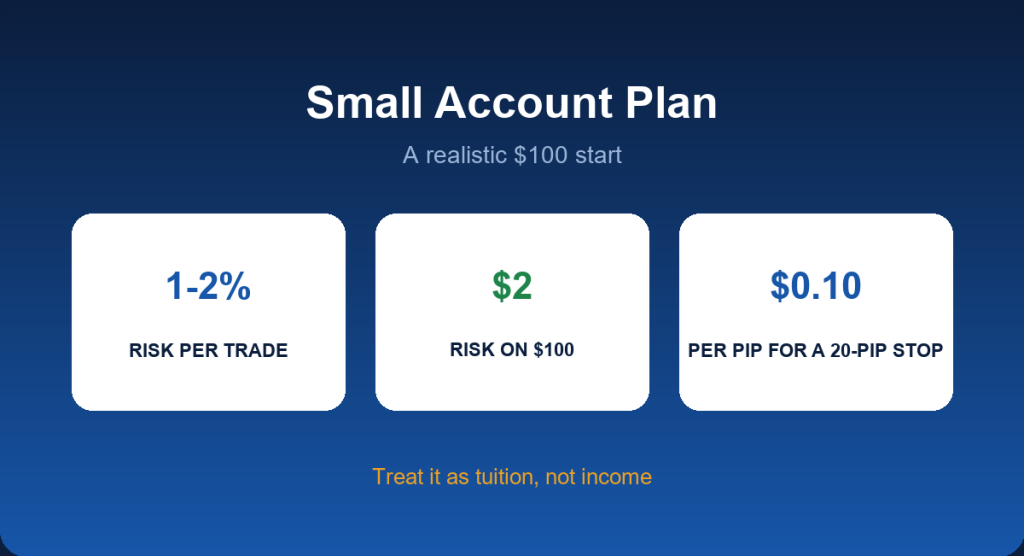
A $100 forex account is not a shortcut to wealth, and anyone who says otherwise is selling something. It is, however, a legitimate way to learn real trading at low cost if you treat it as tuition. This guide gives a realistic plan: how much to risk, which pairs and sessions to focus on, what costs do to a small balance and the mistakes that end most small accounts in weeks.
Set Honest Expectations First
Doubling an account every month is a headline, not a plan. If you make a steady 3% a month on $100, that is $3. The point of a small account is not the profit; it is building habits (position sizing, stop placement, journalling) that will matter when the balance is bigger. Many experienced traders still follow the same rules on every account size.
The Rules That Keep a Small Account Alive
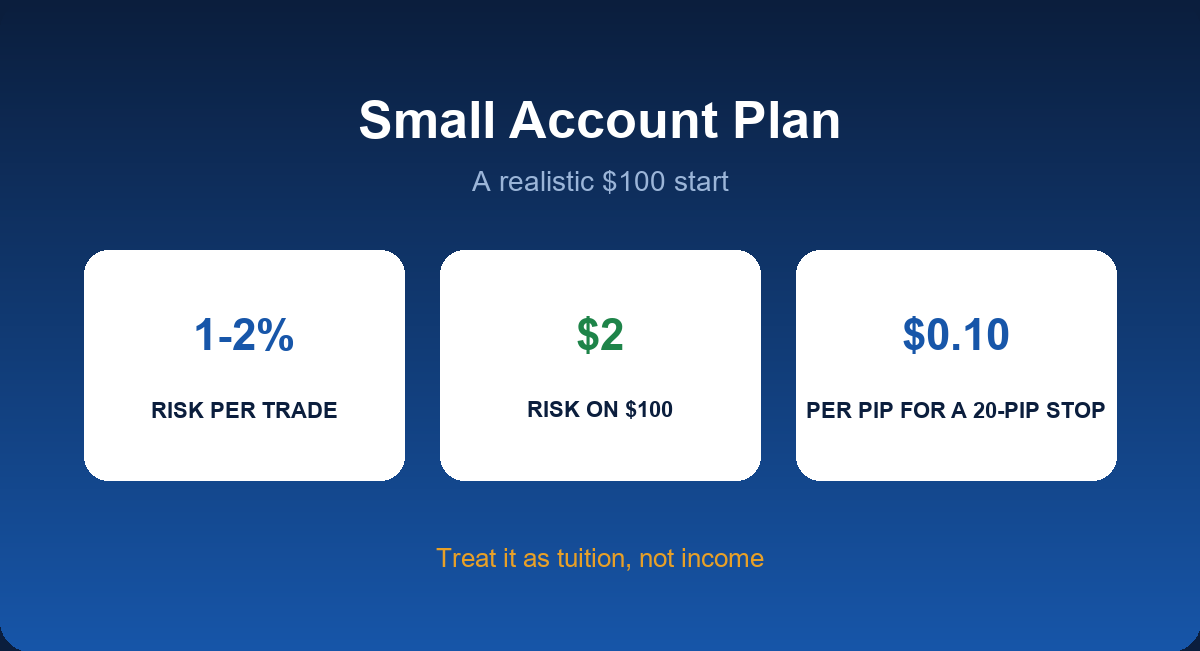
- Risk 1–2% per trade. On $100 that is $1 to $2. If that feels too small, you are over-sizing.
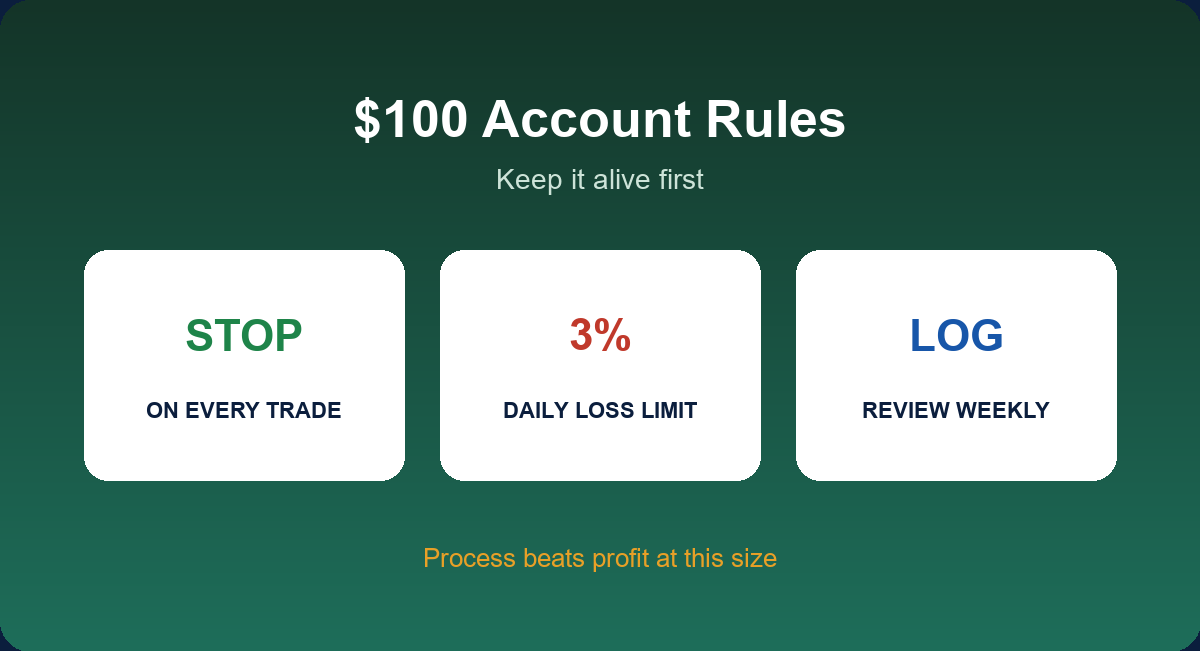
- Always use a stop loss, placed where your idea is wrong, not where it hurts least.
- Limit open trades. Two small positions are easier to manage than six.
- Stop for the day after a set loss (for example 3%).
- Do not add to losers. Averaging down is the fastest way to a margin call.
What a 2% Risk Looks Like
| Balance | Risk (2%) | Stop of 20 pips needs |
|---|---|---|
| $100 | $2 | $0.10 per pip (about a 0.01 lot on EUR/USD) |
| $250 | $5 | $0.25 per pip |
| $500 | $10 | $0.50 per pip |
Use our lot size calculator for your exact pair and stop.
Choose the Account and Broker Carefully
- A cent or small-minimum account lets you trade small enough to follow the risk rule. See micro vs cent accounts and best cent account brokers.
- A regulated broker with a proven withdrawal process. See regulated forex brokers.
- Low leverage in practice, even if the broker allows more. See high leverage forex brokers.
Pairs and Sessions to Focus On
Liquid major pairs such as EUR/USD, GBP/USD and USD/JPY usually have the tightest spreads, which matters on a small balance. Trade them during the London session and the London–New York overlap, when liquidity is highest. Avoid exotic pairs; wide spreads can swallow a small account. Spreads are explained in what a spread is in forex.
How Costs Hit a Small Balance
A 1-pip spread costs about $0.10 on a 0.01 lot, which is 5% of a $2 risk. Add a $2 withdrawal fee on a $10 profit and the numbers change again. Check deposit and withdrawal fees before you start, and compare spreads at the hours you trade. A rebate can offset part of the cost; for example, cashback of up to 33% of the spread on Headway returns part of that $0.10 on every trade, although the amount is tiny at this size. See how the Headway rebate works.
A Simple Four-Week Plan
- Week 1: demo only. Learn the platform and practise stops. See forex demo accounts.
- Week 2: fund the small account and trade the minimum lot with one simple set-up.
- Week 3: keep risk at 1% and start the journal in earnest: entry, stop, target, reason, result, emotion.
- Week 4: review. Count trades, average win versus loss and how often you broke your own rules. Adjust one thing.
Mistakes That End Small Accounts
- Using maximum leverage because it is available.
- Risking 10% to 20% per trade to “grow faster”.
- Moving the stop to avoid a loss.
- Trading during major news without a plan.
- Switching strategies after two losses.
- Depositing more to recover a loss.
When to Add Money or Move Up
Add funds only after you have followed your rules consistently over a meaningful number of trades, and only an amount you can afford to lose. Moving to a standard account makes sense when your risk rule needs larger lot sizes than the small account allows and when your journal shows a positive expectancy. Until then, the small account is doing its job.
An Illustrative Month on $100
This example is built from assumptions, not promises. Suppose you take 20 trades in a month, risking $1 each (1%). With a 45% win rate and an average win of $1.50, your result is 9 wins × $1.50 − 11 losses × $1 = $13.50 − $11 = +$2.50 before costs. If spread and commission cost you $0.20 per trade, that is $4 for the month, and you finish at −$1.50. The numbers show how thin the edge can be and why costs matter so much on small accounts. A trader with a 55% win rate and the same risk-reward would make about +$10.50 before costs and about +$6.50 after. Neither result changes your life; both teach you something.
A Realistic Look at Compounding
| Monthly return | $100 after 12 months | $100 after 24 months |
|---|---|---|
| 2% | about $127 | about $161 |
| 5% | about $180 | about $321 |
| 10% | about $314 | about $985 |
A sustained 10% per month is far beyond what most professionals achieve, and chasing it usually means taking oversized risk. The table shows why patience and survival matter more than speed.
A Simple Daily Routine
- Check the calendar for news and note your daily loss limit.
- Look at your higher-timeframe chart and decide whether any set-up qualifies.
- Calculate the position size from the stop distance before you click.
- Place the trade with the stop already attached.
- Log it, step away and review at the end of the day.
The Psychology of a Tiny Account
A small balance tempts you to treat losses as unimportant and wins as proof of skill. Both are traps. Treat each trade as a rehearsal for a larger account: the same rules, the same journal, the same discipline. Many people find that the first time they feel real fear is when a $5 loss feels like $500, and that is useful information about how you will behave later. For a broader structure, read forex risk management strategy and position sizing in forex.
More Questions Answered
Is it better to start with $100 or $1,000?
A larger balance lets you size positions more precisely, but a small one is fine for learning if you follow the risk rule. Never deposit more than you can afford to lose.
Can I grow $100 to $1,000?
It is possible in theory, but not reliably. Aim to build process and consistency first.
Which timeframe suits a small account?
Higher timeframes such as 1 hour or 4 hours need wider stops but fewer trades, which suits small balances and reduces cost.
Should I use leverage on a small account?
Use the minimum you need. Effective leverage under about 1:10 keeps risk manageable.
When should I stop trading for the day?
After a pre-set loss, such as 3% of the balance, or after a set number of losing trades.
What to Review Every Week
- How many trades followed the written rules, and how many did not.
- Average risk per trade as a percentage of the balance.
- Total costs: spreads, commissions and fees.
- The biggest loss and what caused it.
- One habit to improve next week.
Small accounts are good teachers precisely because mistakes are cheap. If you review honestly, a few months of this routine are worth more than any signal service.
Tools That Help
Use a spreadsheet or a free journaling app for trade records, the lot size calculator for position size, the economic calendar to avoid news surprises and a demo account to test new ideas before risking money.
Where to Go Next
Once your habits are stable, compare broker options in our broker guide and learn how costs shape results in what a spread is in forex. Revisit your risk rule every time the balance changes by more than 25%, and keep the journal even when trading feels easy.
Related Guides
This guide is part of our Starting Small series. For the full overview, start with Best Cent Account Brokers, then continue with:
- micro vs cent accounts
- low minimum deposit brokers
- position sizing
- risk management
- no deposit bonuses
Related: What leverage a small account should use
Key Takeaways
- A small account is for learning habits, not for fast profit.
- Risk 1–2% per trade, use a stop loss and keep effective leverage low.
- Choose a regulated broker with a cent or low-minimum account and check withdrawal fees.
- Treat the first months as tuition and keep a journal.
FAQ
Can I really start forex with $100?
Yes, technically, especially with a cent account, but results depend on discipline more than on the amount.
How much can I make with $100?
There is no reliable figure. Realistic expectations are small, and losses are common while you learn.
What is the best pair for a small account?
Liquid majors such as EUR/USD are common choices because of tighter spreads.
Should I use a bonus on a small account?
Be cautious: bonus conditions can lock your deposit. See forex no deposit bonus terms.
Open a Headway Account & Activate Rebate →
Risk Disclaimer: Trading forex and CFDs carries a high level of risk and may not be suitable for all investors. You can lose all the money you deposit. JFRebate earns a referral commission from brokers it reviews; this never changes the spreads you pay. This article is for information only and is not financial advice.

Om Erick, CTA, is a Certified Technical Analyst and a forex trading veteran active since 2010, recognized as one of the Top 35 Best Traders in the World (MQL5, 2024). As the author of “Belajar Trading dari 0” and “Psikologi Trading,” as well as an active Psychological Trading Coach, Om Erick is dedicated to providing objective, data-backed trading guidance. Through JFRebate, he helps traders achieve peak performance by providing access to trusted brokers and a transparent, industry-leading rebate system.