Leverage lets you control a large position with a small deposit, which is why traders search for high leverage forex brokers. It is also the main reason beginners lose their accounts. This guide explains how leverage works, which brokers we cover offer very high ratios, the regulatory limits, and a practical set of rules to use it safely.
How Leverage Works
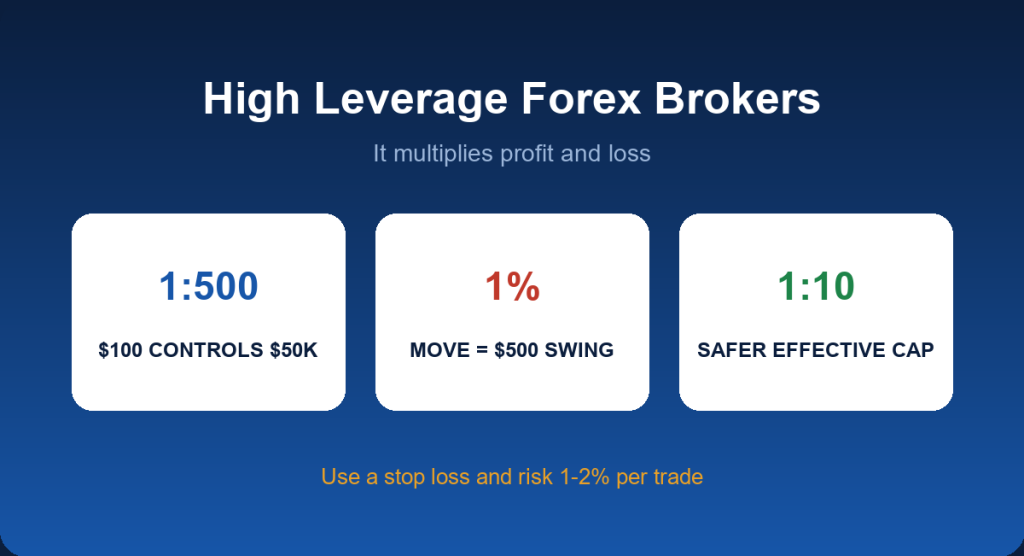
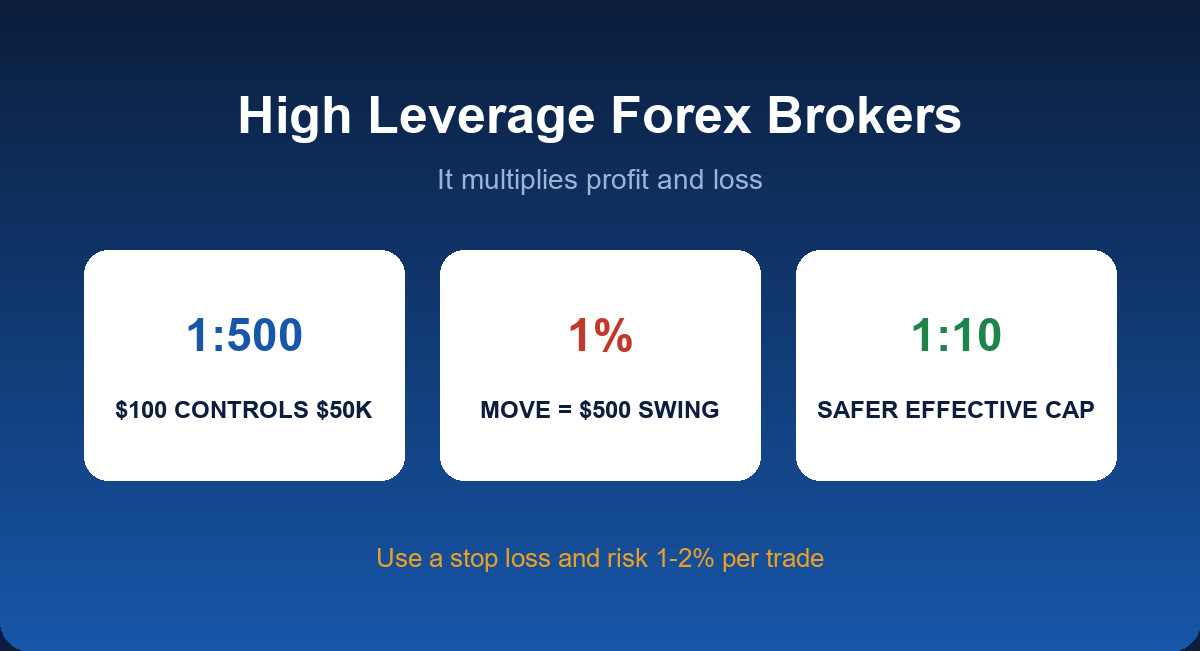
With 1:500 leverage, $100 of margin controls up to $50,000 of position. A 1% move in the market then changes your account by $500, which is five times your balance. Leverage magnifies profit and loss equally, so a small adverse move can close the position at a stop-out.
| Leverage | Margin for a $10,000 position |
|---|---|
| 1:30 | $333 |
| 1:100 | $100 |
| 1:500 | $20 |
| 1:1000 | $10 |
Brokers We Cover
- JustMarkets: up to 1:3000 on eligible accounts (1:30 for clients under EU regulation). See JustMarkets leverage.
- Headway: very high or “unlimited” leverage on some accounts, depending on the balance and your region. See Headway leverage.
Maximum leverage is usually tiered: it falls as your balance or open position size grows. Confirm the current rules in your own client area.
Regulatory Limits
Strict regulators cap retail leverage, commonly at 1:30 for major currency pairs (UK, EU and Australia). Offshore regulators allow much more, which is exactly why higher-leverage brokers are often offshore. Read regulated forex brokers to understand the trade-off.
Rules for Using High Leverage Safely
- Think in effective leverage, not the maximum. Position value divided by your balance. Keeping it under about 1:10 is a sensible ceiling for most beginners.
- Always use a stop loss and risk only 1–2% of your balance per trade. See position sizing and risk management.
- Size by risk, not by margin. Use our lot size calculator.
- Know the margin-call and stop-out levels of your account.
- Avoid trading around major news when spreads widen and slippage is common.
A Worked Example: Same Trade, Different Leverage
Assume a $500 account and a 20-pip stop loss on EUR/USD (each pip of a standard lot is about $10).
| Cautious | Aggressive | |
|---|---|---|
| Lot size | 0.10 | 1.00 |
| Position value | $10,000 | $100,000 |
| Effective leverage | 1:20 | 1:200 |
| Loss at 20-pip stop | $20 (4%) | $200 (40%) |
The broker’s maximum leverage did not change; what changed is the position you chose. The aggressive trader loses 40% of the account on one normal stop-out.
Common Mistakes With High Leverage
- Using the full leverage available because the broker allows it.
- Trading without a stop loss and hoping the market turns.
- Adding to losing trades to average down.
- Ignoring weekend and news gaps, when price can jump past your stop.
- Chasing a big account from a tiny deposit. Growth from a small balance should come from consistency, not from maximum lot size. A cent account is a safer way to learn.
Margin, Free Margin and Stop-Out Explained
- Margin: the part of your balance the broker locks to keep a position open.
- Equity: your balance plus or minus the floating profit or loss on open trades.
- Free margin: equity minus margin; it is what is left to absorb losses and open new trades.
- Margin level: equity ÷ margin × 100%. When it falls to a set threshold, you get a margin call; at a lower threshold, the broker closes positions automatically (stop-out).
Example: with $500 of equity and $100 of margin in use, margin level is 500%. If losses reduce equity to $100, margin level falls to 100%, and many brokers will start closing trades around there or lower. The exact thresholds vary by broker and account type, so read them in your client area.
Position Size and Effective Leverage
| Account balance | Position value | Effective leverage | Risk level |
|---|---|---|---|
| $1,000 | $5,000 | 1:5 | Low |
| $1,000 | $10,000 | 1:10 | Moderate |
| $1,000 | $50,000 | 1:50 | High |
| $1,000 | $200,000 | 1:200 | Extreme |
The broker’s maximum leverage only sets the ceiling. Your position size sets the leverage you actually use.
You Can Usually Lower Your Leverage
Most brokers let you change the leverage on a live account from the client area or by contacting support. If you open an account that allows 1:1000, you can request 1:100 or lower. Doing so does not change your trading costs, but it limits how large a position the platform will let you open, which can protect you from your own mistakes.
Different Instruments, Different Leverage
Brokers often apply different maximum leverage to forex majors, metals, indices, energy and crypto, and the limit may fall as your balance grows. Check the specification for each instrument before assuming that the headline ratio applies to it.
Pros and Cons of High Leverage
| Pros | Cons |
|---|---|
| Lower margin per trade, so a small account can open meaningful positions | Small adverse moves can cause large percentage losses |
| More flexibility to hold several positions | Faster margin calls and stop-outs |
| Useful for experienced traders using tight stops | Encourages overtrading and oversized positions |
How High Leverage Affects Your Decisions
Large positions make every tick matter. Traders tend to move stops, close winners too early and hold losers too long. A stop that is a tiny share of the account is much easier to respect. If the size you want to trade makes you check the chart every minute, the position is too large.
A Checklist Before You Use High Leverage
- Decide the maximum percentage you will risk (1–2%) before opening a trade.
- Place the stop loss first and calculate the lot size from it.
- Check the margin level after the trade is open; keep it far above the stop-out level.
- Avoid holding large positions over the weekend or through major news.
- Review your last 20 trades: how many were larger than your plan allowed?
For a size calculator and the methodology behind it, see our lot size calculator and what a pip is and how pip value works.
Which Trading Style Uses How Much Leverage?
| Style | Typical holding time | Sensible effective leverage |
|---|---|---|
| Scalping | Seconds to minutes | Moderate, with very tight stops and low spreads |
| Day trading | Hours | Low to moderate |
| Swing trading | Days to weeks | Low, because stops are wider |
| Position trading | Weeks to months | Very low |
The wider your stop, the smaller your position must be for the same dollar risk, so longer-term styles naturally use less leverage even on an account that allows more.
What a Losing Streak Does at Different Risk Levels
| Risk per trade | Balance left after 10 losses in a row |
|---|---|
| 1% | about 90.4% |
| 2% | about 81.7% |
| 5% | about 59.9% |
| 10% | about 34.9% |
Ten losses in a row is not rare for a strategy with a 50% win rate over a few hundred trades. High leverage makes it easy to risk 10% or more per trade without noticing, which is how accounts disappear.
Alternatives to Maximum Leverage
- Use a cent account. You can trade very small lot sizes with a small deposit, learning without large risk. See best cent account brokers.
- Lower the account leverage. Ask support to set it to 1:100 or less.
- Use smaller lots. Position sizing, not leverage, controls your risk. See position sizing in forex.
- Practise first. Try your approach on a demo account at the leverage you plan to use.
More Questions Answered
Can I be liable for more than my deposit?
Many brokers offer negative balance protection, so your loss is limited to the account balance, but terms vary. Check your agreement.
Is leverage the same on all account types?
Not always. Cent, Standard, Pro and Raw accounts can have different limits.
Does a bigger deposit change my leverage?
At many brokers maximum leverage falls as your balance or open volume increases, so verify the tiers.
How to Choose a High-Leverage Broker Responsibly
If you decide that a broker with high maximum leverage fits your plan, treat the choice as a risk decision, not a bonus. Verify the entity and licence that will serve you, read the leverage and margin rules for the specific account, and check whether negative balance protection applies. Compare the stop-out level, because a high stop-out level can close your trades earlier than you expect. Open a demo account to see how margin changes as you open positions, then start live with a small deposit and a leverage setting well below the maximum. Finally, remember that the safest leverage is the one that lets you survive a long losing streak without being forced out of the market. Use our regulation guide for the safety checks and the lot size calculator to keep each position within your risk limit.
Related: What Is the Best Leverage for Forex Beginners? | Forex Margin Explained: Margin Level, Margin Call and Stop Out
Key Takeaways
- High leverage lowers the margin required but does not lower risk. It multiplies it.
- Strict regulators cap retail leverage at 1:30; offshore brokers allow far more.
- Use a stop loss, risk 1–2% per trade and keep effective leverage low.
- Confirm current leverage tiers in your own client area.
FAQ
Which broker has the highest leverage?
Several offshore brokers offer 1:1000 or more; leverage is usually tiered by balance and region. Check your account’s actual terms.
Is 1:500 leverage safe for beginners?
The available maximum is not the amount you should use. Beginners should keep effective leverage low and risk very little per trade.
Why is leverage limited in the EU and UK?
Regulators capped retail leverage to protect clients from large losses.
Can high leverage wipe out my account?
Yes. A small adverse move with no stop loss can trigger a stop-out.
Open a JustMarkets Account & Activate Rebate →
Risk Disclaimer: Trading forex and CFDs carries a high level of risk and may not be suitable for all investors. You can lose all the money you deposit. JFRebate earns a referral commission from brokers it reviews; this never changes the spreads you pay. This article is for information only and is not financial advice.

Om Erick, CTA, is a Certified Technical Analyst and a forex trading veteran active since 2010, recognized as one of the Top 35 Best Traders in the World (MQL5, 2024). As the author of “Belajar Trading dari 0” and “Psikologi Trading,” as well as an active Psychological Trading Coach, Om Erick is dedicated to providing objective, data-backed trading guidance. Through JFRebate, he helps traders achieve peak performance by providing access to trusted brokers and a transparent, industry-leading rebate system.