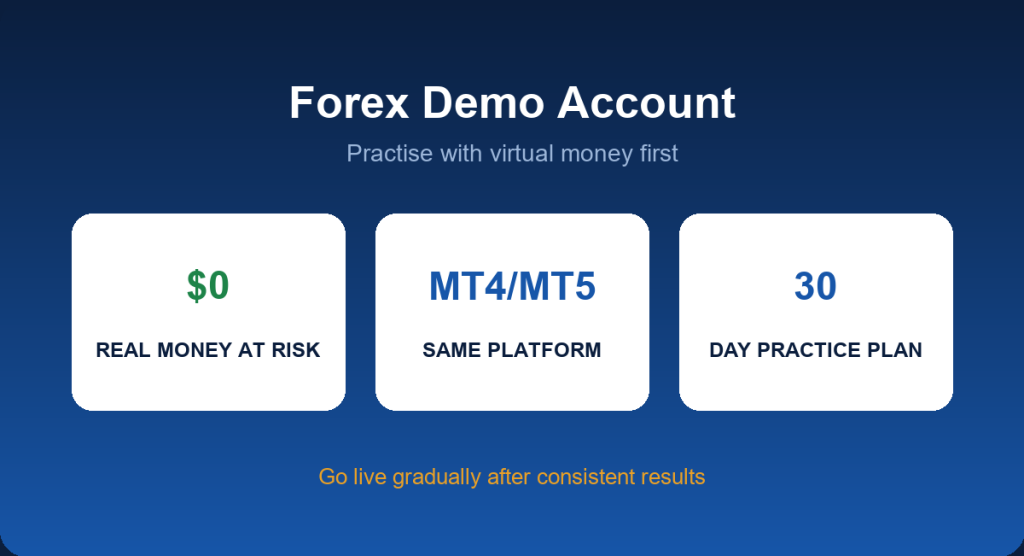
A forex demo account lets you trade with virtual money on real market prices. It is the safest way to learn a trading platform, test a strategy and see how a broker executes orders before you risk a cent. This guide explains how to choose a demo account, how to use it properly and how to know when you are ready to go live.
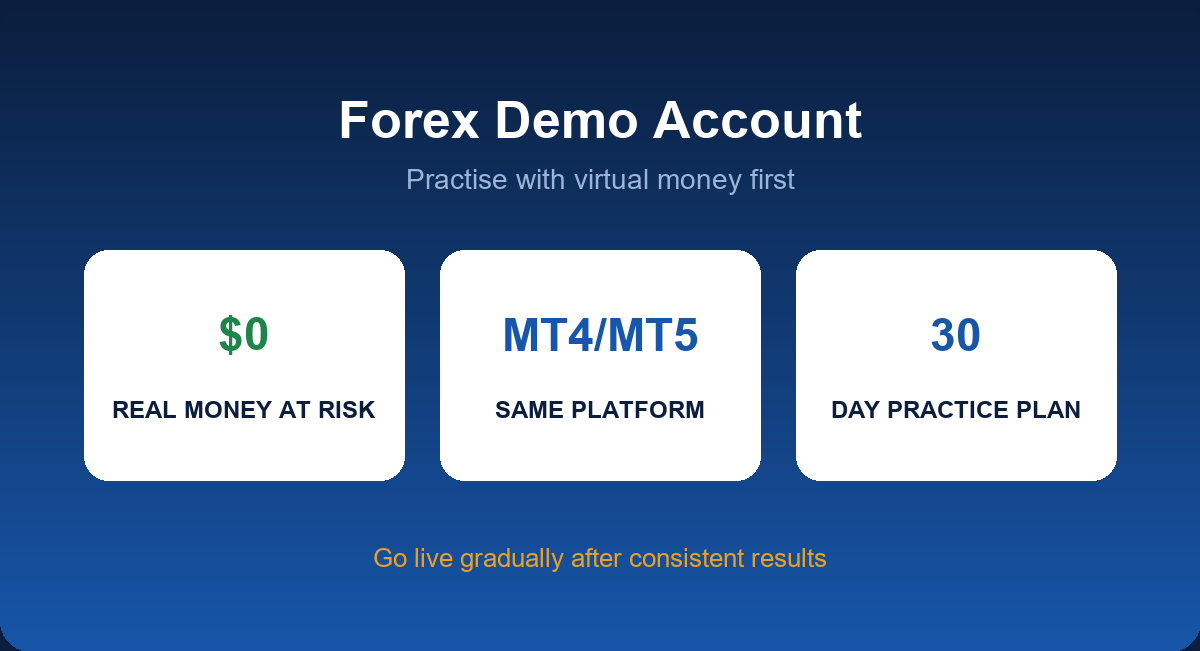
What Is a Forex Demo Account?
A demo account is a practice account funded with virtual money, usually $10,000 or more, that mirrors live market prices. You use the same platform (typically MetaTrader 4 or MetaTrader 5) as on a live account, but no real money is at stake.
What to Look For
- The same platform as the live account. MT4 or MT5, so you learn the tools you will actually use.
- Live-like spreads and conditions. A demo on a different account type than you plan to trade can give misleading cost results.
- A regulated broker. Even for a demo you share personal details; see regulated forex brokers.
- Adjustable virtual balance and leverage. Set them to match your real plan, for example a $100 or $500 starting balance.
- No time pressure. Some demo accounts expire if unused; check the terms.
Demo Accounts From Brokers We Cover
| Broker | Platforms | Guide |
|---|---|---|
| JustMarkets | MT4, MT5 | JustMarkets demo account |
| Headway | MT4, MT5 | Headway demo account |
A 30-Day Practice Plan
- Week 1: learn the platform. Place market, limit and stop orders; set stop loss and take profit; use charts and indicators.
- Week 2: trade one simple strategy. Write down your entry, exit and risk rules before each trade.
- Week 3: apply risk rules. Risk 1–2% per trade, size positions with our lot size calculator and keep a journal.
- Week 4: review the results. Count trades, win rate, average win versus average loss and maximum drawdown.
Demo vs Live: What Changes
- Emotions. Fear and greed appear only when real money is at risk.
- Execution. Live accounts can have slippage and requotes during news that a demo may not show.
- Discipline. It is easy to over-risk with virtual money. Treat the demo balance as if it were real.
When Are You Ready to Go Live?
There is no magic number, but a sensible checklist is: at least 50–100 demo trades with a written plan, results that are consistent rather than lucky, a drawdown you could live with, and a risk rule you follow every time. Then start small, for example with a cent account; see best cent account brokers.
How to Open a Demo Account
- Choose a regulated broker that offers the platform and account type you plan to trade.
- Register on the broker’s website with an email address. Most demo accounts do not require identity verification.
- Select the account type and platform. Choose MT4 or MT5, the leverage and the starting balance that match your real plan.
- Download the platform or use the web terminal, then log in with the server name and number shown in the confirmation email.
- Check the quotes. Compare a few prices with a public chart to confirm the feed is live.
For step-by-step help with specific brokers, see the JustMarkets demo guide and the Headway demo guide.
What to Test Besides Your Strategy
- Order types. Practise market, limit, stop and stop-limit orders, and moving a stop loss to break-even.
- Spread behaviour. Note the spread at quiet times, at the London and New York opens, and around news releases.
- Execution speed. Watch how quickly orders fill and whether the price shown matches the fill.
- Platform tools. Charts, templates, alerts, the economic calendar and one-click trading.
- Mobile app. If you plan to trade on a phone, test the same actions there.
Metrics to Track in Your Demo Journal
| Metric | How to calculate | Why it matters |
|---|---|---|
| Win rate | Winning trades ÷ total trades | Useful only together with risk-reward |
| Average win / average loss | Total profit ÷ wins; total loss ÷ losses | Shows whether winners outweigh losers |
| Expectancy | (Win rate × average win) − (loss rate × average loss) | Positive expectancy is the minimum for a viable strategy |
| Maximum drawdown | Largest peak-to-trough fall in balance | Tells you whether you could emotionally survive the worst run |
| Rule adherence | Trades that followed your plan ÷ all trades | Consistency matters more than any single result |
Example: a 45% win rate with an average win of $30 and an average loss of $15 gives an expectancy of (0.45 × 30) − (0.55 × 15) = $5.25 per trade. A 60% win rate with an average win of $10 and an average loss of $20 gives (0.6 × 10) − (0.4 × 20) = −$2 per trade. Win rate alone tells you almost nothing.
Common Demo Account Mistakes
- Using a huge balance. A $100,000 demo does not teach you how to manage a $200 account. Set the balance to your real starting capital.
- Ignoring risk rules because it is not real money. If you would not risk 10% on a live trade, do not risk it on a demo.
- Switching strategies every few days. Give one strategy enough trades to judge it.
- Trading only the best setups in hindsight. Record every trade according to the written rules.
- Staying on demo forever. At some point you need to feel real risk, at a very small size.
Demo Trading vs Backtesting
Backtesting runs your rules over historical data and is fast, but it can hide slippage, spread changes and your own hesitation. A demo account tests the same rules in real time, which is slower but includes live spreads and the discipline needed to follow a plan. Use backtesting to filter ideas and a demo account to confirm them.
Moving From Demo to a Small Live Account
- Start with a deposit you can afford to lose entirely.
- Use a cent or very small account so each loss is emotionally manageable; see best cent account brokers.
- Keep the same position sizing rules; calculate lots with our lot size calculator.
- Withdraw a small amount early to confirm the broker pays.
- Only increase size after you have kept to your rules over a meaningful number of live trades.
A Day-by-Day 30-Day Demo Schedule
| Days | Focus | Goal |
|---|---|---|
| 1–3 | Platform basics | Open and close trades, set stops, change timeframes, add indicators |
| 4–7 | Reading price | Mark support and resistance, identify trend direction, note spread at different times |
| 8–14 | One strategy, small size | Take every valid setup, record entry, stop, target and reason |
| 15–21 | Risk management | Risk a fixed 1% per trade and calculate lot size before each entry |
| 22–28 | Review and refine | Analyse the journal; remove one weakness (for example early exits) |
| 29–30 | Decide | Go live small, extend the demo or change the plan |
Three Simple Strategies to Practise First
- Trend following: trade in the direction of a moving average slope on a higher timeframe, entering on pullbacks, with a stop beyond the recent swing.
- Range trading: buy near support and sell near resistance when price is moving sideways, and stop trading if the range breaks.
- Breakout trading: enter when price closes beyond a clear level with expanding momentum, and place the stop on the other side of the level.
No strategy is guaranteed. The point of the demo is to learn how a method behaves, how often it loses and how you react when it does. For the risk side, read forex risk management strategy.
Frequently Missed Demo Details
- Check whether the demo account has the same spreads and commission as the live account type you plan to use.
- Note that some brokers apply different execution on demo, which can make fills look better than they will be live.
- Try trading during a major news release to see how spreads widen, but do not rely on the demo’s fills as proof of live results.
Signs You Are Learning, Not Just Clicking
A productive demo period leaves evidence. You should be able to explain each trade in one sentence, show the stop and target you planned before entering, and point to at least three mistakes you have already fixed. If your journal consists only of profit and loss numbers, you are probably gambling with play money. Review your notes every week and pick a single improvement to focus on, such as waiting for the candle to close before entering, or never moving a stop further from price. Small, specific changes build habits that carry over to live trading, where emotions will test them. When your behaviour is consistent for several weeks, you are ready for the next step: a small live account with the same rules.
Key Takeaways
- A demo account mirrors live prices with virtual money, so it carries no financial risk.
- Use the same platform and account type you plan to trade live.
- Follow a written plan and risk rules, and review your results after 30 days.
- Demo results do not include real emotions or slippage, so go live gradually.
FAQ
Is a forex demo account free?
Yes. Demo accounts are free to open at regulated brokers.
Do demo accounts expire?
Some do if unused for a period. Check your broker’s terms.
Can I make real money on a demo account?
No. Demo funds are virtual and cannot be withdrawn.
Which demo is best for beginners?
The one on a regulated broker that uses MT4 or MT5 with conditions similar to your planned live account.
Open a JustMarkets Account & Activate Rebate →
Risk Disclaimer: Trading forex and CFDs carries a high level of risk and may not be suitable for all investors. You can lose all the money you deposit. JFRebate earns a referral commission from brokers it reviews; this never changes the spreads you pay. This article is for information only and is not financial advice.

Om Erick, CTA, is a Certified Technical Analyst and a forex trading veteran active since 2010, recognized as one of the Top 35 Best Traders in the World (MQL5, 2024). As the author of “Belajar Trading dari 0” and “Psikologi Trading,” as well as an active Psychological Trading Coach, Om Erick is dedicated to providing objective, data-backed trading guidance. Through JFRebate, he helps traders achieve peak performance by providing access to trusted brokers and a transparent, industry-leading rebate system.