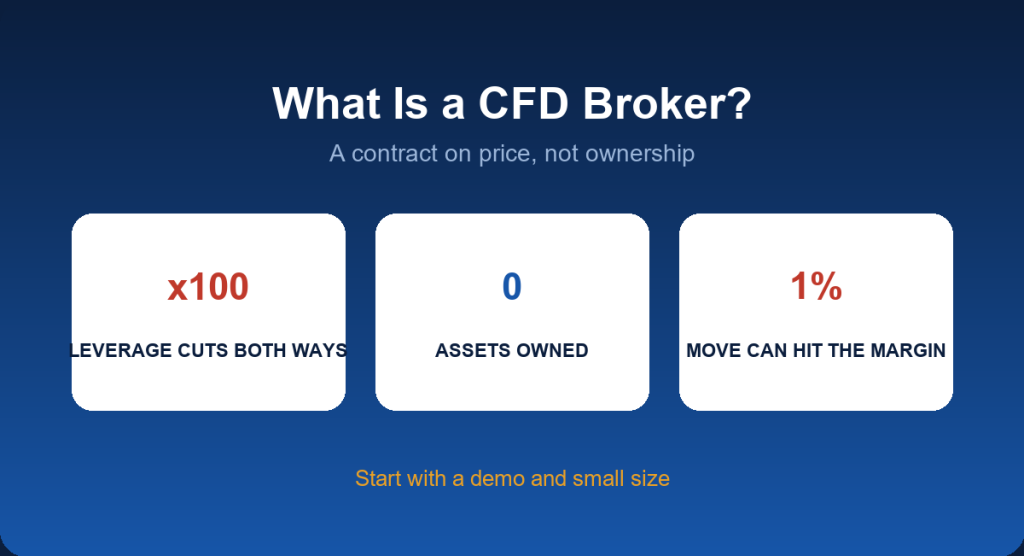
Most online forex brokers are really CFD brokers. A CFD, or contract for difference, lets you speculate on the price of an asset without owning it. The same product covers currencies, gold, stock indices, shares and crypto. This guide explains how CFDs work, what they cost, why regulators warn about them and how to evaluate a CFD broker sensibly.
What Is a CFD?
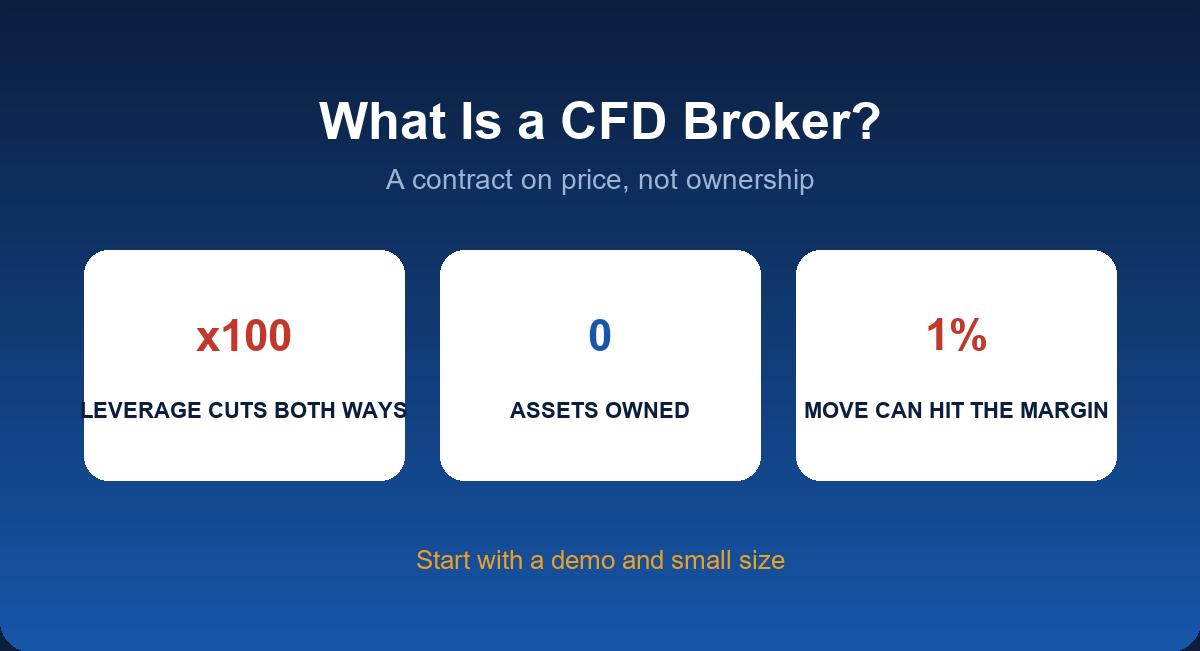
A CFD is an agreement between you and a broker to exchange the difference in an asset’s price between the time you open and close the position. If you buy and the price rises, the broker pays you the difference. If it falls, you pay the broker. You never own the underlying currency, gold or share. Because the position is leveraged, a small deposit controls a much larger exposure, which magnifies both gains and losses.
A Simple Example
Suppose gold trades at $2,400 and you buy 1 CFD unit with 1:100 leverage. The position is worth $2,400 but needs about $24 of margin. If gold rises to $2,420, you make $20 before costs, close to the whole margin. If it falls to $2,380, you lose the same $20. A $24 margin position can therefore wipe out most of your deposit on a 1% move. The numbers are illustrative; actual contract sizes and margin rules differ by broker and instrument.
Why CFDs and Forex Overlap
Retail spot forex is offered as a CFD-style contract at most brokers. The mechanics are similar: leverage, margin, spread and swap. The word CFD usually signals a wider product range, including indices, metals, energies, shares and crypto, on the same MetaTrader account.
What CFDs Cost
| Cost | What it is |
|---|---|
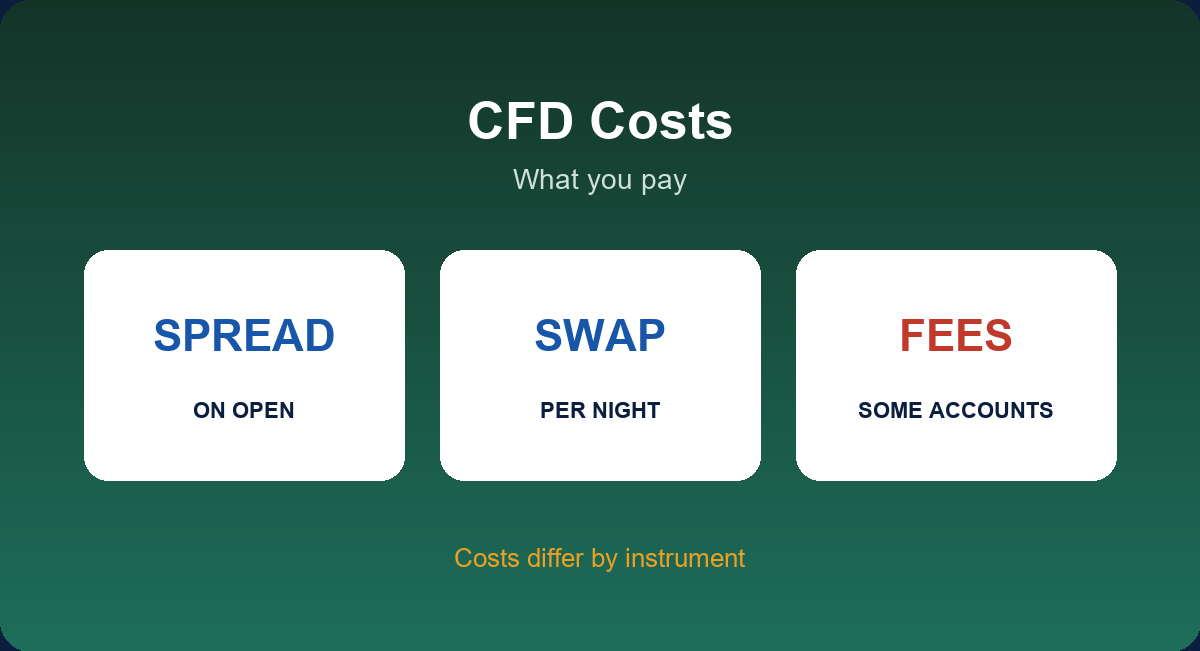
| Spread | The difference between the buy and sell price; paid when you open |
| Commission | A per-lot or percentage fee on some accounts and instruments |
| Overnight financing (swap) | Interest applied when you hold positions past the daily cut-off |
| Currency conversion | Applies if the instrument is priced in a currency other than your account’s |
| Other fees | Possible inactivity or withdrawal fees; read the terms |
Costs differ by instrument. Indices and shares may carry commission or wider spreads than major forex pairs, so compare the cost per trade on the exact market you plan to trade. See what a spread is and how to reduce it.
The Risk Warning You Should Take Seriously
Regulators in several regions require CFD brokers to publish the percentage of retail clients who lose money, and the figures are commonly well above half of accounts. Leverage, volatility and emotion are a hard combination. That is why you should start on a demo, use small positions, always set a stop loss and only trade money you can afford to lose. For a practical plan, read forex risk management strategy and position sizing in forex.
How to Choose a CFD Broker
- Regulation. Check the licence and which entity serves you; see regulated forex brokers.
- Instruments. Does the broker offer the markets you want, and with what contract specifications?
- Costs. Compare spread, commission and swap for the specific instruments.
- Platform. MT4 or MT5, with a mobile app and a demo; see MT4 vs MT5.
- Account types and minimum deposit. Cent accounts can be a safer way to start.
- Funding and withdrawals. Test with a small withdrawal early.
- Client protections. Look for segregated funds and negative balance protection.
Limits and Typical Gaps
Some brokers have a wide product range; others, such as JustMarkets, focus on forex, metals, indices, energies and crypto CFDs and offer a limited stock selection compared with large multi-asset brokers. Check that the broker covers your markets before you open an account, and read the JustMarkets review or the Headway review for the instruments they offer.
CFDs and Cashback
A rebate returns part of the cost per lot on eligible instruments, which makes CFD trading cheaper on volume. It does not change the leverage risk. For how it works, see what a forex introducing broker is and how rebates are paid.
A Beginner’s Safety Checklist
- I understand that I can lose more than I expect on a fast move.
- I have practised on a demo account.
- I will set a stop loss on every position.
- I will risk a small percentage of my balance per trade.
- I have checked the broker’s regulation and withdrawal process.
CFDs Compared With Other Ways to Trade
| CFD | Buying the asset | Futures | |
|---|---|---|---|
| Ownership | None; a contract on price | You own the asset | A contract with an expiry date |
| Leverage | Built in | Usually none | Built in |
| Going short | Easy | Often complex | Easy |
| Holding costs | Overnight financing | None, apart from custody | Margin and roll costs |
| Typical access | Retail brokers, MetaTrader | Exchanges and brokers | Futures brokers |
A Worked Overnight Financing Example
If you hold a long CFD on an index worth $20,000 overnight, the broker may charge financing equal to a benchmark interest rate plus a markup, spread over 365 days. At a combined annual rate of 7%, the daily charge is roughly $20,000 × 0.07 ÷ 365, about $3.84 a night. Hold it for 30 nights and the cost is around $115, which is a meaningful cost for a position that does not move. For forex, the equivalent is swap, which can be positive or negative. Compare it using the contract specification, and see swap-free accounts if overnight interest is an issue for you.
Margin and Leverage on Different Markets
Brokers set different maximum leverage by instrument. Forex majors usually allow the highest ratios, while shares and crypto CFDs often have lower limits because their prices are more volatile. Check the specification for each instrument, not just the headline on the broker’s homepage. For a deeper look at how leverage amplifies results, read high leverage forex brokers.
A Short CFD Glossary
- Margin: the deposit held while a position is open.
- Stop-out: the level at which the broker closes positions automatically to protect the account.
- Contract size: how many units one lot controls.
- Swap or financing: the overnight cost or credit.
- Slippage: the difference between the requested and filled price.
A Safer Way to Start
Open a demo, choose one market, and place trades small enough that a stop-out costs about 1% of your balance. Track every cost. Only after a few weeks of consistent behaviour consider a small live account, and think about whether a micro or cent account would let you learn at lower risk.
More Questions Answered
Are CFD brokers regulated?
Reputable ones are, but the regulator and level of protection vary widely. Check the licence of the entity that serves your country.
What is the difference between a CFD broker and a forex broker?
Many are the same company. A forex broker usually offers currency CFDs and often other CFD markets too.
Can I trade CFDs with a small amount?
Yes, with a cent or low-minimum account, but risk per trade must be small. Costs weigh more on small balances.
Do CFDs pay dividends?
On share CFDs, long positions may receive a dividend adjustment and short positions pay one, depending on the broker.
Why do regulators warn about CFDs?
Because leverage and volatility cause many retail accounts to lose money, and the products are complex.
Who CFDs Suit and Who They Do Not
CFDs suit traders who understand leverage, manage risk strictly and want access to several markets from one account. They suit less well anyone who is tempted by high leverage, who cannot accept quick losses or who wants a long-term investment in the underlying asset. If your goal is to build wealth slowly, buying the asset directly or using a diversified fund may fit better than leveraged contracts.
What to Read Before You Open an Account
- The risk disclosure and the percentage of clients who lose money.
- The client agreement, including which entity holds the account.
- The execution policy and the conflict-of-interest policy.
- The fee schedule, including swap and inactivity.
Related Guides
This guide is part of our Choosing a Broker series. For the full overview, start with Best Forex Brokers, then continue with:
- regulated forex brokers
- high leverage forex brokers
- spreads explained
- swap-free accounts
- forex demo accounts
Related: Forex Swap Explained | Forex Margin Explained
Key Takeaways
- A CFD is a leveraged contract on price movement; you never own the underlying asset.
- Costs include spread, commission, swap and possible conversion fees.
- Many retail CFD accounts lose money, so start with a demo and small size.
- Choose a CFD broker on regulation, costs, instruments and withdrawal reliability.
FAQ
Is CFD trading the same as forex trading?
Retail forex is usually traded as a CFD-style contract. CFDs also cover other markets such as indices and shares.
Do I own the asset with a CFD?
No. You hold a contract on the price difference.
Can I lose more than I deposit?
Many brokers offer negative balance protection, but you can lose your entire balance quickly. Check your terms.
Are CFDs available everywhere?
No. Some countries restrict or ban them for retail clients.
Open a JustMarkets Account & Activate Rebate →
Risk Disclaimer: Trading forex and CFDs carries a high level of risk and may not be suitable for all investors. You can lose all the money you deposit. JFRebate earns a referral commission from brokers it reviews; this never changes the spreads you pay. This article is for information only and is not financial advice.

Om Erick, CTA, is a Certified Technical Analyst and a forex trading veteran active since 2010, recognized as one of the Top 35 Best Traders in the World (MQL5, 2024). As the author of “Belajar Trading dari 0” and “Psikologi Trading,” as well as an active Psychological Trading Coach, Om Erick is dedicated to providing objective, data-backed trading guidance. Through JFRebate, he helps traders achieve peak performance by providing access to trusted brokers and a transparent, industry-leading rebate system.