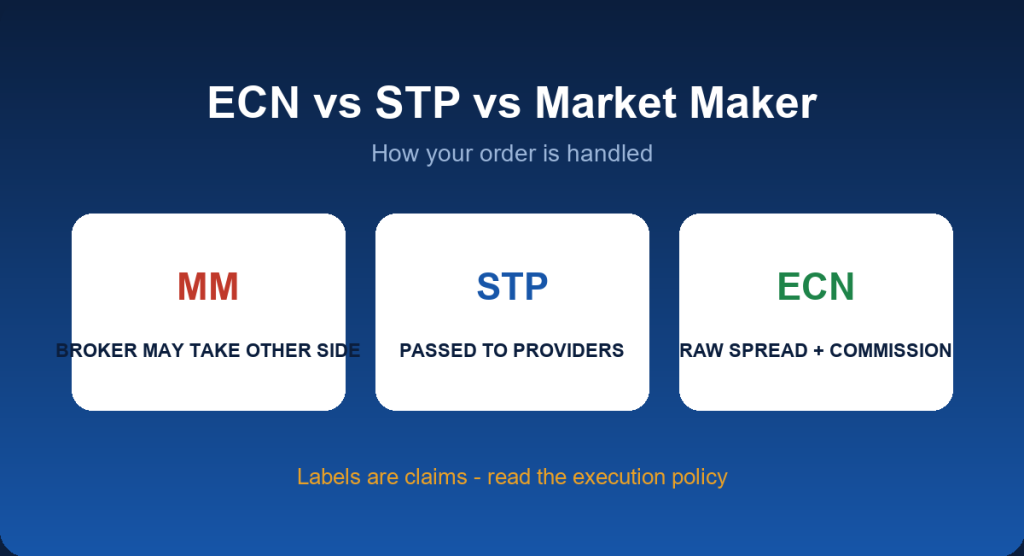
Search for a forex broker long enough and you will hit three labels: ECN, STP and market maker. Brokers use them as selling points, often loosely. The labels describe how your order is handled after you click buy or sell, and that affects spreads, slippage and possible conflicts of interest. This guide explains each model in plain terms, what it means for your costs, and how to check what a broker is actually doing instead of trusting a banner.
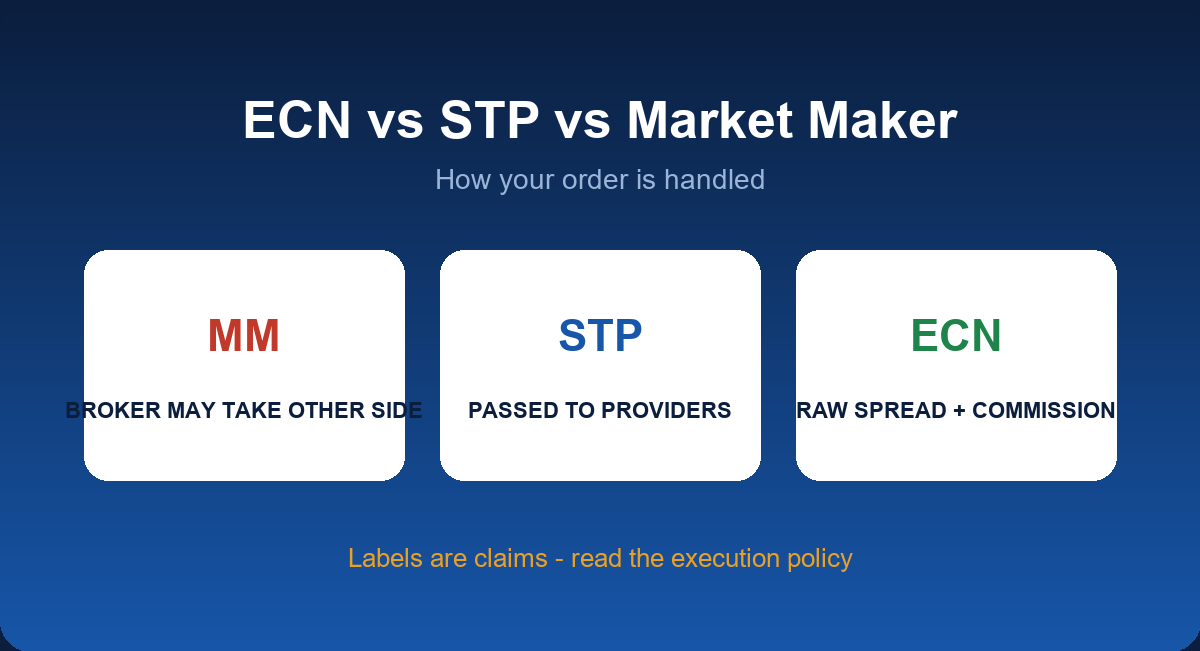
The Short Version
| Model | Who takes the other side of your trade? | Typical pricing |
|---|---|---|
| Market maker (dealing desk) | The broker itself, at least for part of the flow | Fixed or variable spread, usually no commission |
| STP (straight-through processing) | Liquidity providers, with orders passed on automatically | Variable spread, often with a small markup |
| ECN (electronic communication network) | Other participants and liquidity providers in a pooled order book | Raw spread plus commission |
In real life the boundaries are blurry. Many brokers run a hybrid: some orders are passed to liquidity providers, others are internalised. A broker can be called “ECN” in marketing and still route a large share of its flow in-house. The label is a claim, not a certificate.
How a Market Maker Works
A market maker quotes both a bid and an ask and is willing to take the opposite side of your trade. It earns the spread and, if it keeps the position, any profit if you lose. That sounds alarming, but it is how many retail venues have worked for decades, and regulated market makers must handle conflicts of interest and execute fairly. The advantages for you are simple pricing, no commission and generally small minimum trade sizes. The disadvantages are the potential conflict of interest and the possibility of requotes or wider spreads during fast markets if the broker manages its own risk.
How STP Works
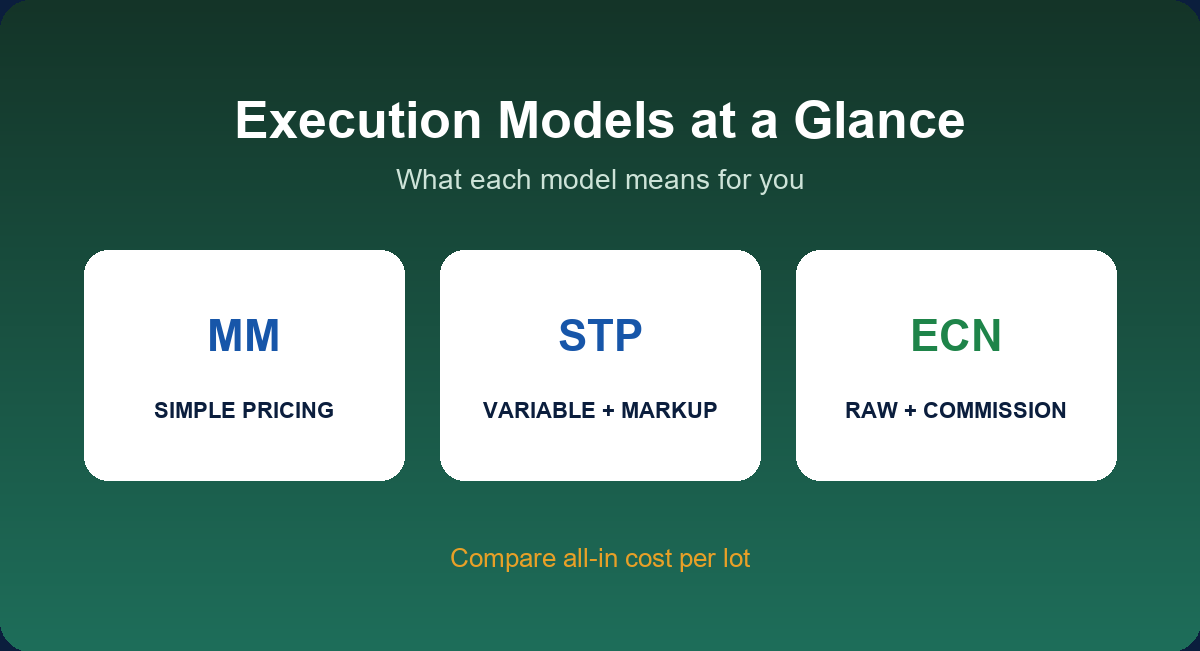
With straight-through processing, the broker does not keep your order. It passes it on, usually to one or more liquidity providers such as banks, and often adds a markup to the spread. Because the broker is paid by the markup rather than your loss, its incentives line up better with yours: it earns when you trade, not when you lose. Prices come from several providers, so spreads vary through the day. STP accounts are common on standard-type accounts at many brokers.
How ECN Works
In an ECN setup, orders from many participants meet in a single pool, and you may trade against other clients or institutions. The broker charges a commission per lot and passes on the raw spread, which can be very tight, sometimes 0.0 pips on major pairs. You can see market depth, and execution speed is a focus. The trade-off is that the commission is a real cost and total costs only fall below a standard account if you trade often enough. On quiet or illiquid pairs, the raw spread can also widen sharply.
What This Means for Your Costs
Suppose a standard account shows a 1.0-pip spread with no commission, and an ECN-style account shows 0.1 pips plus a $7 round-turn commission. On a standard lot of EUR/USD, a pip is worth about $10. The standard account costs about $10 per lot. The ECN-style account costs $1 in spread plus $7 in commission, so about $8. For a trader who places 40 lots a month, that is a $80 difference. For someone trading 2 lots a month, it is $4, and the simpler account may be the better choice. Treat the figures as an example and check the real numbers on a demo account.
A rebate shifts the maths again. Cashback of up to 33% of the spread on a standard-type account, or a per-lot rebate on others, lowers the effective cost; see how IB rebates work and zero spread accounts for the comparison.
Which Model Suits Which Trader?
- Beginner with a small balance: a standard or cent account. Simple pricing matters more than saving a fraction of a pip. See best cent account brokers.
- Scalper or high-volume trader: a raw-spread account with commission usually costs less per lot at volume. See our scalping guide.
- Swing trader: spread matters less than swap and reliability; a standard account is fine.
- EA user: check execution speed, rules on automated trading and server stability.
How to Check What a Broker Actually Does
- Read the execution policy. Regulated brokers publish one. Look for how orders are routed and whether the broker may take the other side.
- Look at the account specifications. A genuine raw-spread account lists a commission. If a so-called ECN account shows a wide spread and no commission, treat the label sceptically.
- Test on a demo and a small live account. Watch spreads at different times and note slippage on stop orders.
- Check the regulator. A strict regulator imposes best-execution rules. See regulated forex brokers.
- Ask support directly. “Do you internalise any client orders on this account type?” is a fair question, and the answer, or the avoidance of one, tells you something.
Common Misconceptions
- “Market makers always trade against you.” Many hedge their exposure with liquidity providers rather than betting against clients.
- “ECN means no conflict of interest.” The broker still earns a commission and may run its own risk.
- “No commission means no fee.” The fee is in the spread.
- “Tighter is always better.” A 0.0 spread with a large commission can cost more than a 0.8 spread without one.
Our Practical Take
For most readers the execution model matters less than three simpler questions: Is the broker regulated for your country? What is the all-in cost per lot on the account you will use? Can you withdraw without problems? Start there, then look at the execution label. JustMarkets, for example, offers both standard-type accounts and a Raw Spread account with a per-lot commission; compare them with the figures in our Raw Spread account guide.
Slippage, Requotes and “Last Look”
Three execution terms show up in broker comparisons and are worth knowing. Slippage is the gap between the price you requested and the price at which the order filled; it can be negative or, occasionally, positive. A requote is when the broker rejects your price and offers a new one, which was more common on dealing-desk setups with fixed spreads. “Last look” is a practice in which a liquidity provider can reject a trade at the last moment; brokers should disclose whether they use it. None of these tell you a model is good or bad on its own, but together they explain why two accounts with identical spreads can feel very different in a fast market.
How Order Types Behave Under Each Model
| Order | Typical behaviour |
|---|---|
| Market order | Fills at the best available price; slippage is possible in fast markets on any model |
| Limit order | Fills at your price or better, but may not fill at all |
| Stop loss | Becomes a market order when triggered, so it can fill beyond your level during gaps |
| Guaranteed stop | Offered only by some brokers and usually for a fee; not standard on MetaTrader accounts |
Questions to Put to Support
- Do you pass all client orders to external liquidity providers on this account, or do you internalise some?
- Do you use last look on any liquidity source?
- What is the typical average spread on EUR/USD on this account during the London session?
- What is the minimum stop level, and does it change around news?
- Are there any restrictions on scalping or automated trading?
Save the answers. A broker that responds clearly and consistently across several chats is showing you something about how it runs the business.
Related Guides
This guide is part of our Choosing a Broker series. For the full overview, start with Best Forex Brokers, then continue with:
- zero spread accounts
- regulated forex brokers
- what a spread is
- forex scalping
- the JustMarkets Raw Spread account
Key Takeaways
- Market maker, STP and ECN describe how orders are handled, and labels are often used loosely.
- ECN-style accounts pair raw spreads with a commission; standard accounts build the cost into the spread.
- Compare the all-in cost per lot for your monthly volume, not the headline spread.
- Read the execution policy, test on a demo and verify the regulator.
FAQ
Is ECN better than STP?
Not automatically. ECN-style accounts can be cheaper at higher volume, but the commission and the broker’s real routing matter more than the label.
Do ECN brokers have requotes?
Generally less, but fast markets can still produce slippage on any model.
Can a market maker be trusted?
A regulated market maker follows conflict-of-interest and best-execution rules. Regulation and track record matter more than the model.
Does the model affect cashback?
Rebate programmes pay on volume and account type, so check the rate for the exact account you use.
Open a JustMarkets Account & Activate Rebate →
Risk Disclaimer: Trading forex and CFDs carries a high level of risk and may not be suitable for all investors. You can lose all the money you deposit. JFRebate earns a referral commission from brokers it reviews; this never changes the spreads you pay. This article is for information only and is not financial advice.

Om Erick, CTA, is a Certified Technical Analyst and a forex trading veteran active since 2010, recognized as one of the Top 35 Best Traders in the World (MQL5, 2024). As the author of “Belajar Trading dari 0” and “Psikologi Trading,” as well as an active Psychological Trading Coach, Om Erick is dedicated to providing objective, data-backed trading guidance. Through JFRebate, he helps traders achieve peak performance by providing access to trusted brokers and a transparent, industry-leading rebate system.