“Zero spread” is one of the most clicked phrases in forex marketing, and one of the most misunderstood. A zero-spread account usually does not mean trading is free. It means the broker shows you the raw market spread, which can be 0.0 pips at certain moments, and charges a separate commission instead. This guide explains how that works, how to calculate whether it saves you money and what to check before opening one.
What “Zero Spread” Really Means
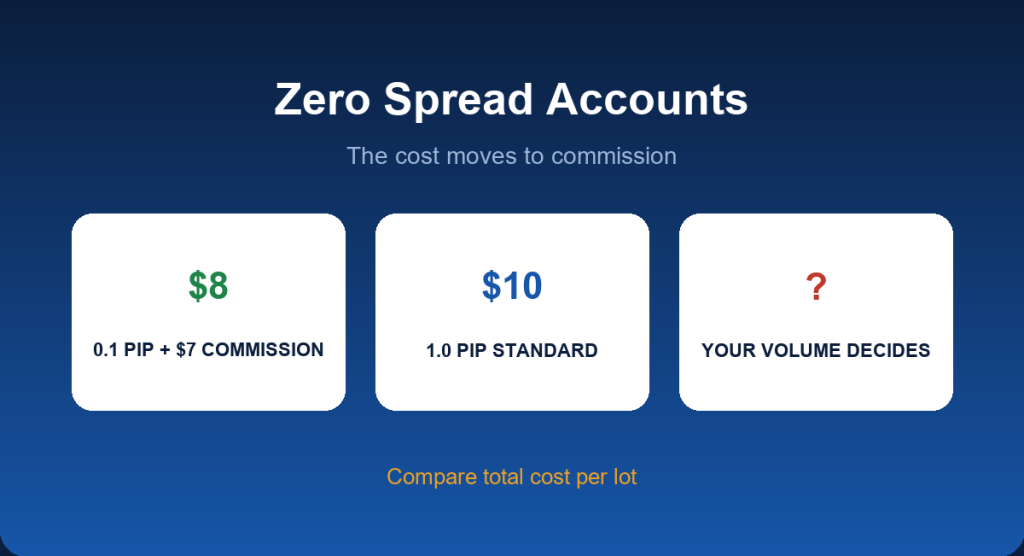
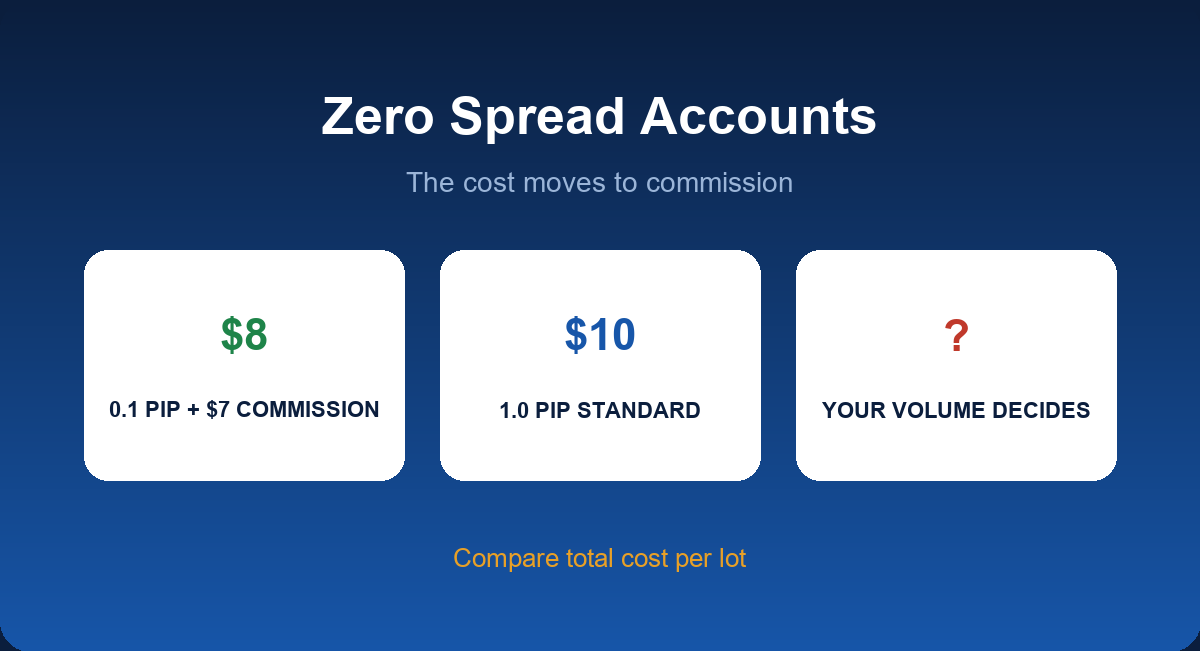
On a standard account the broker builds its fee into the spread, so you might see 1.0 pip with no commission. On a raw-spread account you see the underlying spread, often between 0.0 and 0.3 pips on major pairs, and pay a fixed commission for each lot you trade, typically quoted per side or per round turn. The cost moved from the spread to the commission line; it did not disappear. Also, 0.0 is the best case and is not available at every moment.
How to Compare Total Cost
Convert commission into pips so both accounts use the same unit. On EUR/USD a pip on a standard lot is worth about $10.
| Standard | Raw spread | |
|---|---|---|
| Spread | 1.0 pip ($10) | 0.1 pip ($1) |
| Commission per lot (round turn) | $0 | $7 (0.7 pip) |
| Total cost | $10 | $8 |
The numbers are an example. The raw account saves $2 per lot here, so a trader placing 50 lots a month saves $100. If the commission were $9, the saving disappears. Always use the commission and spread published for the exact account you plan to open, and check them at the hours you trade.
Who Benefits From a Raw-Spread Account
- Scalpers and high-frequency traders, whose small targets are sensitive to fractions of a pip. See our scalping guide.
- EA users who place many trades.
- Traders with larger position sizes, where the saved spread is a larger dollar amount.
Who Is Usually Better Off on a Standard Account
- Beginners who want simple pricing and tiny trades.
- Swing and position traders who place a few trades a month; a few pips of spread matters less.
- Anyone whose trading volume is too low for the commission saving to appear.
The Fine Print to Check
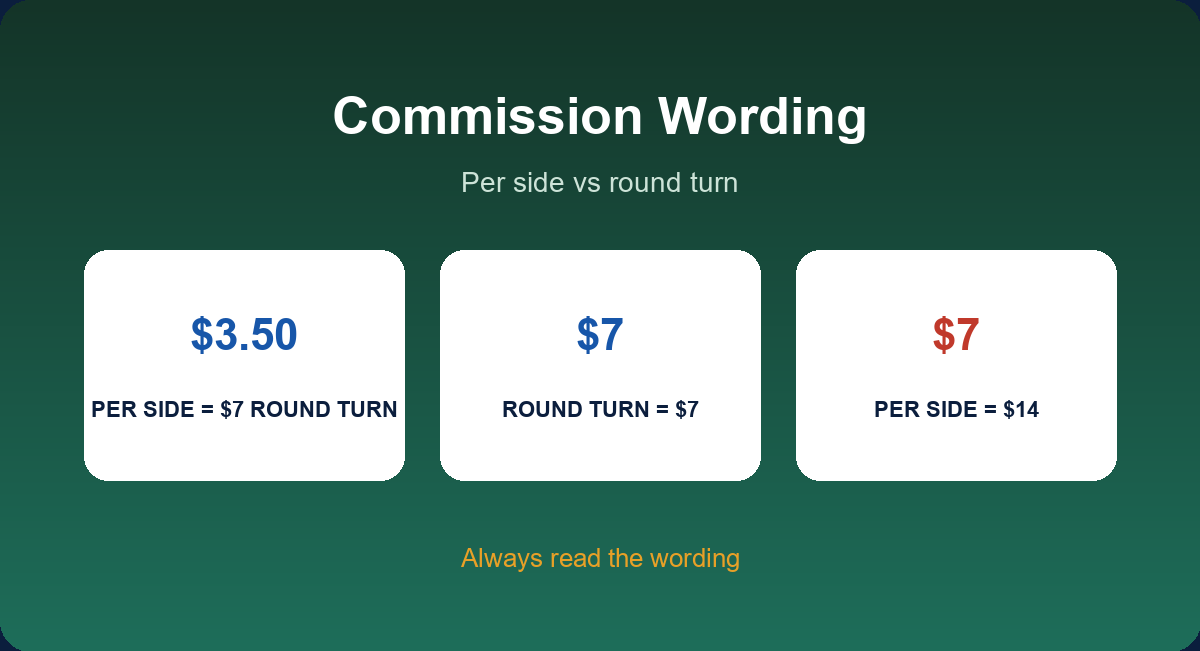
- Is the commission per side or round turn? A “$3.50 per side” account costs $7 per lot round turn.
- Which instruments does the commission apply to? It can vary for metals, indices and crypto.
- What is the average spread, not the minimum? Ask for or measure typical values on a demo.
- Is there a higher minimum deposit? Raw accounts often require more than standard ones.
- Are there trade restrictions? Check rules on scalping, hedging and EAs.
Where Rebate Fits In
Cashback changes the comparison. If a rebate returns part of the cost on every lot, a standard account with a high rebate share can cost about as much as a raw account without one. For a trader with 50 lots a month, test both: compute the total after commission and rebate. The calculation method is in how to calculate your rebate.
Examples Among Brokers We Cover
- JustMarkets Raw Spread: spreads from 0.0 pips with a commission per lot. Read the Raw Spread account guide, and compare with JustMarkets spreads.
- Headway Pro: tighter spreads than the other Headway accounts, with commission reported by third parties; confirm the current figures on Headway’s own site. See Headway spreads and commission.
How to Test It Yourself
- Open a demo on each account type.
- Record the spread on EUR/USD at the London open, the New York open and during a news event on several days.
- Add the commission for your usual lot size.
- Multiply by your real monthly lots to get a monthly cost.
- Subtract any rebate you would receive.
Warning Signs
- “Zero spread, zero commission” claims with no explanation of how the broker earns.
- Spreads that look zero only on a chart screenshot.
- Withdrawal or inactivity fees buried in the terms.
Commission Per Side vs Round Turn
| Quoted | Meaning | Cost for 1 lot opened and closed |
|---|---|---|
| $3.50 per side | Charged on open and on close | $7 |
| $7 per round turn | Charged once for the full trade | $7 |
| $7 per side | Charged on open and on close | $14 |
The same number can mean very different costs depending on how it is quoted, so always find the wording in the account specification and, if unclear, ask support.
Break-Even Volume: When Does a Raw Account Win?
If the raw account saves you a fixed amount per lot (standard cost minus raw cost), it wins from the first lot. If instead the raw account needs a higher deposit or has other fixed costs, divide the fixed cost by the per-lot saving to find the break-even volume. For example, if a raw account saves $2 per lot but you give up a $20 monthly rebate that only the standard account offers, you need 10 lots a month before the raw account comes out ahead. The same logic applies to every account comparison: find the per-lot difference and the fixed differences, then compare with your real volume.
Three Traders, Three Answers
- Anna trades 5 lots a month. A $2 per lot saving is $10. The simpler standard account may be worth more than the $10.
- Ben trades 60 lots a month. The same saving is $120, which pays for a lot of coffee and justifies the raw account.
- Chloe runs an EA with 300 lots a month. The saving is $600, and she should negotiate or compare every cost, including the rebate.
How Spreads Vary by Session
Raw spreads are typically tightest during the London and New York sessions and widest around rollover and major news. A 0.0-pip screenshot at 14:00 does not describe 22:00. Test the hours you trade and record the average; our guide on what a spread is in forex explains why the figure moves.
Do Not Forget Slippage and Swap
Raw-spread accounts do not change slippage or swap. A scalper who loses a pip to slippage on every trade is not helped by saving half a pip on the spread. Add all four costs together: spread, commission, slippage and swap.
More Questions Answered
Why do brokers offer zero spread accounts?
They attract active traders who care about tight pricing, and the broker earns through the commission instead.
Is 0.0 spread available all day?
No. It tends to appear in liquid conditions, and spreads widen around news and rollover.
Which pairs have zero spread?
Usually major pairs at busy times. Exotic pairs and metals typically have higher spreads.
Does the commission change with lot size?
Normally it scales per lot, so a 0.10 lot pays a tenth of the 1.00 lot commission.
Can I get cashback on a zero spread account?
Often yes, but the rate may differ from standard accounts. Confirm before opening.
Checklist Before You Open a Raw-Spread Account
- I know how the commission is quoted (per side or per round turn) and for which instruments.
- I have measured the average spread on a demo at my trading hours.
- I have compared total cost per lot with a standard account at my monthly volume.
- I know the minimum deposit and whether the cashback rate differs.
- I have confirmed that my strategy is allowed on this account type.
Why Some Traders Return to Standard Accounts
After a few months, many traders realise their monthly volume is lower than they expected, or that simple pricing makes it easier to calculate risk per trade. Others find that slippage on a raw account during volatile moments cancels the spread saving. There is no shame in switching back: the best account is the one that gives you the lowest all-in cost for the trading you actually do, not the trading you imagined.
Related Guides
This guide is part of our Trading Costs series. For the full overview, start with Brokers With Rebates, then continue with:
- what a spread is
- ECN, STP and market maker brokers
- lowest spread forex brokers
- how IB rebates work
- calculating your rebate
Key Takeaways
- Zero spread means the spread is shown raw and a commission is charged separately.
- Convert commission into pips to compare total cost with a standard account.
- Raw accounts help high-volume traders; low-volume traders may pay more.
- Include rebate and typical spread, not just the minimum, in your comparison.
FAQ
Is a zero spread account really free?
No. The broker is paid by commission, and spreads are only zero some of the time.
Is a raw-spread account better for beginners?
Usually not. Simple pricing and small positions matter more at the start.
Does cashback apply to raw accounts?
It can, but the rate may differ from standard accounts. Check before you register.
Are zero spread accounts ECN?
They are often marketed as ECN-style. See ECN, STP and market maker brokers.
Open a JustMarkets Account & Activate Rebate →
Risk Disclaimer: Trading forex and CFDs carries a high level of risk and may not be suitable for all investors. You can lose all the money you deposit. JFRebate earns a referral commission from brokers it reviews; this never changes the spreads you pay. This article is for information only and is not financial advice.

Om Erick, CTA, is a Certified Technical Analyst and a forex trading veteran active since 2010, recognized as one of the Top 35 Best Traders in the World (MQL5, 2024). As the author of “Belajar Trading dari 0” and “Psikologi Trading,” as well as an active Psychological Trading Coach, Om Erick is dedicated to providing objective, data-backed trading guidance. Through JFRebate, he helps traders achieve peak performance by providing access to trusted brokers and a transparent, industry-leading rebate system.