Most trading psychology advice tells you to “stay disciplined”, which is like telling someone with a headache to “stop hurting”. This guide takes a more practical view. It names the specific biases that damage trading decisions, explains why they appear, and gives you rules you can write down and follow before your emotions have a chance to vote.
Why Emotions Behave Differently With Money on the Line
Behavioural economics has documented that people feel losses more strongly than equal gains, a pattern called loss aversion, described by Daniel Kahneman and Amos Tversky. In trading it shows up as holding losers too long and closing winners too early. It is not a character flaw; it is a default setting, and the best answer is a rule that overrides it.
Five Patterns That Cost Traders Money
| Pattern | What it looks like | A rule that counters it |
|---|---|---|
| Loss aversion | Moving the stop further away, closing winners early | Stops never move away; targets are set before entry |
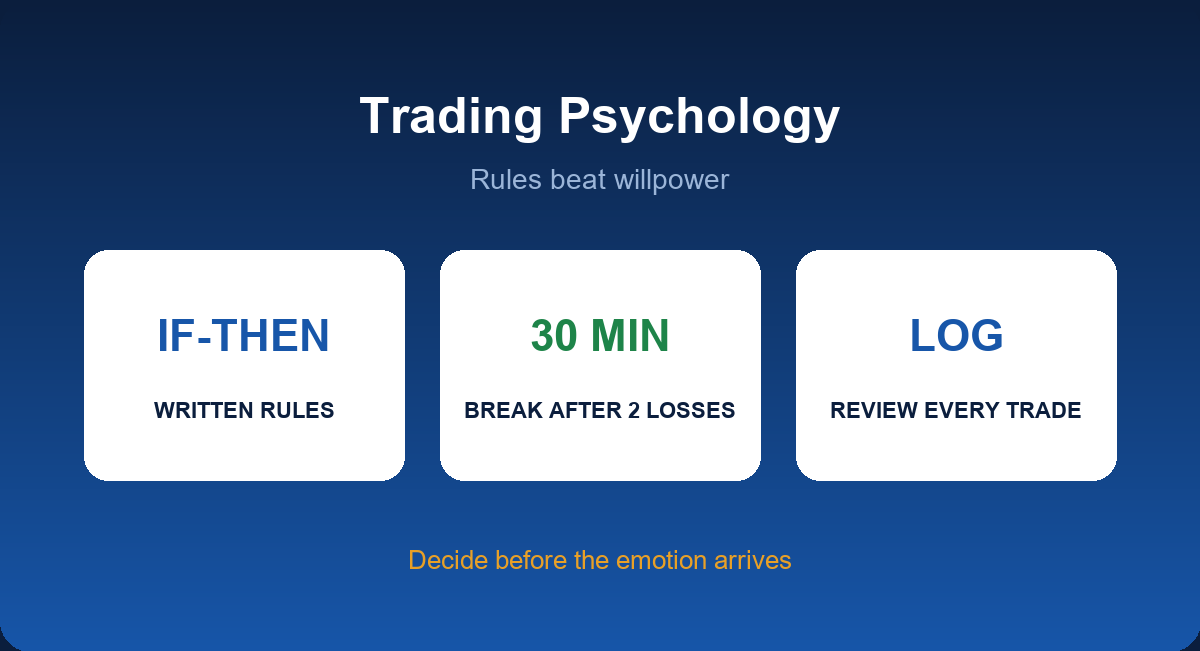
| Revenge trading | A quick, larger trade after a loss | Mandatory 30-minute break after two losses |
| FOMO | Chasing a move that has already happened | No entries outside the written set-up |
| Overconfidence | Increasing size after a winning streak | Size changes only on a scheduled review |
| Recency bias | Treating the last three trades as the strategy’s true performance | Judge results over at least 50 trades |
If-Then Rules Beat Willpower
Decide your response in advance, in the form “if X happens, I do Y”. Examples:
- If I lose two trades in a row, then I close the platform for 30 minutes.
- If I reach my daily loss limit, then I stop and write down why.
- If I want to move a stop further away, then I close the trade instead.
- If I miss an entry, then I wait for the next set-up and do not chase.
Written rules work because they replace a decision under pressure with a decision you made while calm. The limits in our risk management framework give you the numbers to plug in.
A Pre-Trade Checklist
- Does this match one of my written set-ups?
- Do I know my stop, target and size in dollars?
- Is there news in the next hour?
- Am I trading to recover a loss or because I am bored?
- How do I feel on a scale from 1 (calm) to 5 (tense)? If 4 or 5, skip the trade.
A Tilt Protocol
“Tilt” is the state where frustration drives decisions. Signs include trading faster, increasing size and ignoring your rules. When you notice two of these: stop trading, close the charts, do something physical for 20 minutes, and decide at the next session whether to trade again that day. If you are already past your daily limit, the decision is made for you.
Post-Trade Review Template
| Question | Example answer |
|---|---|
| Did I follow my plan? | Yes / No, and where I deviated |
| Was the stop where my rule said? | Yes |
| Result in R | −1R |
| Emotion before and after | Anxious before, frustrated after |
| One thing to repeat or fix | Wait for the candle close |
After 30 trades, count how many deviations happened and what each cost you in R. Most traders discover that a few repeated deviations explain most of their losses. For a list of the usual suspects, see common forex mistakes.
Habits Outside the Chart
- Trade when you are rested; poor sleep makes impulsive decisions more likely.
- Do not trade money you need for rent or bills.
- Limit time in front of charts; more screen time rarely means better trades.
- Keep results private from social feeds that reward drama over process.
When to Stop Trading for a While
If you break your rules repeatedly for two weeks, go back to a demo or a very small account until you can follow them. A pause costs a few missed trades; continuing on tilt can cost the account.
Dealing With a Drawdown Without Making It Worse
- Acknowledge the number: write down the current drawdown in percent.
- Check whether your rules were followed. If yes, the drawdown is normal variance. If not, fix the behaviour first.
- Reduce size by half until you complete a set number of trades by the rules.
- Do not change strategy mid-drawdown; schedule a review after the next 30 trades.
Setting Goals That Do Not Backfire
Goals based on money, such as “make $500 this month”, push you to force trades. Goals based on behaviour, such as “follow my plan on 95% of trades” or “never move a stop away”, are within your control. Keep profit as an outcome you observe, not a target you chase.
Two Trader Routines Compared
| Trader A (reactive) | Trader B (structured) | |
|---|---|---|
| Before trading | Opens charts and looks for something | Checks the calendar, marks levels, confirms limits |
| During | Watches every tick | Waits for listed set-ups, sets alerts |
| After a loss | Enters again quickly | Breaks for 30 minutes after two losses |
| Weekly | Looks at profit and loss | Reviews rule adherence and cost |
Neither trader is guaranteed profit, but only one can learn from the data they produce. For the rules that create that structure, see building a trading plan.
When Trading Stops Being Healthy
Signs to take seriously include borrowing to trade, hiding losses, trading instead of sleeping or working, and feeling unable to stop. If this sounds familiar, stop trading and talk to someone you trust or a professional. No strategy is worth that cost.
Key Takeaways
- Loss aversion, revenge trading, FOMO, overconfidence and recency bias account for many avoidable losses.
- Use written if-then rules instead of relying on willpower.
- A pre-trade checklist and a post-trade review turn emotions into data.
- Pause or drop to a demo when you cannot follow your own rules.
FAQ
Can psychology be trained?
Habits can be trained with rules, checklists and review. You do not need to eliminate emotions, only prevent them from deciding.
Is a trading journal necessary?
It is the simplest tool for spotting repeated mistakes and measuring improvement.
How do I stop revenge trading?
Use a forced break after a set number of losses and a daily loss limit.
Does experience remove fear?
It reduces it, but good traders still use rules because emotions return under stress.
Open a JustMarkets Account & Activate Rebate →
Risk Disclaimer: Trading forex and CFDs carries a high level of risk and may not be suitable for all investors. You can lose all the money you deposit. JFRebate earns a referral commission from brokers it reviews; this never changes the spreads you pay. This article is for information only and is not financial advice.

Om Erick, CTA, is a Certified Technical Analyst and a forex trading veteran active since 2010, recognized as one of the Top 35 Best Traders in the World (MQL5, 2024). As the author of “Belajar Trading dari 0” and “Psikologi Trading,” as well as an active Psychological Trading Coach, Om Erick is dedicated to providing objective, data-backed trading guidance. Through JFRebate, he helps traders achieve peak performance by providing access to trusted brokers and a transparent, industry-leading rebate system.