
A stop loss is the price at which you accept that a trade idea was wrong. Its job is not to avoid losses but to make them a known size. Where you place it decides your position size, your risk-reward and how often you get stopped out. This guide compares the main placement methods with numbers, explains how spread and slippage interfere, and sets out simple rules for moving or removing a stop.
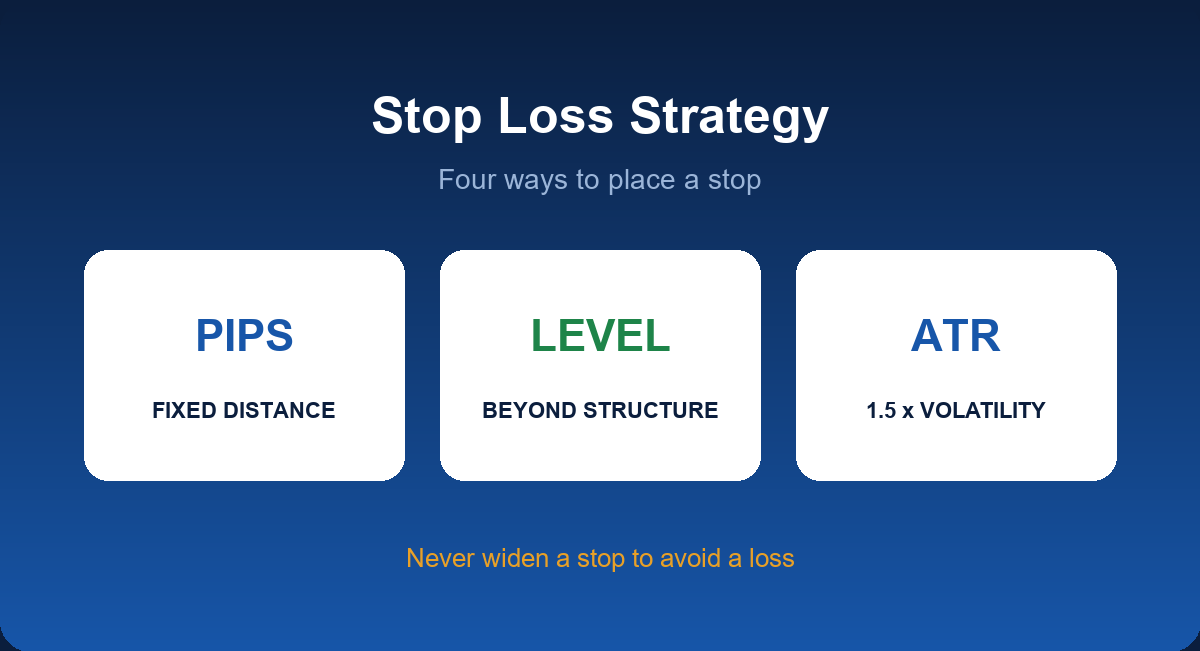
Four Ways to Place a Stop
| Method | How it works | Strength | Weakness |
|---|---|---|---|
| Fixed pips | Same distance every trade (for example 20 pips) | Simple, easy to size | Ignores how volatile the market is |
| Structure-based | Beyond a swing high or low, or a support or resistance zone | Ties the stop to the idea | Distances vary; sometimes very wide |
| Volatility-based (ATR) | A multiple of Average True Range, such as 1.5 × ATR | Adapts to market conditions | Needs an indicator and a rule |
| Time stop | Exit if the trade has not worked within a set time | Frees capital from stalled trades | Can exit just before a move |
A Worked ATR Example
Suppose the 14-period ATR on the 1-hour EUR/USD chart is 18 pips. A stop of 1.5 × ATR is 27 pips. With a $2,000 account risking 1% ($20), the position is $20 ÷ (27 × $10) = 0.07 lots. On a quieter day when ATR is 10 pips, the same method gives a 15-pip stop and a 0.13 lot position. The dollar risk is identical; the lot size adapts to volatility.
Structure-Based Placement
For a buy at 1.0850 with a recent swing low at 1.0820, the logical stop is just beyond that low, for example 1.0815. The distance is 35 pips. If that distance is too large for your risk limit, either reduce the size or skip the trade. Do not move the stop closer to make the numbers work, because a stop inside normal noise is likely to be hit for no reason. See position sizing in forex for the sizing step.
Spread and Slippage Work Against You
- A stop on a buy trade triggers at the bid, while you entered at the ask, so you start the trade already down by the spread.
- In fast markets, a stop becomes a market order and can fill beyond your level (slippage), especially around news and over weekends.
- A stop that is only a few pips from the entry can be triggered by the spread alone when it widens.
Measure the spread on your account; see what a spread is in forex.
Rules for Moving a Stop
- Never move a stop further from the entry to avoid a loss.
- Move it to break-even only after price has moved in your favour by a set amount (for example 1 × your risk).
- Trail it using a rule, such as below the last swing low or a multiple of ATR, not by feel.
- Write down the rule before the trade so you do not invent one while it is open.
Why “Mental Stops” Do Not Work
A mental stop relies on you pressing the button during a sharp move, when hesitation is most likely. A stop order held by the broker works even if your internet fails or you are asleep. Use real stops, and treat the exceptions (such as an EA that manages exits) with a separate safety net.
Do Stops Cause Losses?
Traders sometimes complain that price “hits the stop and reverses”. Sometimes the stop was too tight. Sometimes it is a normal feature of any strategy: a stop does not know about the future. Test it: record 50 trades, then compare results with the stop where it was against 20% wider. If the wider stop would have improved the result after adjusting position size, your stops may be too tight. If not, the stops are doing their job.
Take Profit and Risk-Reward
A stop is half of a pair. The target decides your reward relative to the risk. Read risk-reward ratio in forex to see how stop distance and target interact with your win rate.
Common Mistakes
- Placing the stop at an obvious round number where many others cluster.
- Using the same pip distance on every pair regardless of volatility.
- Removing the stop “just this once”.
- Putting the stop so close that normal movement triggers it.
- Forgetting to account for spread, swap and slippage on small accounts.
Choosing a Stop for Three Strategies
| Strategy | Sensible stop placement | Typical error |
|---|---|---|
| Trend pullback | Beyond the swing low or high of the pullback | Stop inside the pullback range |
| Range trading | Just outside the range boundary | No stop, hoping price returns |
| Breakout | Back inside the broken level, with room for a retest | Stop on the breakout candle itself |
A Break-Even Example
You buy at 1.0850 with a stop at 1.0820 (30 pips) and a target at 1.0910 (60 pips). Your rule is to move the stop to break-even only after price reaches +30 pips (1R), at 1.0880. If price touches 1.0880 and then falls back to 1.0850, you exit at break-even and lose only the spread. If you had moved the stop at +10 pips, a normal pullback might have stopped you out. The rule you choose changes your results, so test it.
A Test You Can Run on 20 Trades
| Question | How to answer |
|---|---|
| How many stops were hit and then price went to my target? | Review each stop-out on the chart afterwards |
| Would a stop 20% wider have survived? | Measure the maximum adverse move on those trades |
| Would a smaller position at the wider stop have been better? | Recompute with the same dollar risk |
If most stopped trades would have survived a slightly wider stop and still hit target, your stops are too tight. If few would, your stops are fine and the setups need refining.
Guaranteed Stops and Gaps
Ordinary stop orders can fill beyond your price in gaps and fast markets. Some brokers offer guaranteed stops for a fee on certain accounts; MetaTrader accounts usually do not. The practical defence is smaller size, avoiding major news and not holding large positions over weekends.
Key Takeaways
- A stop makes a loss a known size; it does not prevent losses.
- Choose a method (structure, ATR or fixed pips) and size the position from the stop distance.
- Spread and slippage move your real stop level; allow for them.
- Never widen a stop to avoid a loss; move it only by a rule you wrote in advance.
FAQ
Where should I put my stop loss?
Beyond the level that proves your idea wrong, such as a swing point, and far enough to survive normal volatility.
Is a tight stop better?
Not necessarily. Too tight and noise triggers it; too wide and the position must be small.
Should I use a trailing stop?
It can lock in profit, but only with a clear rule. Test it on a demo before using it live.
What happens if the market gaps over my stop?
The stop fills at the next available price, which can be worse than your level.
Open a JustMarkets Account & Activate Rebate →
Risk Disclaimer: Trading forex and CFDs carries a high level of risk and may not be suitable for all investors. You can lose all the money you deposit. JFRebate earns a referral commission from brokers it reviews; this never changes the spreads you pay. This article is for information only and is not financial advice.

Om Erick, CTA, is a Certified Technical Analyst and a forex trading veteran active since 2010, recognized as one of the Top 35 Best Traders in the World (MQL5, 2024). As the author of “Belajar Trading dari 0” and “Psikologi Trading,” as well as an active Psychological Trading Coach, Om Erick is dedicated to providing objective, data-backed trading guidance. Through JFRebate, he helps traders achieve peak performance by providing access to trusted brokers and a transparent, industry-leading rebate system.