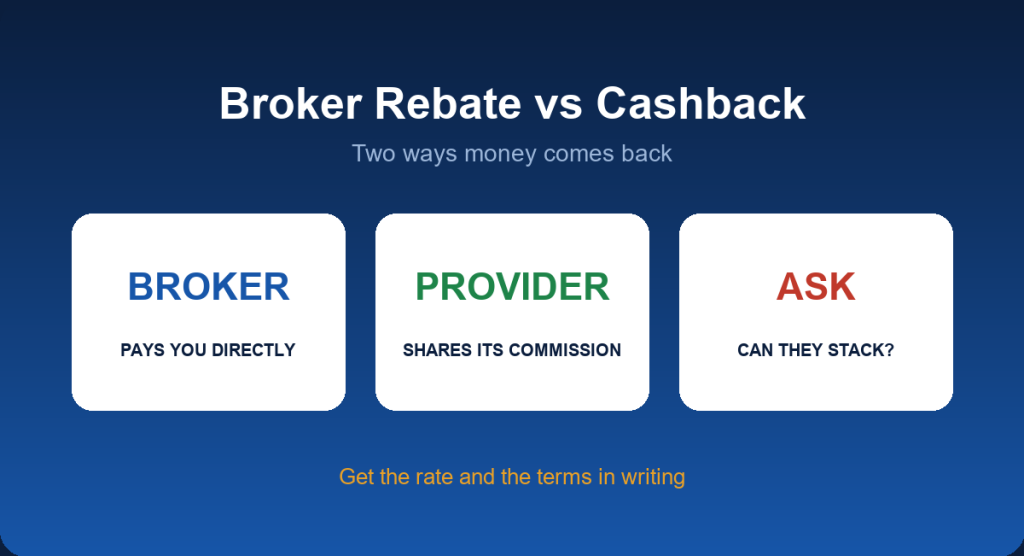
“Forex rebate” is used for two different things, and mixing them up leads to bad comparisons. In the first, the broker itself pays you money back because you trade a lot. In the second, a separate company that introduced you to the broker passes part of its own commission on to you. Both reduce your trading cost, but they are paid by different people, measured in different ways and carry different conditions. This guide explains each, shows how the numbers compare with a worked example, and lists what to ask before you register anywhere.
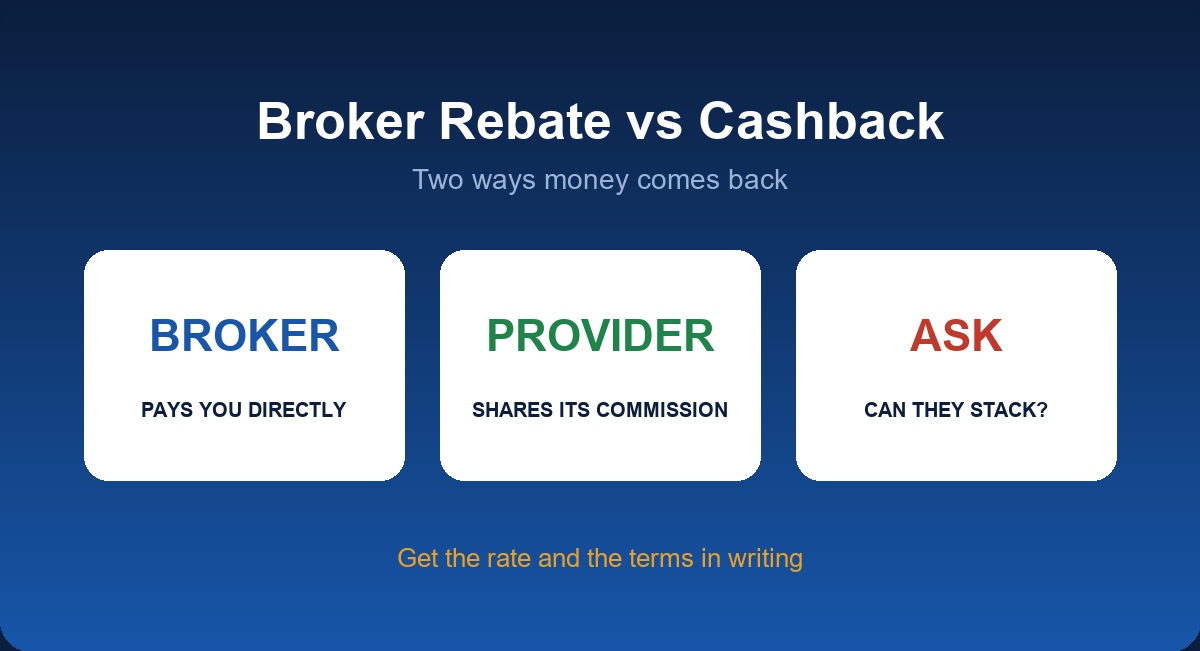
The Short Version
| Broker volume rebate | Third-party cashback | |
|---|---|---|
| Who pays you | The broker itself | A rebate provider (an introducer), out of the commission the broker pays it |
| How it is measured | Usually a percentage of the spread or commission you paid, or a small amount per lot | Money per lot, a percentage of the spread, or pips per lot |
| Published examples we checked | IG (UK): 5% to 25% of spread and commission by monthly volume tier. IG US pages: up to 15%. Tickmill past promotions: $0.25 to $0.75 per lot, and up to $2 per lot on one account type | Set by the provider. Our worked examples use $2 to $4 per lot; some providers publish higher maximums |
| Volume conditions | Often yes: tiers or a monthly minimum | Varies: some providers set no minimum, others do |
| Can it change or end? | Yes, promotions and tiers change | Yes, programme terms change |
| Account requirement | Usually a normal account that meets the conditions | Usually the account must be registered through the provider’s link |
All figures in the middle row come from the broker pages we read in October 2026. Brokers edit these pages often, so treat them as examples of how each model looks, not as current offers.
How a Broker Volume Rebate Works
A volume rebate is a loyalty scheme. The broker looks at what you traded during the month and returns a share of what you paid in spreads or commissions. The more you trade, the higher the share.
IG is a clear example. Its UK page describes a rebate that is a percentage of the spread and commission you have already paid, with the percentage rising by monthly volume tier; the table we saw ran from 5% at the lowest tier to 25% at the highest. Its US-facing pages, which now carry the tastyfx name, advertise up to 15% and say rebates begin once you pass $1 million of cumulative notional volume in a calendar month. For scale, $1 million is roughly nine or ten standard lots of EUR/USD at a price near 1.08 (illustrative), so the entry level is not out of reach for an active trader, and the top tiers are not for most people.
Tickmill has run per-lot schemes. One tiered scheme paid between $0.25 and $0.75 per lot depending on monthly volume. A later “Trade More, Get More” promotion paid up to $2 per lot on Classic accounts, $0.75 or $0.50 on Raw accounts and $0.25 on VIP accounts, with a cap per participant, and ended in 2024. We did not find a rebate promotion running now, which is the main lesson: a loyalty rebate is a marketing programme and can be withdrawn.
The pattern across both: the rebate is small per lot, it depends on volume or on an active promotion, and it is tied to the broker’s own decision to offer it.
How Third-Party Cashback Works
A rebate provider is usually an introducing broker (IB) or affiliate. When you open an account through its link, the broker pays the provider a commission on your trading volume. The provider then returns part of that commission to you. Tickmill’s own introducing broker page, as we read it, lists commissions of up to 55% of spread revenue on Classic accounts and $2.50 per lot on Raw accounts for qualified trades. Those are the sums a provider has to share from.
That is why third-party figures can look larger than loyalty rebates. An introducer’s commission pays for finding a client, so the pool is bigger than a loyalty scheme, and the provider decides how much of it to hand back. It is also why you must read the provider’s terms: the rate, the payout schedule and any minimum are set by the provider, not by the broker. On this site, for example, we use $3 per lot as an example for JustMarkets, we describe Headway as a share of spread (published maximum up to 33%), and we explain how payments appear in how the JustMarkets rebate works.
A Worked Comparison
Illustration only. A trader makes 20 standard lots of EUR/USD a month on an account with a 1.0 pip spread and no commission. One pip is worth $10 per lot, so the cost is $10 per lot, or $200 for the month.
| Rebate type | Rate | Money back | Share of cost returned |
|---|---|---|---|
| Broker volume rebate, low tier | 5% of spread | $10 | 5% |
| Broker volume rebate, mid tier | 15% of spread | $30 | 15% |
| Broker volume rebate, top tier | 25% of spread | $50 | 25% |
| Third-party cashback | $2 per lot | $40 | 20% |
| Third-party cashback | $3 per lot | $60 | 30% |
| Third-party cashback | $4 per lot | $80 | 40% |
At $3 per lot, the effective spread falls from 1.0 pip to about 0.7 pip. Run your own volume and spread in the forex rebate calculator, which now accepts money per lot, a percentage of the spread or pips per lot.
Two cautions. First, the table assumes the trader reaches the tier; at lower volume the broker percentage could be zero. Second, the broker rows and the third-party rows are not usually alternatives you can pick freely. Which one you get depends on the broker, the account type, the country and how you opened the account.
Can You Have Both?
Do not assume so. When an account is registered through an introducer, it is tagged to that introducer, and a broker may exclude tagged accounts from its own promotions, or the other way round. Nothing in the pages we checked says the two stack. The safe approach is to ask both parties in writing before you open an account: “If I register through your link, am I still eligible for the broker’s own rebate or promotion?” If the answers conflict, the broker’s terms win, because the broker pays one of them and controls the other.
Do Regulation Rules Affect Rebates?
In the UK and EU, rules on inducements (in the UK, section 2.3A of the FCA handbook’s Conduct of Business Sourcebook; in the EU, MiFID II) restrict certain payments between firms in connection with services to clients. We did not find official guidance spelling out how those rules apply to cashback an introducer returns to a client, and we are not lawyers, so we will not claim an answer. What is observable is practical: some regulated brokers limit or do not offer introducer programmes to retail clients in certain regions, and the broker entity that holds your account determines what it can offer. Ask both the provider and the broker, and see regulated forex brokers for how entities and regulators differ. None of this is legal advice.
Red Flags in Either Model
- Wider spreads after you register. A rebate should not change your spread or commission. A provider that raises your trading cost to fund a bigger rebate is a known scam pattern. Compare the live spread on a demo account opened through the link with one opened directly.
- A rate that is not in writing. A headline maximum is not a rate. Ask for the figure for your account type and instruments.
- Any request for your trading password or a deposit into the provider’s own account.
- Promised profit. A rebate lowers cost. It cannot turn a losing strategy into a winning one.
- No payment record. Real providers can show how payments appear. We publish a redacted partner report, and our provider checklist lists more questions.
A Short Checklist Before You Register
- Decide the broker first, on regulation, costs and withdrawals. Cashback is the tiebreaker, not the reason.
- Find out whether the broker has its own rebate for your account type and what volume it needs.
- Ask any provider for the per-lot (or percentage, or pip) rate for your account in writing.
- Ask whether the two can stack, and whether you must register through a link.
- Check payment timing, minimum payout and what happens if terms change.
- Compare live spreads with and without the link, then use the spread and commission calculator for the all-in cost.
Key Takeaways
- A broker volume rebate is paid by the broker as a share of spreads or commissions and usually depends on volume tiers or a promotion.
- Third-party cashback is paid by an introducer out of the commission it receives, and the provider sets the rate.
- Published broker rebates we checked ranged from fractions of a dollar per lot to a percentage of spread; introducer cashback can be larger but varies by provider.
- Do not assume the two can be combined. Ask both parties in writing.
- A rebate lowers cost. It never guarantees profit, and it should not change your spread.
Related Guides
This guide is part of our Trading Costs and Rebates series. For the overview, start with forex cashback and rebate brokers, then continue with:
- Forex rebate calculator
- How to choose a forex rebate provider
- What a forex introducing broker is and how IB rebates work
- What a spread is in forex
FAQ
What is the difference between a broker rebate and a cashback provider?
A broker rebate is paid by the broker as a loyalty reward, usually based on volume. A cashback provider is a separate introducer that shares part of the commission it receives from the broker.
Which pays more, a broker rebate or third-party cashback?
It depends on your volume, the broker and the provider. At low volume a broker tier may pay little or nothing, while introducer cashback is often paid from the first lot. At very high volume a top broker tier can be competitive. Run your numbers rather than trust a headline.
Does third-party cashback make my spread wider?
It should not. If your spread or commission is higher when you register through a link than when you open an account directly, do not proceed.
Can I get a broker rebate and third-party cashback on the same account?
Do not assume so. Ask both the broker and the provider in writing, and follow the broker’s terms if the answers differ.
Are these rebates guaranteed to continue?
No. Both kinds of programme are set by the party offering them and can be changed or ended, as the Tickmill promotions we mention show.
Open a JustMarkets Account & Activate Rebate →
Risk Disclaimer: Trading forex and CFDs carries a high level of risk and may not be suitable for all investors. You can lose all the money you deposit. JFRebate earns a referral commission from brokers it reviews; this never changes the spreads you pay. This article is for information only and is not financial advice.

Om Erick, CTA, is a Certified Technical Analyst and a forex trading veteran active since 2010, recognized as one of the Top 35 Best Traders in the World (MQL5, 2024). As the author of “Belajar Trading dari 0” and “Psikologi Trading,” as well as an active Psychological Trading Coach, Om Erick is dedicated to providing objective, data-backed trading guidance. Through JFRebate, he helps traders achieve peak performance by providing access to trusted brokers and a transparent, industry-leading rebate system.