Margin is the part of your balance that a broker sets aside as a deposit while a leveraged trade is open. It is not a fee and it is not lost, but it decides how much room your account has before the broker starts closing positions for you. Most traders who blow an account never actually decided to lose it; they simply did not track the five numbers in the MetaTrader “Trade” tab. This guide explains each of them with a single worked example you can repeat on a demo account.
The Five Numbers in Your Terminal
| Term | What it means | Formula |
|---|---|---|
| Balance | Account value counting only closed trades, deposits, withdrawals, swaps and credited rebates | Changes only when something is booked |
| Equity | Balance plus or minus the floating result of open trades | Balance + floating P/L |
| Used margin | Deposit locked by open positions | Lots × contract size × price ÷ leverage |
| Free margin | What is left to open new trades or absorb losses | Equity − used margin |
| Margin level | Health ratio the broker watches | Equity ÷ used margin × 100% |
The key detail: margin call and stop out are triggered by margin level, which depends on equity, not balance. A floating loss counts in full even though you have not closed the trade.
How Used Margin Is Calculated
One standard lot of EUR/USD is 100,000 euros. At a price of 1.0800 (illustrative), the notional value is $108,000. The broker only asks for a fraction of that, set by the leverage on your account.
| Position (EUR/USD at 1.0800) | Leverage 1:30 | Leverage 1:100 | Leverage 1:500 |
|---|---|---|---|
| 0.01 lot (notional $1,080) | $36.00 | $10.80 | $2.16 |
| 0.10 lot (notional $10,800) | $360.00 | $108.00 | $21.60 |
| 1.00 lot (notional $108,000) | $3,600.00 | $1,080.00 | $216.00 |
For pairs where the account currency is not the quote currency, the platform converts the result automatically. Some brokers also apply fixed margin rates to metals, indices and crypto CFDs, or raise margin around weekends and major news. The exact rules are in the contract specification for each symbol, so check the account page before trading a new instrument.
Worked Example: From Healthy to Stop Out
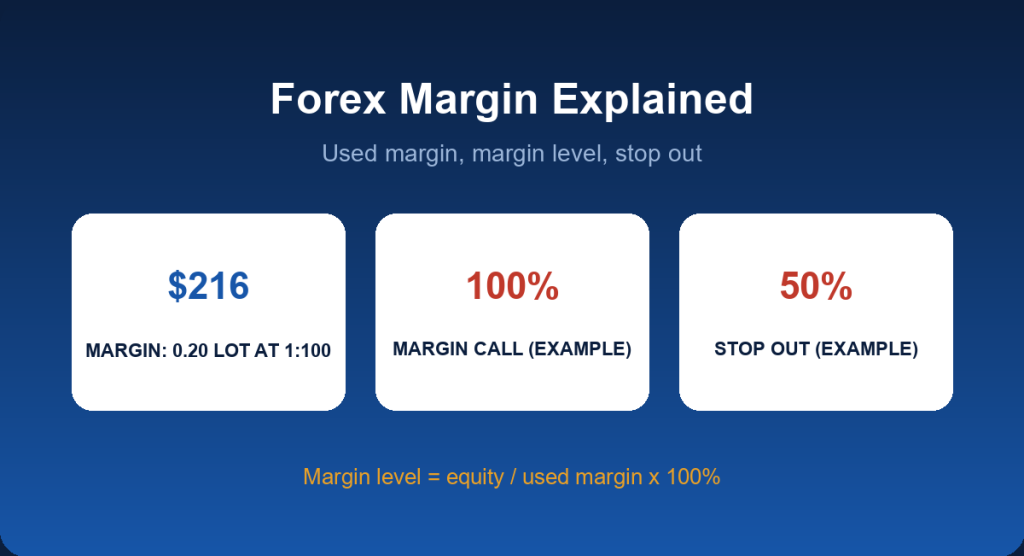
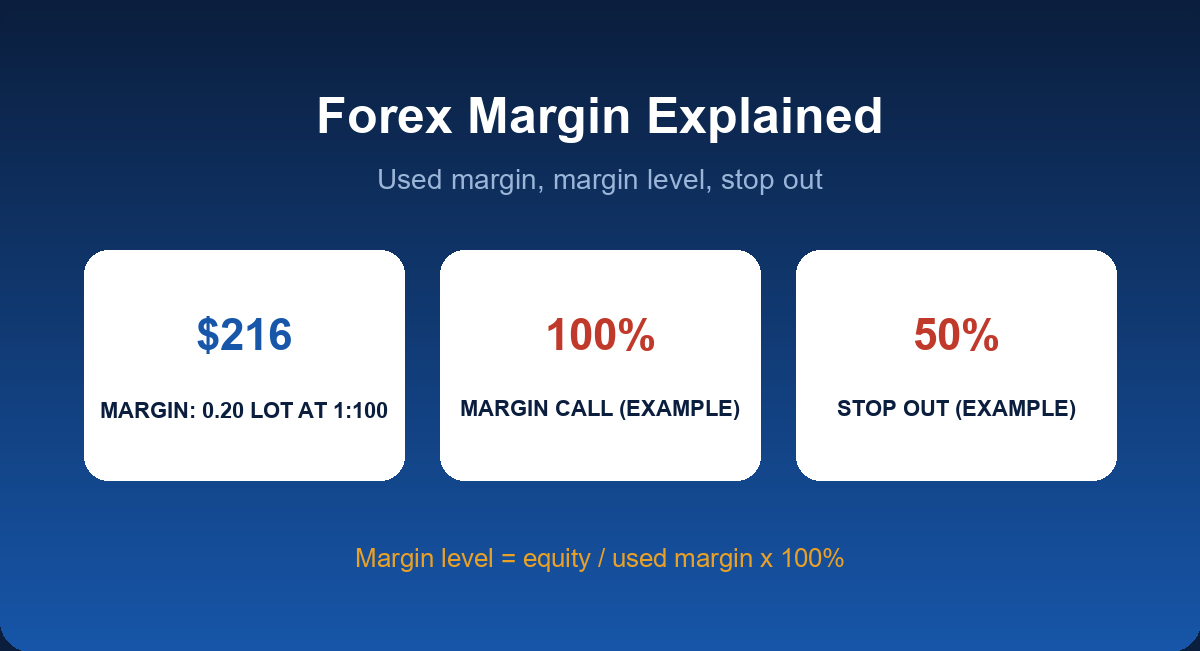
Illustration only. A trader deposits $1,000, uses 1:100 leverage and buys 0.20 lot EUR/USD at 1.0800. Used margin is $216 and each pip is worth about $2. We assume a margin call level of 100% and a stop out level of 50%; your broker’s levels may differ, so check the account page.
| Price move | Floating P/L | Equity | Free margin | Margin level | Status |
|---|---|---|---|---|---|
| Entry | $0 | $1,000 | $784 | 463% | Healthy |
| −100 pips | −$200 | $800 | $584 | 370% | Healthy |
| −300 pips | −$600 | $400 | $184 | 185% | Getting thin |
| −392 pips | −$784 | $216 | $0 | 100% | Margin call: no new trades |
| −446 pips | −$892 | $108 | −$108 | 50% | Stop out: broker closes the trade |
Two lessons sit in that table. First, a 0.20 lot on $1,000 can survive a long way in pips, which tempts traders to skip the stop loss. Second, by the time the stop out fires, almost 90% of the deposit is gone. The margin system is there to protect the broker from a negative balance, not to protect your capital. Your stop loss and position size do that job.
Margin Call vs Stop Out
- Margin call is a warning level. Usually you cannot open new positions, and you may get an alert. Nothing is closed yet.
- Stop out is forced closing. The platform typically closes the position with the largest floating loss first, then re-checks the margin level and repeats if needed.
- In fast markets the stop out can be filled at a worse price than the level implies. Negative balance protection, where offered, is meant to stop the balance going below zero; confirm whether your account has it.
Why Several Small Trades Can Be Worse Than One
Used margin adds up across positions, but so do floating losses. Five correlated trades (say EUR/USD, GBP/USD, AUD/USD, NZD/USD long and USD/CHF short) behave like one large bet against the dollar. If the dollar strengthens, every position loses together and the margin level falls five times faster than the single-trade example above. Count correlated exposure, not the number of tickets.
A Margin Safety Checklist
- Size every trade from risk first: risk 1% to 2% of equity to the stop, using the lot size calculator.
- Keep margin level well above 500% in normal conditions as a personal rule of thumb; low readings mean you are oversized.
- Look up the margin call and stop out levels for your account type before the first trade.
- Check whether margin requirements rise before weekends, holidays or high-impact news.
- Do not add to a losing position to “average down”; it raises used margin while equity falls.
- Remember that withdrawals reduce equity immediately; never withdraw while trades are open on a thin margin level.
Do Rebates Help With Margin?
Slightly, and only after the fact. A cashback rebate is credited to the balance after trades close, so it adds to equity and free margin from then on. With realistic rates of about $2 to $4 per lot, an active trader closing 20 lots a month might see $40 to $80 credited (illustration). That lowers trading cost; it is not a cushion for an oversized position. You can estimate your own figure with the forex rebate calculator.
Related Guides
This guide is part of our Starting Small series. For the full overview, start with Best Cent Account Brokers, then continue with:
- what leverage beginners should use
- forex risk management
- stop loss strategy
- high leverage forex brokers
- micro vs cent accounts
Key Takeaways
- Used margin = lots × contract size × price ÷ leverage; it is a deposit, not a fee.
- Margin level = equity ÷ used margin × 100%, and floating losses count in full.
- Margin call is a warning; stop out is forced closing, often at levels like 100% and 50% (check your account).
- By the time a stop out fires, most of the deposit is usually gone, so rely on stops and position sizing.
- Correlated trades drain margin level together.
FAQ
What is margin in forex in simple terms?
It is the deposit your broker locks while a leveraged trade is open. It is returned to free margin when the trade closes, adjusted by the profit or loss.
What is a good margin level?
There is no official number, but many careful traders stay far above 500%. A level near 100% means a margin call is close.
What happens at a margin call?
Usually you cannot open new trades until the margin level recovers, by closing positions, depositing or the market moving back.
What is the stop out level?
The margin level at which the broker starts closing your positions automatically. It differs by broker and account type, so check the account page.
Does higher leverage mean higher margin risk?
Higher leverage lowers the margin per trade. The risk comes from using that freedom to open bigger lots. See our guide to choosing leverage.
Practise reading these numbers on a forex demo account before trading real money.
Open a JustMarkets Account & Activate Rebate →
Risk Disclaimer: Trading forex and CFDs carries a high level of risk and may not be suitable for all investors. You can lose all the money you deposit. JFRebate earns a referral commission from brokers it reviews; this never changes the spreads you pay. This article is for information only and is not financial advice.

Om Erick, CTA, is a Certified Technical Analyst and a forex trading veteran active since 2010, recognized as one of the Top 35 Best Traders in the World (MQL5, 2024). As the author of “Belajar Trading dari 0” and “Psikologi Trading,” as well as an active Psychological Trading Coach, Om Erick is dedicated to providing objective, data-backed trading guidance. Through JFRebate, he helps traders achieve peak performance by providing access to trusted brokers and a transparent, industry-leading rebate system.