Open a Headway Account & Activate Cashback
Cent account from $1 • Up to 33% of spread back • Paid automatically
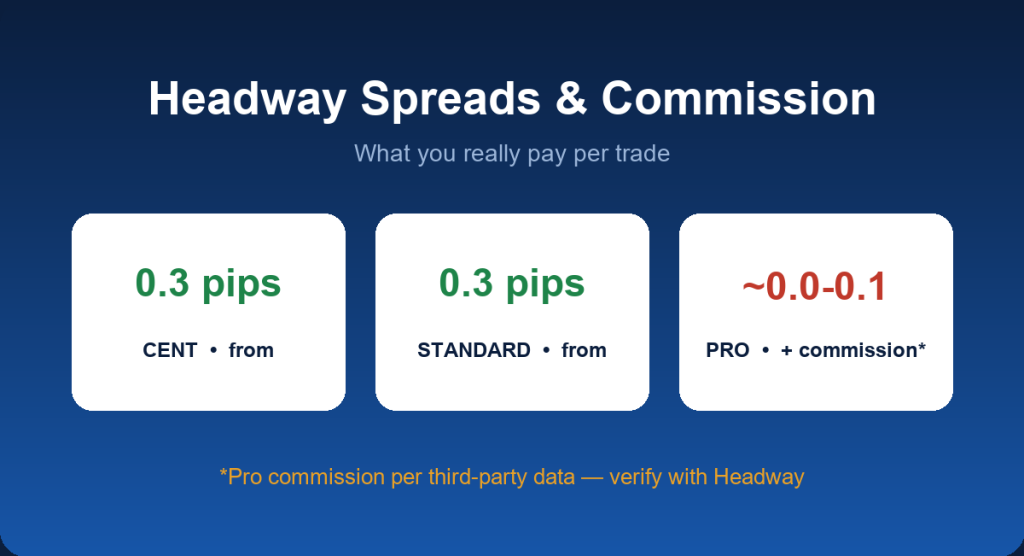
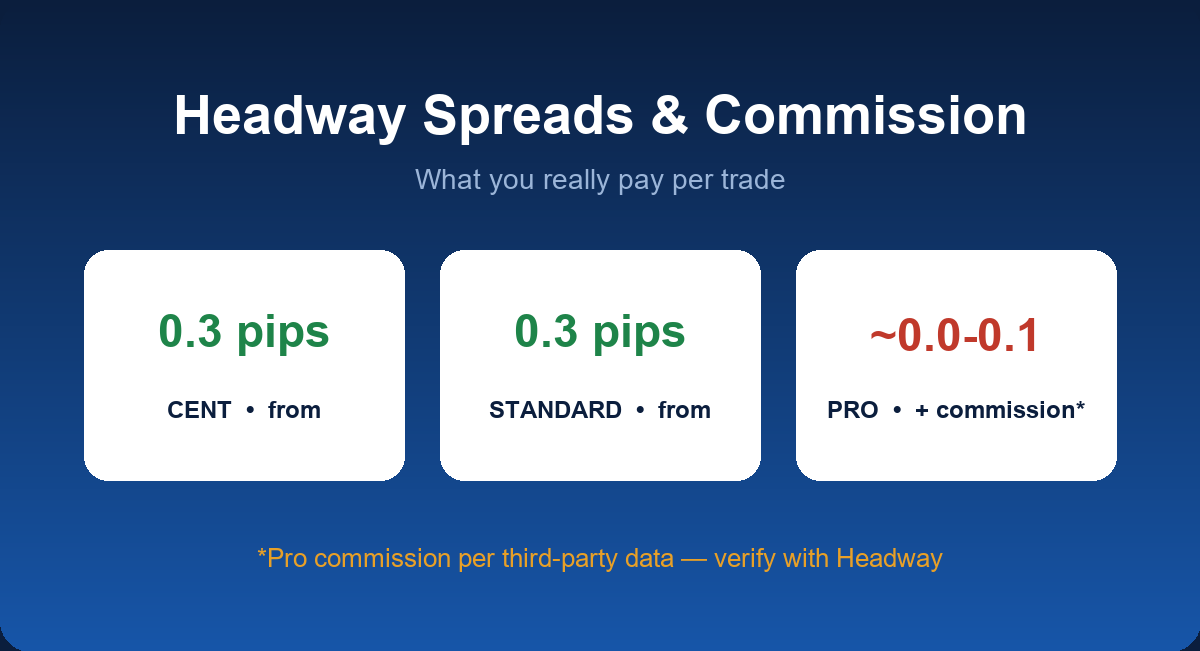
Headway spreads look cheap on paper: “from 0.3 pips” on its Cent and Standard accounts and tighter on the Pro account. But the number you actually care about is your total cost per trade, which is spread plus any commission. This guide explains Headway’s spreads and commission account by account, shows a worked cost example, and explains where cashback fits in.
Headway Spreads by Account Type
| Account | Minimum deposit | Spread from | Commission |
|---|---|---|---|
| Cent | $1 | 0.3 pips | None |
| Standard | $10 | 0.3 pips | None |
| Pro | $100 | Roughly 0.0–0.1 pips | Up to $1.5 per side per lot* |
*Commission and spread figures for Pro vary between third-party sources, and Headway can change its pricing. Confirm current numbers on Headway’s official site before you fund an account.
Two points matter here. First, “from” means the minimum spread: real spreads widen during news and low liquidity, so your average cost is higher. Second, the Pro account trades a lower spread for a commission, which is not automatically cheaper.
A Worked Cost Example
This is an illustration, not a quote. Take one standard lot of EUR/USD, where one pip is worth about $10:
- Standard account at a 0.3 pip spread: 0.3 × $10 = $3 spread cost, no commission.
- Pro account at a 0.1 pip spread plus a commission of $1.5 per side: $1 spread + $3 round-turn commission = $4.
At those minimum spreads the Standard account is actually cheaper, and the Pro account only wins if its spread stays very tight. Always compare total cost. A Cent account works the same way but with trade sizes 100 times smaller, which is why it is popular for testing; see our cent account guide.
Other Costs to Check
- Swaps: Headway offers a swap-free (Islamic) option on its accounts; see our Headway Islamic account guide. Otherwise overnight swaps apply and differ by instrument.
- Deposits and withdrawals: third-party reviews report no broker-side fees, but your bank or e-wallet may charge. See the withdrawal guide.
- Leverage and margin: very high leverage does not lower costs, it only increases risk. See Headway leverage explained.
Where Cashback Fits In
Registering through JFRebate gives you automatic cashback of up to 33.3% of the spread on eligible trades. On the Standard example above, that is up to about $1 back on a $3 spread cost, which lowers your effective cost. Rebate does not change Headway’s spreads, and it applies only to new accounts opened through our link. See how the Headway rebate works.
Which Account Should You Choose?
- Beginners and testers: Cent account, to learn with very small real-money risk.
- Most retail traders: Standard account, spread-only pricing that is easy to understand.
- High-volume or scalping traders: compare Pro’s total cost against Standard using your real trade size before switching.
Practise on a demo account first. For the full picture of the broker, read our Headway review and Is Headway safe or legit?
Reading a Spread Quote
A quote has two prices: the bid, where you sell, and the ask, where you buy. The gap between them is the spread. If EUR/USD shows 1.08500 / 1.08510, the spread is 0.00010, which is one pip. The moment you open a trade you are already down by that amount; the price has to move that far in your favour before you break even. This is why spreads matter more to short-term traders than to people holding trades for weeks.
When Spreads Widen
Advertised spreads are usually the best case. They widen in predictable moments: around major news such as US employment data and central bank decisions, at the daily rollover when liquidity thins, during the first minutes after the weekend open, and on exotic or illiquid pairs. A broker can quote 0.0 on a Pro account during London hours and a very different number at 22:00 server time. If you trade at odd hours, test at those hours.
Test the Spread Yourself
- Open the demo account on the account type you plan to use.
- Pick two pairs, for example EUR/USD and GBP/USD.
- Note the spread at three times: quiet Asian hours, the London open and a major news release.
- Repeat on three different days and average the numbers.
- Do the same on a competitor’s demo and compare the totals, not the headlines.
Twenty minutes of notes beats any spread table, including ours.
Converting Commission Into Pips
A commission account looks cheaper because the spread is smaller, but you pay the commission on top. To compare fairly, convert the commission into pips. If the round-turn commission is $7 per lot and a pip on a standard lot is about $10, the commission equals 0.7 pips. Add it to the quoted spread. A 0.1-pip spread plus 0.7 pips of commission costs about 0.8 pips in total. Compare that figure with an account that shows 1.0 pip and no commission. Check Headway’s current commission before relying on any number in this paragraph; the arithmetic is the point, not the figure.
What 33% Back Does to the Total
With cashback of up to 33% of the spread, a trade that costs you $10 in spread returns about $3.30. The effective cost falls to about $6.70, or 0.67 pips instead of 1.0. Over 30 lots in a month, that is roughly $100 returned. The percentage applies to the spread portion, so it will not offset commission directly. Read how the Headway rebate works for eligibility and payout, and use our pip value guide if you want to run your own numbers.
Which Pairs Cost More to Trade?
Spreads follow liquidity. Heavily traded majors such as EUR/USD and USD/JPY tend to carry the narrowest spreads. Crosses such as EUR/GBP or GBP/JPY are usually wider, and exotic pairs, for example those involving the Turkish lira or the South African rand, can be several times wider and move erratically. If you are new, stay with a few majors until you understand how your broker prices them. A strategy that works on EUR/USD can lose its edge on an exotic simply because the spread eats the expected gain.
Spread and Strategy: What Matters Where
| Style | How much the spread matters |
|---|---|
| Scalping (seconds to minutes) | A great deal; a fraction of a pip changes expectancy |
| Day trading | Significant; costs repeat every day |
| Swing trading (days) | Moderate; swap and gaps matter as much |
| Position trading (weeks) | Small; fundamentals dominate |
Spread Mistakes We See
- Choosing an account on the headline spread without checking commission.
- Placing a stop so tight that the spread alone can trigger it.
- Trading right at the news release when spreads are widest, then blaming the broker.
- Forgetting that a “zero spread” account pays for itself through commission.
A Quick Decision Table
| If you… | Look at |
|---|---|
| Trade a few times a week with small size | Cent or Standard; simplicity beats saving a few cents |
| Trade daily with moderate size | Compare Standard against Pro using your real monthly lots |
| Trade very actively | Pro or the lowest effective cost after commission and cashback |
Whichever you choose, rehearse on the demo account first and use the cost maths in the lot size calculator to see what each pip means for your position.
Costs That Hide Behind the Spread
Two other things behave like spread even though they are not quoted as one. Slippage is the difference between the price you clicked and the price you got, and it grows in fast markets. A requote happens when the broker offers a new price instead of filling at the old one. Neither shows on a spread table, but both affect real results. Judging a broker only by the quoted spread is like judging a restaurant only by the price of its starters.
A Final Word on Choosing by Spread
The cheapest-looking account is not always the cheapest to trade. Add the commission, add the slippage you actually experience, subtract any cashback and you have a number worth comparing. Do that for two accounts using your own trade log and the choice is usually obvious.
Keep a Cost Log
For a month, note the spread you paid on each trade, any commission and the slippage on entry. Total them and divide by lots traded. That figure is your real cost per lot, and it is the one to hold up against any broker’s marketing. It takes about a minute per trade and usually surprises people in one direction or the other.
FAQ
Does Headway charge commission?
Cent and Standard accounts are spread-only. Third-party data indicates the Pro account charges a commission; confirm the current figure with Headway.
Are Headway’s spreads fixed?
No, they are floating and can widen during news releases or thin markets.
Which Headway account has the lowest cost?
It depends on your trade size and pair. Compare spread plus commission in a demo or small live test.
Open a Headway Account & Activate Rebate →
Risk Disclaimer: Trading forex and CFDs carries a high level of risk and may not be suitable for all investors. Cost figures are illustrations; verify current pricing with the broker. This article is not financial advice.
Key Takeaways
- Cent and Standard are spread-only; Pro swaps a tighter spread for a commission.
- “From” spreads are minimums, so judge by your average total cost, not the headline number.
- Cashback of up to 33.3% of the spread reduces your effective cost on eligible trades.
- Pricing changes, so confirm current spreads and commission on Headway before depositing.

Om Erick, CTA, is a Certified Technical Analyst and a forex trading veteran active since 2010, recognized as one of the Top 35 Best Traders in the World (MQL5, 2024). As the author of “Belajar Trading dari 0” and “Psikologi Trading,” as well as an active Psychological Trading Coach, Om Erick is dedicated to providing objective, data-backed trading guidance. Through JFRebate, he helps traders achieve peak performance by providing access to trusted brokers and a transparent, industry-leading rebate system.