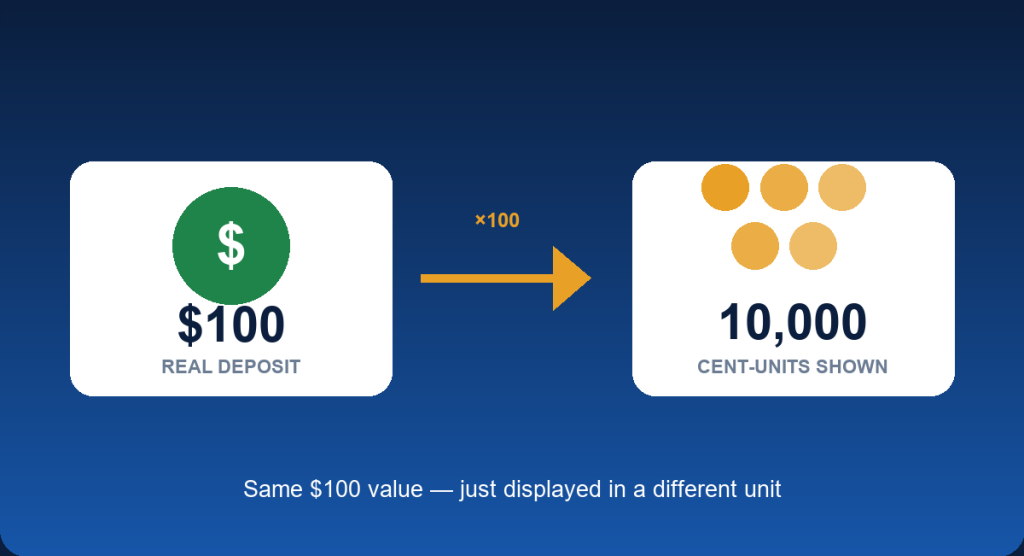
If you’ve ever opened a forex cent account and watched your balance show “10,000” after depositing just $100, you’ve probably had a small panic moment — did I just get 100x richer, or did something go wrong? Neither. It’s just how cent accounts work, and once you understand the math, they become one of the safest ways to start live trading. Below: the exact conversion, plus the best cent account brokers for 2026 if you’re looking beyond Exness.
What Is a Forex Cent Account?
A cent account is a regular live trading account where your balance and trade sizes are denominated in cents instead of whole dollars. You deposit real money in USD, but the platform displays and calculates everything in cent-units — which is exactly why a small deposit shows up as a much bigger number on screen.
The appeal for beginners is simple: you trade under real market conditions, with real execution and real emotions, but your actual dollar risk per trade is roughly 100x smaller than the same lot size on a Standard account.
How Much Is $100 in a Cent Account? (The Math, Explained)
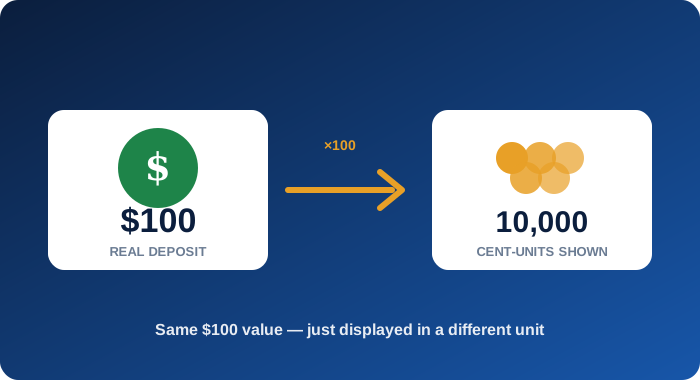
The conversion is fixed: 1 USD = 100 cent-units. So when you deposit $100 into a cent account, your account balance displays as 10,000 — but its real-money value is still exactly $100. Nothing is multiplied for free; the number just changes units, the same way $1 equals 100 physical cents.
| Real USD Deposited | Cent Account Balance Shown |
|---|---|
| $10 | 1,000 |
| $50 | 5,000 |
| $100 | 10,000 |
| $500 | 50,000 |
| $1,000 | 100,000 |
What actually changes is your real-dollar risk per trade. A 1.0 lot trade on a cent account risks roughly what a 0.01 lot trade would risk on a Standard account — which is exactly why cent accounts are used for testing strategies and building execution confidence without meaningful financial exposure. Use our Lot Size Calculator if you want to check exact risk per trade before funding an account.
Best Cent Account Brokers 2026 (Beyond Exness)
Exness gets recommended by default in most “best cent account” lists simply because it’s the most heavily marketed. That doesn’t mean it’s the only solid option — or the right fit for every trader. Here are two regulated, rebate-eligible alternatives worth comparing, plus a short list of other known cent-account brokers for completeness.
1. JustMarkets — Standard Cent Account
- Minimum deposit: $10
- Spreads: from 0.3 pips
- Commission: none
- Leverage: up to 1:3000
- Platforms: MT4 & MT5
- Regulation: CySEC, FSA, FSCA, FSC
Opening a JustMarkets account through JFRebate also activates automatic cashback of up to $20/lot at the published maximum (our worked examples use $2 to $4 per lot) on top of the broker’s own conditions — no manual claims needed. Full details in our JustMarkets Review & Rebate Guide or see the full JustMarkets account type breakdown.
Open a JustMarkets Cent Account & Activate Rebate →
2. Headway — Cent Account
- Minimum deposit: $1
- Spreads: floating, from 0.3 pips
- Commission: none
- Leverage: 1:1 up to unlimited
- Max lot size: 1000
Headway’s Cent account has one of the lowest entry points in the industry — a $1 deposit is technically enough to open it, though we’d still point you to our note on realistic starting amounts below. Registering through JFRebate activates automatic cashback on top of Headway’s own terms. See our Headway Minimum Deposit & Account Types guide or the full Headway Review.
Open a Headway Cent Account & Activate Rebate →
Other Cent Account Brokers Worth Knowing
For context, a few other brokers commonly offer cent-style accounts: RoboForex (ProCent account, $10 minimum), FBS (Cent account, $1 minimum), InstaForex (Cent account, known for large deposit bonuses), and HFM (Cent account with no stated minimum deposit). We don’t currently run rebate programs with these brokers, so we can’t offer cashback on them — always verify current terms directly on the broker’s own site before opening an account anywhere.
Cent Accounts and IDR Deposits
A common question from Indonesian traders: can a cent account be funded directly in Rupiah? Technically no — cent accounts at JustMarkets and Headway are USD-denominated, not IDR-denominated. When you deposit via a local bank transfer or e-wallet, your IDR is converted to USD (then displayed in cent-units) at the payment provider’s exchange rate. There’s no separate “IDR cent account” product; the cent mechanism only applies to the account’s base currency. Factor in conversion fees when depositing small amounts, since a fixed fee eats a bigger percentage of a $10–$50 deposit than a larger one.
Cent vs. Standard Account — Quick Comparison
| Cent Account | Standard Account | |
|---|---|---|
| Balance units | Cents | Whole dollars |
| Typical min. deposit | $1–$10 | $10–$100 |
| Real risk per lot | ~100x smaller | Standard |
| Best for | Beginners, strategy testing | Regular live trading |
Reading Cent Account Numbers Without Confusion
The first thing that confuses newcomers is the display. A cent account usually shows your balance in cents, so a $10 deposit appears as 1,000 and $100 appears as 10,000. Nothing is missing; the unit is simply smaller. Contract sizes also differ from a standard account, so a “1.00 lot” on a cent account is not the same exposure as 1.00 lot on a standard one. Before you place a trade, open the contract specification for the symbol and check three things: the contract size, the minimum lot and the value of one pip in your account currency.
A Sample $100 Plan
Suppose you fund $100 and decide to risk 2% per trade. That is $2. If your stop is 20 pips away, each pip may be worth no more than $0.10, and you size the position so a stop-out costs about $2. On a cent account this is easy to reach because the minimum position is very small. On a standard account the same $100 would force you into a lot size that is either too big for your rule or below the minimum. That gap is the main practical advantage of a cent account for small capital.
| Balance | Risk per trade (2%) | If the stop is 20 pips |
|---|---|---|
| $50 | $1 | $0.05 per pip |
| $100 | $2 | $0.10 per pip |
| $500 | $10 | $0.50 per pip |
Use our lot size calculator to turn the per-pip figure into an exact lot size for the pair you trade.
Mistakes We See Most on Cent Accounts
- Treating it as play money. A cent account holds real funds. If you will not follow your risk rule on it, you will not follow it on a larger account either.
- Over-leveraging because the numbers look small. Losing 80% of $100 is still an 80% loss.
- Ignoring spreads. Some cent accounts have wider spreads than standard ones, which is a bigger share of your tiny profit target.
- Staying on cent forever. It is a classroom, not a destination.
When to Move Up to a Standard Account
A reasonable checklist: at least a few dozen live trades with a written plan, a drawdown you stayed calm through, a clear expectancy from your journal, and a balance that now makes the minimum standard lot compatible with your risk rule. If any of those are missing, stay where you are. Before moving, compare the broker’s account types in the best JustMarkets account type or read Headway’s minimum deposit and account types.
Questions Beginners Ask About Cent Accounts
Are cent account profits taxed or limited?
The account does not change how profit is treated; tax rules depend on where you live, so check them locally. There is no special withdrawal limit just because the account is a cent account, but the broker’s normal terms still apply.
Is the spread worse on a cent account?
It can be. Because the minimum trade is tiny, a spread that looks the same in pips represents a larger share of a very small profit. Always compare the cost per trade, not only the quoted spread.
One Last Practical Tip
Whatever broker you choose, run your first week with positions so small that the result barely matters. The goal of the cent account is to find your mistakes while they are cheap.
A Note on Expectations
A cent account will not turn $50 into a living. Its job is to teach position sizing, stop placement and emotional control at almost no cost. People who treat it that way tend to arrive at larger accounts with better habits than those who use it to chase fast growth.
Frequently Asked Questions
Is a cent account real money or a demo?
It’s real. Cent accounts use live market execution and real deposited funds — the only difference from a Standard account is the display currency (cents instead of dollars) and the correspondingly smaller real-dollar risk per lot.
Can I withdraw profits from a cent account?
Yes. Profits are real and withdrawable the same way as any other live account, subject to the broker’s normal withdrawal process.
Do cent accounts qualify for JFRebate cashback?
Yes — both JustMarkets and Headway cent accounts are eligible for automatic rebate through JFRebate, credited the same way as Standard and Pro accounts.
Why isn’t Exness on this list?
Exness is a legitimate, widely used broker for cent accounts, but JFRebate doesn’t currently run a rebate program with them, so we can’t offer cashback on an Exness account. JustMarkets and Headway are the closest equivalents where we can add real value on top of the broker’s own conditions.
Risk Disclaimer: Trading forex and CFDs carries a high level of risk and may not be suitable for all investors. Cent accounts reduce the absolute dollar amount at risk but do not eliminate trading risk. Always verify current account terms directly with the broker before depositing.

Om Erick, CTA, is a Certified Technical Analyst and a forex trading veteran active since 2010, recognized as one of the Top 35 Best Traders in the World (MQL5, 2024). As the author of “Belajar Trading dari 0” and “Psikologi Trading,” as well as an active Psychological Trading Coach, Om Erick is dedicated to providing objective, data-backed trading guidance. Through JFRebate, he helps traders achieve peak performance by providing access to trusted brokers and a transparent, industry-leading rebate system.