
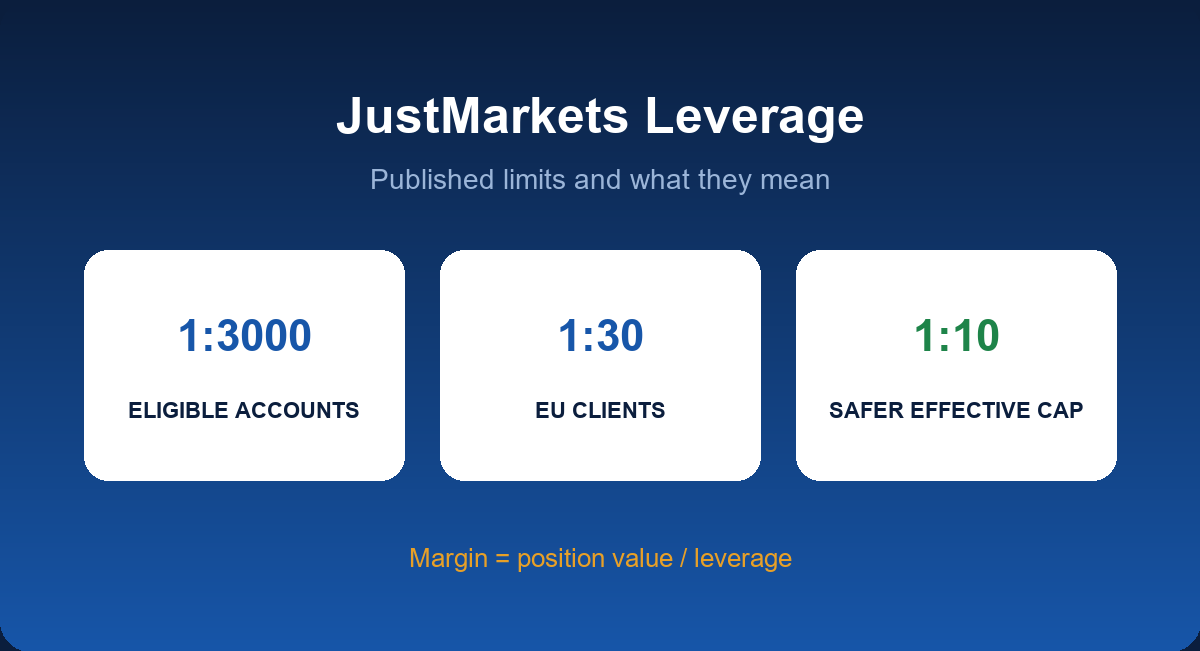
JustMarkets advertises leverage of up to 1:3000 on eligible accounts, while clients served by the EU entity are limited to 1:30. Those two numbers say everything and nothing: they show the range, but not what the ratio does to your account. This page explains the published limits, how margin works with numbers, and how to choose a ratio that fits your balance and style.
The Limits That Are Published
| Situation | Leverage |
|---|---|
| Eligible accounts at the offshore entities | Up to 1:3000 on our review’s data |
| Clients under EU regulation | 1:30 on major pairs |
The maximum usually applies in tiers: leverage falls as your balance or open volume grows, and different instruments (metals, indices, crypto) have their own limits. Check your account’s specification in the client area before you rely on a number. See high leverage forex brokers for how this compares with others.
Leverage Is Margin in Disguise
Leverage sets how much margin the broker locks for a position. The formula is margin = position value ÷ leverage.
| Position value | 1:30 | 1:100 | 1:500 | 1:3000 |
|---|---|---|---|---|
| $10,000 (0.10 lot EUR/USD) | $333 | $100 | $20 | $3.33 |
| $100,000 (1.00 lot) | $3,333 | $1,000 | $200 | $33 |
The table shows why very high leverage tempts small accounts: a $10 deposit can open a position that would need $333 at 1:30. It also shows the risk. Nothing about the position’s size or its profit and loss per pip has changed; only the cushion is thinner.
A Worked Loss Example
You have $200 and open 0.50 lots on EUR/USD (position value $50,000, about $5 per pip). At 1:1000 the margin is $50. You set no stop loss and the price moves 40 pips against you, a $200 loss. That is the entire account on a move that happens most weeks. At 1:100 the margin would be $500, and the platform would not let you open the same position on $200. The higher leverage did not make the trade riskier in itself; it let you take a risk the lower setting would have blocked.
Margin Level and Stop-Out
- Equity = balance plus floating profit or loss.
- Free margin = equity minus used margin.
- Margin level = equity ÷ used margin × 100%.
When the margin level falls to a threshold set by the broker, you receive a margin call, and at a lower threshold positions are closed automatically (stop-out). Read the exact levels for your account type; they are not the same everywhere.
Choosing a Ratio by Trading Style
| Style | Stop distance | Sensible approach |
|---|---|---|
| Scalping | 5–10 pips | Moderate account leverage; position size is driven by risk, not margin |
| Day trading | 20–50 pips | Moderate leverage; keep effective leverage low |
| Swing trading | 50–150 pips | Low leverage; wide stops need small positions |
The key concept is effective leverage: position value divided by your balance. A $500 balance with a $5,000 position is 1:10 effective leverage, regardless of the account setting. Many professionals stay under about 1:10. Use our lot size calculator to size from risk instead of margin.
Can You Change It?
Most brokers let you request a lower leverage in the client area or through support. Doing so does not change your costs. It only limits how large a position the platform lets you open, which can protect you from over-sizing. If you are a beginner, asking for a lower setting is a reasonable safeguard.
A Risk Some Clients Report: Leverage Changes in Volatile Markets
The published maximum is not a promise that your leverage stays fixed. Brokers can lower leverage on some instruments around major news or when volatility is high, and the terms usually allow it. One public client review we found describes a stop-out after a reduction during volatile conditions, which the client says was later settled by cancelling the disputed trades. This is a single account and we cannot verify it, but it illustrates a real mechanism: if leverage drops while you hold a position, required margin can rise and push a thin account toward stop-out.
- Read the clause on leverage changes in the client agreement and note which instruments it covers.
- Keep a margin buffer so that a leverage cut does not push your margin level near the stop-out level.
- Avoid holding oversized positions through major news or over the weekend.
- Use your own effective leverage, not the account maximum, as your guide.
Five Rules for Using It Safely
- Decide risk in dollars (1–2% of balance) before you look at margin.
- Place a stop loss on every trade.
- Keep margin level far above the stop-out level.
- Avoid holding large positions over weekends and major news.
- Start on a demo account or a cent account.
Common Misunderstandings About Leverage
- “Higher leverage means bigger profit.” Profit and loss per pip depend on lot size, not leverage.
- “Leverage costs money.” The ratio itself has no fee, but larger positions mean larger spread and swap costs.
- “Low leverage means a safe account.” Oversized lots on low leverage can still lose quickly.
- “The broker sets my risk.” You set it with position size and stop distance.
A Margin-Call Scenario in Numbers
Balance $300, 1:500 leverage, one open position of 0.60 lots on EUR/USD (position value $60,000, margin $120, about $6 per pip). The price goes 30 pips against you: a $180 floating loss. Equity is now $120 and used margin is $120, so the margin level is 100%. Many brokers start closing positions around or below this level. A trader at 0.10 lots would have used $20 of margin and, in the same move, lost $30, leaving a margin level of $270 ÷ $20 = 1,350%. Lot size, not the available ratio, decided who survived.
Account Types and Leverage
Cent, Standard, Pro and Raw Spread accounts may differ in maximum leverage, margin requirements and stop-out levels. Confirm these in the account specification rather than assuming they match. If you are comparing accounts on cost, read which JustMarkets account type fits you and JustMarkets spreads by account type.
Before You Change Your Leverage Setting
- Close or reduce open positions so the change does not push your margin level too low.
- Check whether the change applies to all instruments.
- Make the request through the client area or support and keep the confirmation.
- Re-check the margin required on a demo trade after the change.
Questions to Ask Before You Rely on a Headline Ratio
- Does the maximum apply to my account type and my balance tier?
- Does it apply to the instruments I trade, including metals and indices?
- What are the margin-call and stop-out levels?
- Will the maximum fall as my positions grow?
- Does my local regulation cap it?
The answers appear in the client area and in the contract specification. Write them down once and revisit them when you change account type or balance. For broader context, see regulated forex brokers and what a CFD broker is.
Key Takeaways
- JustMarkets lists up to 1:3000 on eligible accounts and 1:30 for EU clients; check your account’s tiers.
- Margin = position value ÷ leverage; the ratio sets the cushion, not the risk per pip.
- Judge risk by effective leverage and stop distance, not by the account maximum.
- You can usually ask for a lower setting as a safeguard.
FAQ
What is the maximum JustMarkets leverage?
Up to 1:3000 on eligible accounts according to our review; 1:30 for EU clients. Confirm your own limit in the client area.
Does higher leverage mean higher spreads?
No. Spreads are set by the account type, not the leverage.
Is 1:3000 safe?
The maximum is not a recommendation. Use effective leverage and stop losses to control risk.
Can I lower leverage after opening?
Usually yes, through the client area or support.
Open a JustMarkets Account & Activate Rebate →
Risk Disclaimer: Trading forex and CFDs carries a high level of risk and may not be suitable for all investors. You can lose all the money you deposit. JFRebate earns a referral commission from brokers it reviews; this never changes the spreads you pay. This article is for information only and is not financial advice.

Om Erick, CTA, is a Certified Technical Analyst and a forex trading veteran active since 2010, recognized as one of the Top 35 Best Traders in the World (MQL5, 2024). As the author of “Belajar Trading dari 0” and “Psikologi Trading,” as well as an active Psychological Trading Coach, Om Erick is dedicated to providing objective, data-backed trading guidance. Through JFRebate, he helps traders achieve peak performance by providing access to trusted brokers and a transparent, industry-leading rebate system.