
A trading plan is a short document that tells you what to trade, when, how big and when to stop. It does not need to be clever; it needs to exist, be specific and be followed. This guide gives you a template with each section explained, a filled-in example for a small account and a rule for when to change the plan. Print it, fill it in and review it every month.
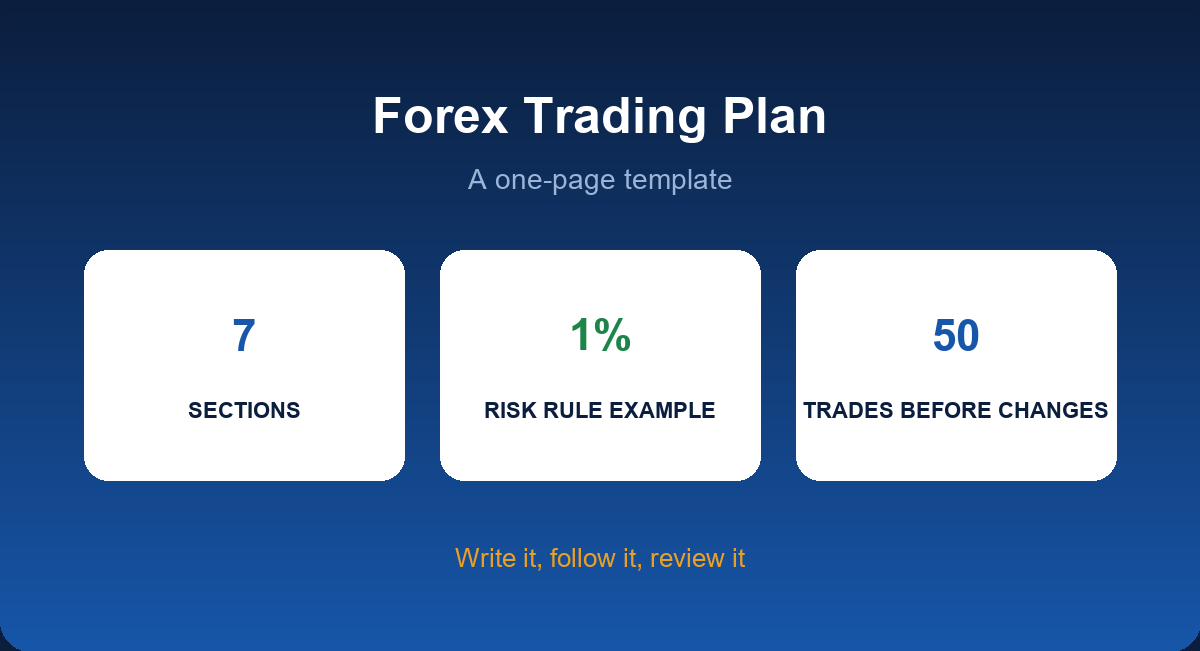
The Template at a Glance
| Section | Question it answers |
|---|---|
| 1. Purpose and expectations | Why am I trading and what do I realistically expect? |
| 2. Markets and sessions | Which pairs and which hours? |
| 3. Set-ups | What exact conditions make me enter? |
| 4. Entry, stop, target | How do I place each of them? |
| 5. Risk rules | How much per trade, per day, per week? |
| 6. Routine | What do I do before, during and after a session? |
| 7. Review and change rules | When do I look back, and what allows me to alter the plan? |
1. Purpose and Expectations
Write one honest sentence: “I trade to learn and to try to build a small account over a year; I accept that I may lose the deposit.” Then state a measure of success that is not a monthly profit target, for example “follow my rules on 90% of trades” or “keep the maximum drawdown under 10%”.
2. Markets and Sessions
Pick one or two liquid pairs, such as EUR/USD and USD/JPY, and the hours when you can focus. London and the London–New York overlap usually have tighter spreads; see what a spread is in forex. Trading fewer instruments makes patterns easier to learn.
3. Set-Ups
Describe each set-up in a sentence a stranger could follow. Example: “Trade in the direction of the 50-period moving average on the 1-hour chart; enter on a pullback to the average when a bullish candle closes above the previous candle’s high.” If you cannot describe it in a sentence, it is not yet a rule.
4. Entry, Stop and Target
- Entry: the trigger, for example a candle close.
- Stop: beyond the swing low or 1.5 × ATR; see stop loss strategy.
- Target: the next level or a minimum of 1.5R; see risk-reward ratio.
- Management: move to break-even at +1R only.
5. Risk Rules
| Rule | Example for a $500 account |
|---|---|
| Risk per trade | 1% = $5 |
| Daily loss limit | 3% = $15 |
| Weekly loss limit | 6% = $30 |
| Maximum open trades | 2 |
| Minimum risk-reward | 1:1.5 |
Size each trade with the formula in position sizing in forex. The wider framework is in forex risk management.
6. Routine
- Before: check the calendar, mark higher-timeframe levels, confirm the daily limit.
- During: take only listed set-ups; log each trade immediately.
- After: review the day’s trades and write one lesson.
7. Review and Change Rules
Review weekly (behaviour) and monthly (results). Change the plan only after at least 50 trades with a written reason and one change at a time. Never change rules in the middle of a losing streak because of how you feel; wait for the review date.
A Filled-In Example (Small Account)
“I trade EUR/USD from 14:00 to 17:00 Western Indonesia Time. I take pullback entries in the direction of the 50 moving average on 1 hour. I risk 1% with the stop beyond the last swing and target at least 1.5R. I stop after two losses or 3% in a day. I review on Sunday. My goal for the next 90 days is to follow these rules on at least 90% of trades.”
Test the Plan Before You Fund It
Run it on a demo account for at least 30 trades. Count rule breaks, not just profit. If you cannot follow the plan on demo, the plan is too complicated or your habits need work.
Adapting the Plan to Your Style
| Item | Scalper | Day trader | Swing trader |
|---|---|---|---|
| Charts | 1–5 minute | 15 minute to 1 hour | 4 hour to daily |
| Trades a day | Many | A few | Few a week |
| Risk per trade | Lower | Moderate | Moderate to higher |
| Main cost to watch | Spread and commission | Spread | Swap and gaps |
Common Mistakes When Writing a Plan
- Making it too long to follow, or too vague to test.
- Listing five set-ups before mastering one.
- Leaving out the daily loss limit.
- Rewriting it after every loss.
- Not including costs in the expectations.
A Monthly Review Checklist
- How many trades did I take, and how many followed the plan?
- What was my total cost, and cost per lot?
- What was the largest loss, and did I break a rule in it?
- What is my expectancy in R, before and after costs?
- What one change will I test next month?
Worked Example: One Trade Written From the Plan
EUR/USD, 15:10 local time. The 1-hour chart is above the 50 moving average, price pulls back to it and a bullish candle closes above the previous high. The plan says: enter on the close at 1.0850, stop beyond the swing low at 1.0820 (30 pips), target the previous high at 1.0910 (60 pips, a 1:2 ratio). Account $500, risk 1% = $5, so lots = $5 ÷ (30 × $10) = 0.016, rounded down to 0.01 lots on a standard-style account, which risks about $3. The trade is logged before it is taken, including the spread (0.6 pip) and the reason. If it loses, the log shows a −0.6R result and the lesson is about the set-up, not about luck. The value of the plan is that every trade can be analysed in this way later.
Keeping the Plan Alive
- Print it and place it beside your screen.
- Read the risk section aloud before the first trade of each session.
- Version it: write the date and the change when you edit.
- Share it with a trusted friend who can ask you whether you followed it.
Key Takeaways
- A plan is a one-page set of rules covering markets, set-ups, risk, routine and review.
- Write set-ups so a stranger could follow them.
- Limit risk per trade, per day and per week in dollars.
- Change the plan only at review dates and one variable at a time.
FAQ
How long should a trading plan be?
One to two pages. If it is longer, you are unlikely to use it.
Do I need a plan for a demo account?
Yes. Practising without rules teaches nothing about how you will behave live.
Can I change my plan after a losing week?
Review it, but change only with a written reason and enough trades to judge it.
What if I cannot follow my plan?
Simplify it, trade smaller or return to a demo until you can.
Open a JustMarkets Account & Activate Rebate →
Risk Disclaimer: Trading forex and CFDs carries a high level of risk and may not be suitable for all investors. You can lose all the money you deposit. JFRebate earns a referral commission from brokers it reviews; this never changes the spreads you pay. This article is for information only and is not financial advice.

Om Erick, CTA, is a Certified Technical Analyst and a forex trading veteran active since 2010, recognized as one of the Top 35 Best Traders in the World (MQL5, 2024). As the author of “Belajar Trading dari 0” and “Psikologi Trading,” as well as an active Psychological Trading Coach, Om Erick is dedicated to providing objective, data-backed trading guidance. Through JFRebate, he helps traders achieve peak performance by providing access to trusted brokers and a transparent, industry-leading rebate system.