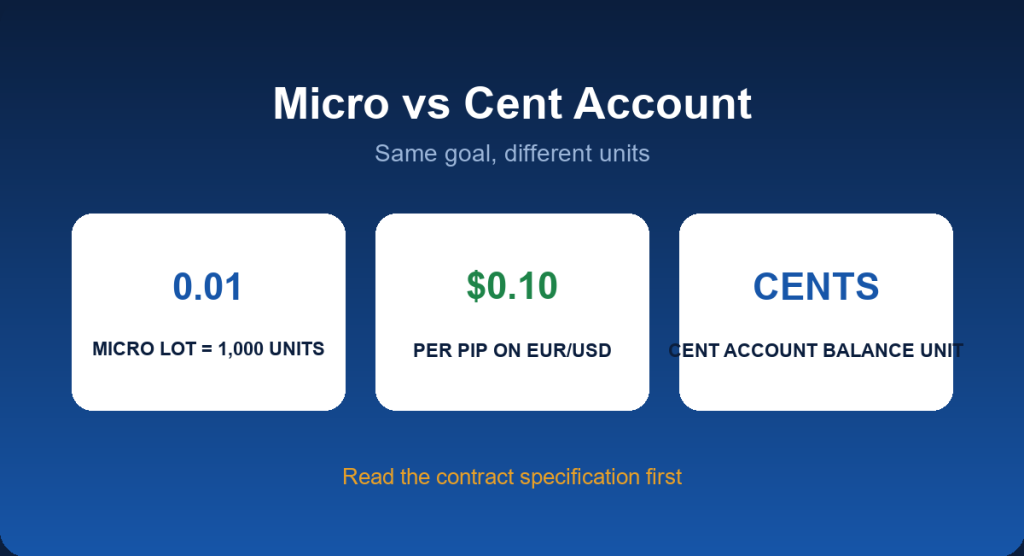
People searching for a small-balance forex account run into two terms that sound similar: micro account and cent account. They are not the same thing, and brokers use the words differently. This guide explains what each term usually means, how they differ in lot size, balance display and cost, and which suits a beginner starting with $10 to $100.
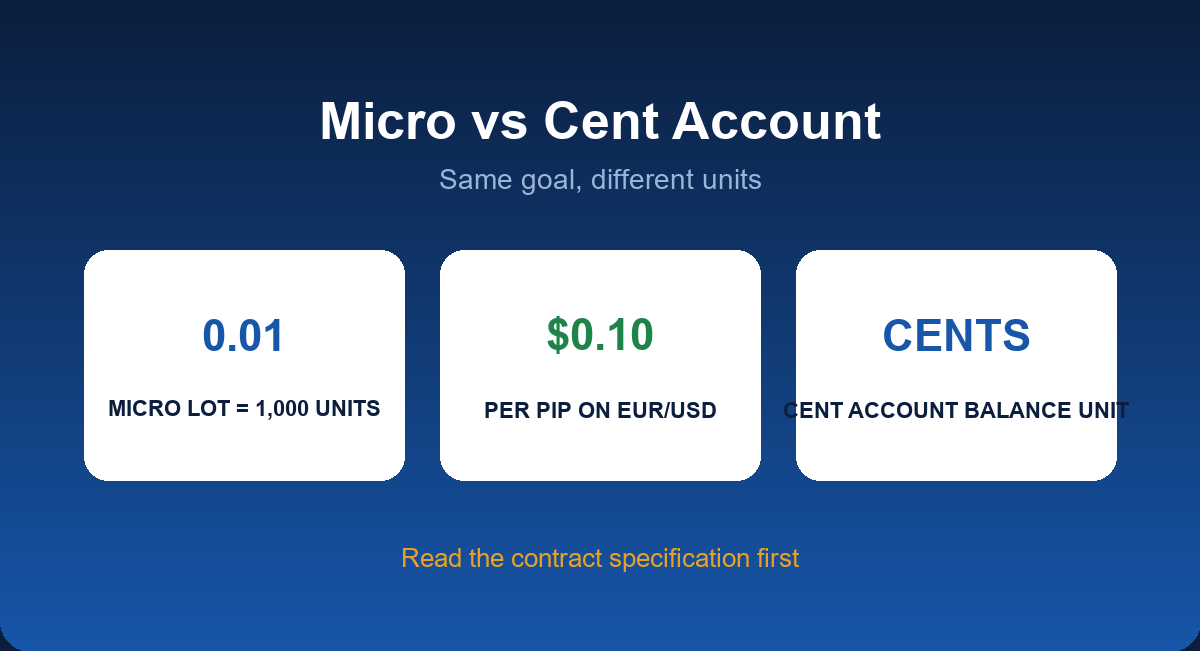
The Quick Difference
| Micro account | Cent account | |
|---|---|---|
| Main idea | Allows micro lots (0.01 standard lot, or 1,000 units) | Shows your balance in cents and often uses smaller contract sizes |
| Balance display | Normal currency units (for example $100) | Cent units (for example 10,000 cents for $100) |
| Typical use | Small positions on a normal-looking account | Very small positions with a tiny deposit |
| Availability | The term is used loosely; many standard accounts already allow 0.01 lots | A distinct account type at brokers that offer it |
Because the terms are not standardised, always read the contract specification: contract size, minimum lot, lot step and pip value. Two accounts with the same label can behave differently.
What a Micro Lot Is
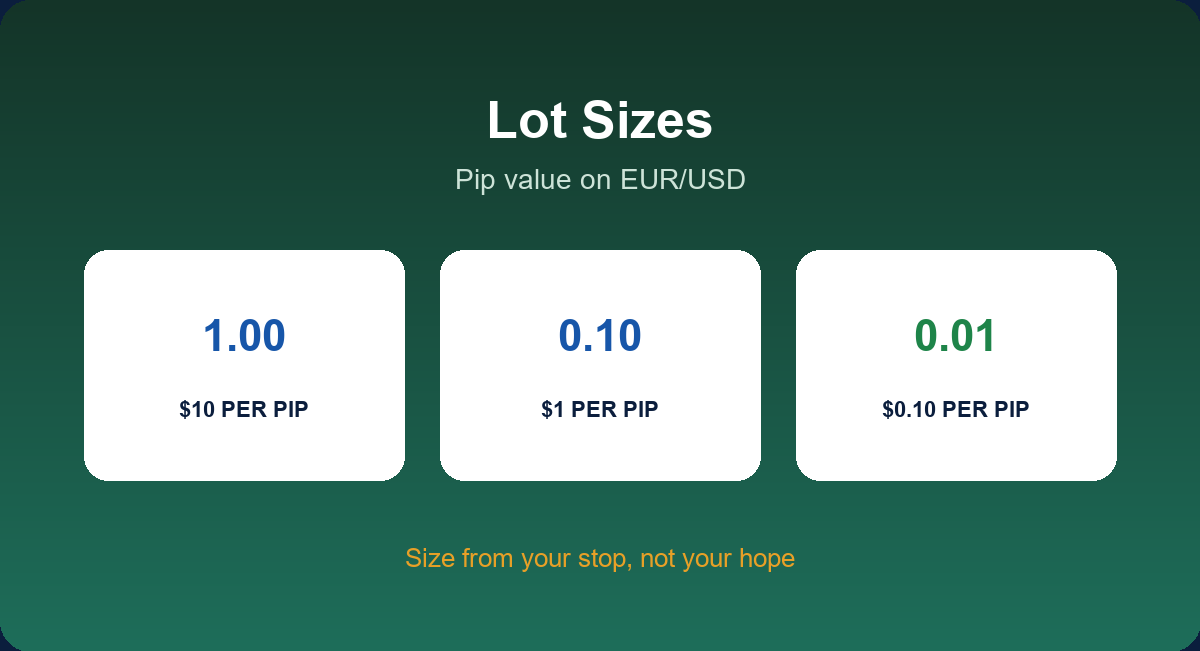
A standard lot is 100,000 units of the base currency. A mini lot is 10,000 and a micro lot is 1,000. On EUR/USD, one pip on a micro lot is worth about $0.10. Many brokers now allow 0.01 lots on ordinary accounts, which is effectively a micro lot, so a “micro account” may simply mean a standard account with a small minimum trade size.
What a Cent Account Adds
A cent account counts your money in cents. The practical effect is that the minimum position carries even smaller dollar risk than on a normal account. The platform may show your balance as 1,000 for a $10 deposit. Margin and profit are shown in cents too, so a small win appears as a bigger number. It is a training environment with real money. See best cent account brokers for providers and the numbers behind a $100 cent account.
Which Should You Choose?
- Under $50: a cent account is usually the better fit, because it lets you place trades small enough to follow a 1–2% risk rule.
- $50 to $500: either works. If 0.01 lots on a standard account give you the risk you want, you may prefer the simpler display.
- Above $500: a standard account is generally the cleaner option.
A Worked Risk Example
You have $100 and want to risk 2% ($2) with a 20-pip stop on EUR/USD. That needs about $0.10 per pip, which is a 0.01 lot on a standard-style account: a 20-pip stop costs about $2. On a cent account the same dollar risk is available too, but you get more room to adjust: you can scale to $0.05 per pip or lower when you need to reduce risk even further. Use our lot size calculator to confirm the numbers for your pair.
Costs to Compare
- Spread. Some cent accounts have a slightly wider spread than standard accounts, which matters more when your profit target is tiny.
- Commission. Most cent and micro accounts charge none, but check.
- Deposit and withdrawal fees. On a $10 account, a $2 fee is 20%.
- Limits. Some brokers cap the maximum lot or number of trades on cent accounts.
Brokers We Cover
- Headway: a $1 Cent account. See Headway minimum deposit and account types.
- JustMarkets: Cent and Standard accounts from $10. See the best JustMarkets account type.
Mistakes to Avoid
- Treating the account as play money and ignoring position sizing.
- Over-leveraging because balances look large in cents.
- Judging a strategy on 10 trades.
- Skipping the withdrawal test.
- Staying on a cent account for years instead of moving up when your results justify it.
Practise First
If you are brand new, start on a demo account and graduate to a very small live balance. The point of a micro or cent account is to learn behaviour at low cost, not to grow $10 into a fortune.
Contract Sizes at a Glance
| Lot type | Units of base currency | Approx. pip value on EUR/USD |
|---|---|---|
| Standard (1.00) | 100,000 | $10 |
| Mini (0.10) | 10,000 | $1 |
| Micro (0.01) | 1,000 | $0.10 |
| Cent account lots | Vary by broker; often a fraction of a normal lot | Check the specification |
A Trade Compared Across Both Accounts
Take a 15-pip stop on EUR/USD. On a micro-style 0.01 lot, a stop-out loses about $1.50. On a cent account where the minimum position carries a smaller value per pip, the same stop might cost a fraction of that. Neither is better in the abstract; what matters is whether the smallest available position lets you follow your risk rule. If the smallest trade already risks more than 2% of your balance, move to a smaller account or a smaller position.
What Changes as the Balance Grows
- $10–$50: cent accounts help you keep risk small.
- $100–$500: 0.01 to 0.05 lots on a standard-type account become workable.
- $1,000 and above: position sizing is flexible on most accounts, and cost per lot starts to matter more than minimum size.
At that stage compare total costs, including raw-spread options, with zero spread accounts, and use our small account plan to keep the habits you built.
Checklist Before You Open One
- I have read the contract specification and know the minimum lot and pip value.
- I know the spread I will actually pay, not only the advertised minimum.
- I know the deposit and withdrawal fees.
- I have a written risk rule in dollars.
- I have tested the platform on a demo account.
More Questions Answered
Is a cent account better for beginners?
Often, because it allows very small risk. A beginner with $200 or more may do fine with 0.01 lots on a standard account.
Do micro and cent accounts have higher spreads?
Sometimes. Compare the actual spread and any fees on each account type before you decide.
Can I use EAs on a cent account?
Usually yes, and it is a good way to test automated strategies with small money.
Can I convert a cent account into a standard one?
Some brokers let you open a second account and transfer funds between them. The process depends on the broker.
Will profit on a cent account look larger?
The platform shows cents, so numbers look big. Convert to dollars before judging results.
How Margin Works on Small Accounts
Margin is the amount the broker locks to keep a position open. At 1:100 leverage, a 0.01 lot of EUR/USD controls about $1,000 and needs about $10 of margin. On a $50 account that leaves $40 of free margin to absorb losses. If you open several positions, the margin adds up quickly and free margin shrinks, which is how small accounts run into margin calls. Check the margin required in the order window before you place each trade, and keep a large share of the balance free.
When a Cent Account Is Not the Right Tool
- When you already follow a strict risk rule and 0.01 lots on a standard account fit it.
- When the cent account has wider spreads that eat a tiny profit target.
- When you want to test a strategy at its true costs, since account conditions can differ.
- When you want to qualify for a promotion or rebate rate that applies only to another account type.
In those cases a standard-type account with micro lots may be the better test. Compare the broker details in the best JustMarkets account type and Headway minimum deposit and account types.
Our Practical Recommendation
If you are starting with less than $50, use a cent account and keep the first ten trades at the minimum size. If you have more, a standard-type account at 0.01 lots is simpler to read. Either way, the account does not make you profitable; the rules you follow do.
Related Guides
This guide is part of our Starting Small series. For the full overview, start with Best Cent Account Brokers, then continue with:
- a realistic small-account plan
- lowest minimum deposit brokers
- the lot size calculator
- pips and pip value
- forex demo accounts
Key Takeaways
- Micro usually means micro lots (0.01); cent means the balance is counted in cents.
- Cent accounts suit balances under about $50; larger small accounts can use 0.01 lots on a standard account.
- Always check the contract specification and the real costs, not the label.
- Use these accounts to build habits, then move up gradually.
FAQ
Is a micro account the same as a cent account?
No. A micro account refers to micro-lot size; a cent account counts the balance in cents. Brokers also use the terms loosely.
Can I withdraw profit from a cent account?
Yes. Cent accounts hold real money; the profit is real too.
What is the smallest deposit possible?
It depends on the broker. Some start at $1, others at $10 or more.
Do cent accounts qualify for cashback?
Often yes on new accounts opened through a partner link, but rates vary by account type.
Open a Headway Account & Activate Rebate →
Cent accounts are also covered from a beginner’s angle in cent accounts explained on leaksfx.com.
Risk Disclaimer: Trading forex and CFDs carries a high level of risk and may not be suitable for all investors. You can lose all the money you deposit. JFRebate earns a referral commission from brokers it reviews; this never changes the spreads you pay. This article is for information only and is not financial advice.

Om Erick, CTA, is a Certified Technical Analyst and a forex trading veteran active since 2010, recognized as one of the Top 35 Best Traders in the World (MQL5, 2024). As the author of “Belajar Trading dari 0” and “Psikologi Trading,” as well as an active Psychological Trading Coach, Om Erick is dedicated to providing objective, data-backed trading guidance. Through JFRebate, he helps traders achieve peak performance by providing access to trusted brokers and a transparent, industry-leading rebate system.